
Trending
GIRARD -- This summer's reading theme at Trumbull County libraries is "Unearth a Story." So it was appropriate to have Matt O'Mansky, Ph.D., Youngstown State University associate professor and program coordinator for the anthropology and sociology department, discuss archaeological digs he has participated in locally and out of the country on Wednesday at Girard Free Library.
"Archaeology is the study of humankind, not dinosaurs," O'Mansky said, clarifying the misconception that people confuse archaeology with paleontology. O'Mansky's concentration is Mayan culture.
He began his discussion with examples of the Mayan digs he has been a part of in Guatemala. O'Mansky's description of the work is that it is more meticulous and slow than movies portray. In the Central American country, he lives in a tent and has no contact with the outside world for long periods of time.
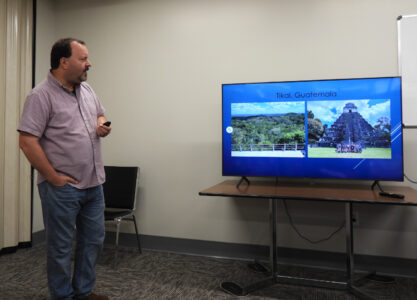
For approximately 20 years, he has brought YSU students and others to Guatemala to excavate at the ruins of that country. His favorite archaeological site in Guatemala is Tikal. The location is a UNESCO World Heritage Site.
"It is a UNESCO site for two reasons -- the rainforest and the Mayan people," he said.
Describing one of the six temples that were unearthed at Tikal National Park, O'Mansky said, "The temple is 160 feet tall. There are howler monkeys in the woods." The location of the park is in a tropical rainforest and jungle.
"You can determine the dates of when the Mayan people lived there from the pottery that was discovered on the site," O'Mansky said. They lived in that area from approximately 750 A.D. to 1050 A.D. when they abandoned the area.
Another frequent destination for O'Mansky to conduct digs is San Salvador Island. It is part of the commonwealth of the Bahamas.
"Because of items that were unearthed there, this is believed to be Christopher Columbus' first stop in the Americas," said O'Mansky.
He described what was found at the dig that are significant, though perhaps common items or small pieces.
"Mostly found lots of pottery and fish bones," he said. These items tell how the people lived there.
Not all of his students can go on the out of country digs for various reasons such as family commitments or lack of funding. O'Mansky still wants them to have the experience of mapping an area and being part of an archaeological exploration. He has explored several sites closer to home. One of the locations was the 19th-century-built Canfield jail.
"The people who bought the house were told from the previous owners that an alcove that was sealed up was a tunnel for the underground railroad. When we did some excavating outside, we found items to show that the building was part of the two-story Canfield jail," O'Mansky said.
Another site he worked was the Cherry Valley Coke Plant in Leetonia. He continued the work that was started by former YSU professor John White.
"The thing that is interesting about local digs is that people always stop by with stories like a grandson saying his grandfather fell into one of the ovens and luckily he was pulled out alive," O'Mansky said.
Near the Boys and Girls Club in Youngstown between Earle Street and Oakhill was another site where he had a dig.
"I always tell people that if I find anything on their property, do they want it or may I donate it to YSU?" he said. "They usually say they want everything until they see what I found and then they say to donate it."
He had permission to do a dig at Idora Park and was quite excited to do so because of the significance of the site to the local population.
Unfortunately because of circumstances beyond his control, when he returned from a Guatemala trip, the dig at the park was cancelled. He still hopes to some day have a dig at the site.
In Trumbull County, he explored The Peter Allen Inn in Kinsman prior to their renovations.
"We found almost nothing at the site," he said.
The next local dig will take place at Centerbrook Manor in North Bloomfield. The 1845 gothic cottage was a major stop on the Underground Railroad. The excavation begins July 1 and runs through the month of July.
In all of the sites that O'Mansky excavates locally or out of the country, he has a similar view, "We may not know their names, but through the items we find, we give people a voice again. All the information that we find helps us understand the people who lived there."