
State reps talk tax reform with local officials
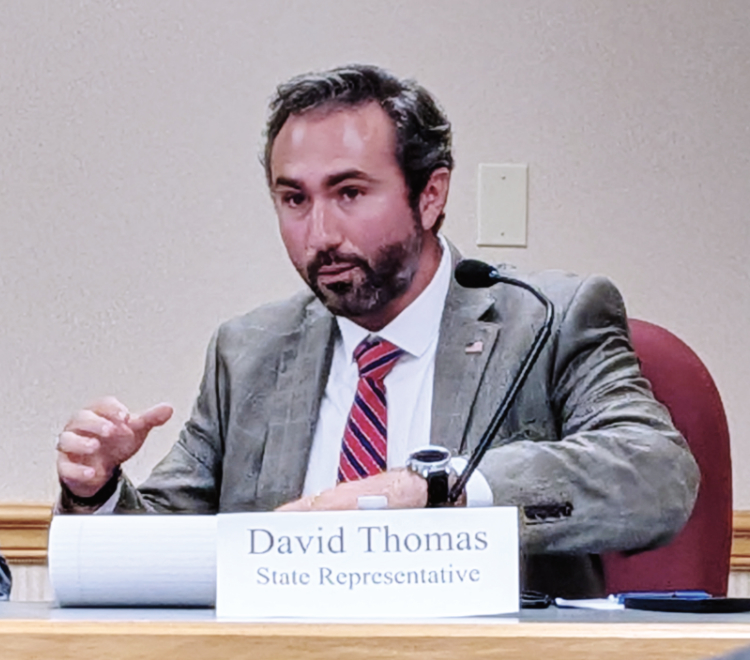
Staff photo / Brandon Cantwell State Rep. David Thomas, R-Jefferson, talks about several tax reform bills at a special meeting Wednesday in Howland. He and his colleague, state Rep. Nick Santucci, R-Niles, as well as county commissioners, school and other county officials, attended the meeting.
HOWLAND — The Trumbull County Commissioners expressed the desire to take a “wait and see” approach with applying a tax change that could have major implications for townships as of July.
School and county officials were among the concerned residents that were in attendance Wednesday evening, as state representatives Nick Santucci and David Thomas provided a timeline of where tax relief stood in the state and an update regarding a group’s effort to repeal property tax altogether.
Santucci, R-Niles, said he and Thomas, R-Jefferson, don’t want to see property taxes abolished, but if tax reform were to be passed, it could restructure the entire state’s way of operating.
Santucci said state officials have looked to Thomas as the “leader and the champion” of the issue, since he serves as the vice chair of the Ways and Means Committee, which oversees taxes in Columbus.
Santucci said if the Committee to Abolish Ohio Property Taxes, the group pushing the initiative forward, collects the needed signatures, it will be on the November ballot.
“It is going to be incumbent on all of us to educate the public, so that they understand that if we remove property taxes, what that could look like in restructuring our school districts and our governments,” Santucci said.
Santucci said he used the word “incumbent” because of the conversations he’s had with Trumbull County voters seeking the removal of taxes, asking them if they know the reciprocal effects it would have on local governments.
“They ponder and they say, ‘Well, someone will figure it out,'” Santucci said. “And then I think that is how the everyday average Ohioan that does not understand how the tax system works in the state of Ohio, that’s how they feel.”
Thomas said state representatives have been “hands-off” on property tax for 50 years as of 2026, and they’ve made things worse instead of making it better.
“We did a whole bunch of catchup this past year, with our legislative reform members, to essentially say, had we acted, pre the current spike, pre the current crisis we’re in, what would have been the results,” Thomas said.
He said state officials had to take action immediately, to firstly say what happened over the past six years with tax bills was wrong and then take preventative action moving forward.
Thomas listed five bills that focused on several areas that were impactful to taxpayers, noting House Bill 335, which caps the unvoted portion of residents’ tax bills that they or local officials never voted for by capping inside millage increases to inflation.
Thomas said the portion of tax millage tied to property value was “just insane.”
“What would have occurred with a 25% increase in values, our schools would have received a 25% increase in their property revenue; the county, townships. You all — cities and villages as well — for that portion that’s tied directly to the value,” Thomas said. “There would have been a 25% increase in that revenue.”
“Instead of a 25% increase in revenue , if you’re still going to get more, it will just be capped to inflation, likely over the last three years, 8% or 9% — the inflation from three years ago to present.”
Thomas said local governments would get more in revenue because of the higher costs and the cost of doing business.
He touched on House Bill 186, which establishes an “inflation cap credit” that prevents increases in school district taxes from exceeding the rate of inflation.
Mathews, Warren and Brookfield are the only districts exempt from the credit.
“Their tax bill is because of all the spikes that they didn’t approve over the last six years,” Thomas said. “Their tax bills are too high, and so we had to do something to actually decrease current property tax bills.”
Thomas said residents in eligible communities will see the tax credit on their bill for the second half of the year. The credit will be the difference between the 35% increase from the last property tax evaluation and inflation.
Thomas said the budget commission, which exists in every county and consists of its treasurer, auditor and prosecutor, is also contributing to reform efforts.
“We made that very uniform, very black and white across the board, that essentially the budget commission should be what it was always intended to do, which is the original check, an extra taxpayer protection,” Thomas said. “To say whatever revenues are coming in whatever tax amounts are actually coming in. They should really only be what’s actually necessary.”
Thomas said they’ve had 13 counties do some type of “impact”, whether it was by decreasing the inside millage amount, passing the owner occupancy and homestead credit, or a combination.
Thomas said the third area of focus was greater taxpayer control, noting 87% of levies passed last November.
“Moving forward, you all as townships, for example — replacement levies were an easy aspect of that; that’s a confusing thing to taxpayers, because they didn’t actually know their bill was going up,” Thomas said. “Emergency levies, substitute levies for schools — very similar, a confusing thing to taxpayers, for they don’t quite fully understand what’s actually happening with their bills.”
Thomas said the options moving forward will be very “straightforward,” that the entity is asking for more money through an additional levy, or a renewal will keep the tax bill the same.
“That empowers the taxpayers then much more, as opposed to the current system, which can cause confusion and cause frustration,” Thomas said.
COMMISSIONERS’ REMARKS
Commissioner Denny Malloy called the bills and programs the state is implementing the “health care plan after the heart attack.”
“Why can’t we roll it back and then implement the stuff because we know, six years ago, people weren’t complaining about this, why can’t we roll it back from these last increases,” Malloy said. “Use some of the rainy day fund from the government to fill the holes for things that have happened in the last six years and then implement this thing.”
Malloy expressed a firm belief that if the option to repeal property taxes reaches the ballot, it will pass, but said implementing the homestead tax exemption with only a few months before the possibility without any knowledge of the needed signatures being gathered is “probably not proper.”
“If the signatures are gathered? 100%, absolutely, I would introduce that again, to increase the homestead in owner occupancy,” Malloy said.
Commissioner Rick Hernandez echoed Malloy’s feelings, calling the homestead exemption “very detrimental” at this point in time.
“As commissioners, we’re only afforded whatever you know the taxpayers want — you don’t want those types of services that you’re getting currently, your fire, your police?” Hernandez said. “Just all the services — your roads, by all means give the credits and cut it out. But it’s got to be done in a different manner.”
Commissioner Tony Bernard said there does need to be a rollback on taxes, which he thinks the state can accomplish, adding that he “strongly believes” that the state should return more of the sales tax percentage.
“I would like to see us get back 2%, or maybe even 3%, it’s our tax dollars and county residents, it’s their money going out to the state,” Bernard said. “I don’t think we’re getting enough back.”
Local News
Girard waits to hear from ODNR on upper lake
GIRARD — City officials said they will wait to hear from the Ohio Department of Natural Resources on options for ...
Commissioners listen to new dog pound ideas
WARREN — New architectural drawings for the proposed Trumbull County Dog Pound significantly lower the cost for ...
State reps talk tax reform with local officials
Supreme Court reverses local appeals ruling on Weathersfield injection well
Judge, jury: No evidence of a suicide pact in Masury murder
On the record: Lakeview
WHAT: Board of Education meeting April 20 PRESENT: Mark Harper, Jennifer Nicholas, Taylor Pease and Danielle ...