
Upton House hosts lecture
‘Six Victorian Women of Genius’ kicks off Women’s History Month
Trending
WARREN -- Thanks to her prolific work in ancient discoveries, Mary Anning's level of genius was unearthed, elevated and appreciated millions of years later.
"Museums and collectors later respected Mary for her finds," Carane Ladd, a retired teacher who lives near Chardon, said.
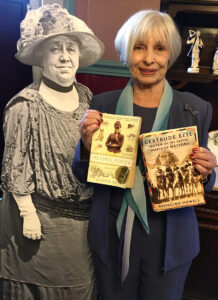
Anning, who, like many women of that time, had little formal education, was one of the women Ladd discussed in her lecture, "Six Victorian Women of Genius," on Wednesday at the Upton House, 380 Mahoning Ave.
Hosting the gathering, which was part of Women's History Month, was the Harriet Taylor Upton Association.
The other five women whom Ladd honored during the program were Gertrude Bell, Beatrix Potter, Elizabeth Philpot, and twin sisters, Agnes and Margaret Smith.
"At least four of them came from wealthy beginnings," Ladd said.
MARY ANNING
Anning had an unusual childhood that began shortly before she was struck by lightning as a baby, which killed three people, including the person holding her, Ladd said. She also grew up in a poor family in Lyme Regis, England, and her father, Richard Anning, was a carpenter and amateur fossil collector -- an interest his daughter soon absorbed and was a prelude to her becoming a pioneering paleontologist. This occurred during a time when Jane Austen had written her famous "Sense and Sensibility," Ladd told an audience of several dozen women and men.
Ladd noted that Anning's father taught her how to find fossils on a beach before he sold them from his shop.
In 1812, two years after her father's death, Mary Anning's brother, Joseph Anning, discovered an unusual fossilized skull, originally assumed to be a crocodile, and credited her for the find before she searched for and dug the skeleton's outline. For several years, the specimen was studied and debated before it became the first discovered ichthyosaurus (fish lizard), but it was later found to be a marine reptile that lived about 200 million years ago, according to the Oxford University Natural History Museum.
In 1823, Anning became the first person to discover the whole skeleton of a plesiosaurus ("near to reptile"). Georges Cuvier, known as the "father of paleontology," initially disputed the discovery but later corrected his mistake at a conference, Ladd said, adding that many men scientists failed to credit in their research papers Anning for her work.
ELIZABETH PHILPOT
Philpot also was a 19th century palaeontologist who collected fossils on the southwest coast of England and a friend of Anning. Unlike Anning, however, Philpot had a better education and was taught largely by governesses, Ladd noted.
Philpot became best known for her fish fossils and collection of specimens. She also drew the attention of leading palaeontologists such as William Buckland, she said.
In addition, Philpot discovered that certain fossils contained sacs with ink that, combined with water, could be used for illustrations, something that became common practice for many artists. Later, her fossil collection was housed at Oxford University's Museum of Natural History.
"She was taught by tutors partly due to poor health as a child. She showed an early interest in science and art," Ladd said about Potter, who developed a strong interest in the study of mushrooms and fungi -- and learned to paint under a microscope.
In addition, Potter became highly adept at using her pets as characters for her illustrations and children's books, Ladd said. She added that Potter also earned her own money and grew less dependent on her parents.
BEATRIX POTTER
Potter, who penned "The Tale of Peter Rabbit" and "The Tale of Benjamin Bunny," spent much of her childhood drawing and inventing narratives about her pets. After the death of Norman Warne, her editor and lover, Potter bought a 34-acre piece of property called Hill Top Farm in England that her family had visited on many occasions, Ladd noted.
Later, Potter supported a visiting nursing association that saved many lives, Ladd continued.
GERTRUDE BELL
Bell defied many conventions of Victorian England via becoming a world traveler, a self-taught archaeologist and an avid mountain climber, Ladd said, adding that her family was among the wealthiest in that country.
Among other things, Bell spent five or six years mountain climbing in Switzerland and became an accomplished photographer who also studied Arabic. Other notable achievements included being the sole woman to work for the British government in the Middle East during World War I. To that end, she attended a conference in the early 1920s in Cairo with notable figures such as British Prime Minister Winston Churchill and T.E. Lawrence -- known as "Lawrence of Arabia" -- to establish the boundaries of what became Iraq.
Bell, who also helped establish the Iraq Museum, was greatly respected. Another major accomplishment during WWI was organizing the Department of Missing and Unknown Soldiers, Ladd noted.
"She was a first-class organizer," Ladd added.
SMITH SISTERS
Agnes and Margaret Smith, known as "the sisters of Sinai," had a gift for mastering many languages, loved to travel and became best known for discovering hidden biblical manuscripts, Ladd explained.
"The girls had a gift for languages -- genius, I might say," she said, adding that their father, John Smith, promised to take them to any country of which they mastered the language.
After losing their father when they were 23, the twins traveled extensively across Europe, including to Constantanople, by camelback. They also learned Arabic and Greek, and in 1892, made it to St. Catherine's Monastery at Sinai, where they discovered a Syriac manuscript.
Thanks to one of the sisters' discoveries, certain verses were thought to be about 200 years older than originally assumed, Ladd noted.
According to a biblical doctrine from the Alliance of Confessing Evangelicals, while examining religious documents at the monastery, Agnes Smith saw a dirty volume with leaves stuck together that was a collection of the lives of women saints written over an older text, and because she studied the Syriac language, Agnes Smith recognized underneath headings that read "Of Matthew" and "Of Luke."
Since they were dated AD 697, Agnes Smith deduced the undertext had to be at least 200 years older, which made it the oldest known copy of the Gospels in Syriac.
The sisters photographed the pages and developed their own negatives. Later, scholars embarked on a major transcription of the texts.
Ladd retired after teaching English and reading in the West Geneva School District. She works part-time for the Geauga County Board of Elections and as a docent for the Geauga County Historical Society.