
City leaders call for end to violence
Trending
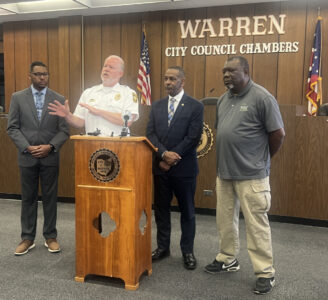
WARREN -- Warren Mayor Doug Franklin alongside Warren police Chief Eric Merkel, councilman Todd Johnson, I-1st Ward, and Brothers against Violence President Greg McElroy urged young people to "put those guns down" and called on families and neighbors to intervene before more tragedies ripple through the city.
"No parent should ever have to live in fear in their own front yard," Franklin said at a morning news conference in city council chambers. "This recent wave of violence is not who we are as a community. It's a heartbreak that we cannot and will not accept as our new normal."
The mayor detailed a grim spectrum of incidents in recent weeks stemming from personal beef to gang-related shootings to domestic attacks involving both gunfire and a fatal stabbing, drug overdoses and a self-inflicted gunshot wound.
The mayor said that drugs, violence and mental health struggles are often intertwined, creating connected crises that shatter families, especially young children who witness the trauma.
Franklin and Merkel were joined by several city council members including Michael O'Brien, D-at Large; Helen Rucker, D-at Large; Ron White, D-7th Ward; Greg Greathouse, D-3rd Ward; Michael Shrodek, D-5th Ward as well as Johnson and McElroy of Brothers Against Violence.
Merkel said the city typically sees four to seven homicides annually. This year, with only four months passed the tally already stands at five as Merkel said the city narrowly avoided a sixth when a man shot in the head on Highland Avenue survived what is expected to be a life-altering injury.
Merkel said the violence in the city is something his own officers have been confronted with as Davontae R. McElroy was sentenced to 14 to 19.5 years in prison Wednesday in Trumbull County Common Pleas Court pleading guilty to firing at two detectives on Austin Avenue last year.
Merkel described a departure from traditional drug-turf disputes. Many recent incidents the chief said arise from perceived disrespect, personal slights or spontaneous escalations sometimes worsened by the existence of mental health issues.
"We've had a homicide that's on video in somebody's kitchen, and the guy was sitting there and got up and shot somebody in the face over essentially no argument or anything," Merkel said.
Motives run the gamut from retribution, revenge, jealousy or "anything like that."
Describing how young people are getting the guns, Merkel said, using stolen handguns frequently taken from relatives that don't have the weapon secured.
Merkel said rifles are rarely the weapon of choice in these local cases. Shell casings recovered from scenes are entered into the federal ballistic information system with the chief revealing links between some firearms recovered from Warren cases to cases including homicides in Columbus, Cleveland and Toledo.
Overdose deaths, meanwhile, have dropped to pre-2015 levels thanks to widespread naloxone use by officers who have administered the life-saving medication nearly 900 times.
Merkel walked through the department's investigative process talking about the professionalism of his detectives and crime scene unit.
He said officers secure scenes, canvass neighborhoods, seek doorbell and security camera footage, and often identify suspects within minutes or hours. He pushed back against social media criticism on when police release information explaining why police rarely issue immediate "be on the lookout" alerts for known suspects. Merkel cautioned that for them it could be tipping them off suspects. He further explained that warrants for private cameras require more than mere proximity to a crime.
The city is leveraging new resources. The mayor and chief discussed a $68,000 Violent Crime Reduction Act grant from the Ohio Office of Criminal Justice Services that will fund overtime for street crimes units, including undercover patrols and a planned summer warrant sweep targeting individuals known to carry firearms.
As the city works through options, at the state level, Franklin called for more sensible gun control laws to combat the issue.
Merkel said that an intelligence analyst that was hired last year is mining records to flag armed suspects with warrants.
The mayor mentioned a pending $3 million federal grant request would support digital forensic training, data-driven crime reduction software and an advanced drone system.
The chief described that the drones would be mounted on buildings across the city, could respond to shooting calls with live video feeds before ground officers arrive, aiding police on pursuits, standoffs and other calls for service.
Merkel said he plans to ask council to strengthen an ordinance on discharging firearms within city limits, elevating it from a minor misdemeanor which he says comes with 30 days in jail and a fine to a first-degree misdemeanor.
Franklin and Merkel repeatedly stressed that policing alone cannot solve the problem. The mayor announced updates to the city website and Facebook pages with resources on youth activities, intervention programs, mental health services and neighborhood connections deliberately targeting teens and young adults who are disconnected from school or traditional programs.
A new "calling system" will let parents, family members or significant others anonymously seek help when they fear a loved one may become a victim or perpetrator.
Johnson, a pastor who has lost family and friends to violence, overdoses and suicide, echoed the call for personal responsibility.
"If you know someone in your life needs help... whether it is mental health counseling, whether it is violence intervention ... you've been watching them, hearing them say things we need to speak up," he said.
He warned of toxic social media exchanges on platforms like TikTok and Snapchat, including threats and grave desecrations that act as "powder kegs" for real-world violence.
Johnson called out "no snitching" culture and urged residents that don't believe in that notion saying that, "If we truly believe that, then when someone has to step forward ... we need to respect them for doing so. We cannot marginalize and demonize those individuals who choose to do the right thing."
Franklin closed by rejecting finger pointing in favor of collective action.
"I cannot parent your children," he said plainly. "Outrage is fleeting, and finger-pointing seems self-satisfied, but only intentional actions by all of us will make a difference."
He added a direct plea to youth "We need you alive. We need you to lead. We need you to help us build a better Warren, not being lost to its streets."
The mayor expressed faith in the city's resilience while acknowledging the heavy grief carried by families."We're tired of balloon releases and vigils," Franklin said. "We need to have celebrations of life to its fullest. So we have some work to do."