
Building empathy for dementia patients
Trending
As dementia rates continue to climb across Ohio -- particularly in the Mahoning Valley -- a new hands-on training is helping caregivers and community members better understand what it's like to live with the condition.
According to the Ohio Department of Health, dementia is not a single disease but a general term used to describe a decline in cognitive ability severe enough to interfere with daily life. Symptoms vary widely, but often include problems with memory, attention, communication, reasoning, judgment, problem-solving and visual perception beyond typical age-related changes.
Warning signs can include getting lost in familiar places, struggling to complete routine tasks, forgetting close family members or using unusual words to describe everyday objects. While occasional forgetfulness can be part of aging, persistent or worsening cognitive issues may signal something more serious.
THE STATISTICS
The Alzheimer's Association estimates that more than 220,000 Ohio residents age 65 and older are living with Alzheimer's disease, which is the most common form of dementia. That number is expected to rise by an additional 30,000 in the near future.
Locally, the numbers are striking. Mahoning County ranks fourth in the state for the highest percentage of seniors living with Alzheimer's or dementia. Approximately 6,000 residents age 65 and older -- about 12.1% of that population -- are affected.
In neighboring counties, an estimated 4,900 seniors (11.1%) in Trumbull County and 2,200 (10.3%) in Columbiana County are living with the condition. Statewide, Ohio's prevalence rate of 11.3% exceeds the national average of 10.7% -- a trend largely attributed to the state's aging population.
Experts note that age remains the strongest known risk factor, particularly for those over 65. Other contributing factors include family history, poor cardiovascular health, smoking and traumatic brain injury. Research also shows disparities among populations, with older black Americans twice as likely and Hispanic Americans 1.5 times more likely to develop dementia compared to white Americans.
While much attention is given to those diagnosed with dementia, the impact on caregivers is equally significant.
Studies published in Dialogues in Clinical Neuroscience describe family caregivers as the "invisible second patients." These individuals -- often spouses or adult children, and most frequently women -- provide the majority of care, assisting with everything from daily routines to financial management.
Though caregiving can be rooted in love, duty or a sense of responsibility, it often comes at a cost. Caregivers face high levels of stress, depression, social isolation and even physical health challenges. Many juggle caregiving responsibilities alongside careers, raising children and maintaining relationships.
Research shows that caring for someone with dementia can be more stressful than caring for someone with a physical disability. The progressive and unpredictable nature of the disease, combined with long hours and emotional strain, creates a uniquely challenging environment.
Yet, experts emphasize that caregivers are essential. Without them, individuals with dementia would experience a lower quality of life and would likely require institutional care much sooner.
NEW TRAINING PROGRAM
In response to the growing need for caregiver support and education, Ohio Living Home Health & Hospice has introduced a new training program called Dementia Live.
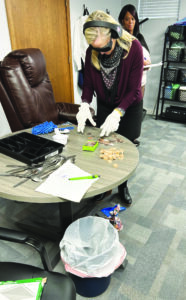
Unlike traditional lectures, Dementia Live is an immersive simulation designed to replicate the sensory and cognitive challenges faced by those living with dementia.
Participants wear specialized equipment -- such as fogged glasses to impair vision, gloves that restrict dexterity and headphones that play disorienting noise -- while attempting simple tasks like buttoning a shirt or sorting medications. Instructions may be garbled or difficult to understand, and the environment is intentionally confusing.
The goal is not just to teach, but to help participants feel the frustration, anxiety and loss of control that often accompany dementia.
"This training allows people to move beyond understanding dementia intellectually and experience it on an emotional level," said Lisa Schultz-Medved, community engagement coordinator at Ohio Living Home Health & Hospice. "A common response we hear is, 'I had no idea this is what it's like for them.'"
For many, the most powerful moment comes when they are unable to complete a simple task -- something they would normally do without thinking.
"That loss of control is often a turning point," Schultz-Medved said.
The impact of the training can be immediate and lasting.
Participants often report a shift in perspective from frustration to empathy. Care becomes more patient, intentional and supportive. Organizations that have implemented the training have noted improved communication, increased staff confidence and fewer behavioral challenges among those they serve.
The program also highlights common mistakes caregivers make, such as speaking too quickly, giving multi-step directions or failing to recognize how overwhelming certain environments can be.
Instead, caregivers are encouraged to slow down, use clear and simple communication, reduce distractions, and approach each interaction with patience and reassurance.
Perhaps most importantly, the training reinforces a critical message: dementia is not just about memory loss.
It affects how individuals perceive the world, communicate and process their surroundings.
Dementia Live is not limited to health care professionals. Family caregivers, first responders and community members are all encouraged to participate.
"Dementia affects so many families," Schultz-Medved said. "Building a dementia-friendly community requires awareness and understanding from everyone."
With the region's aging population, that need is only expected to grow.