Maplewood earns recognition
Rural district fares well in school ratings
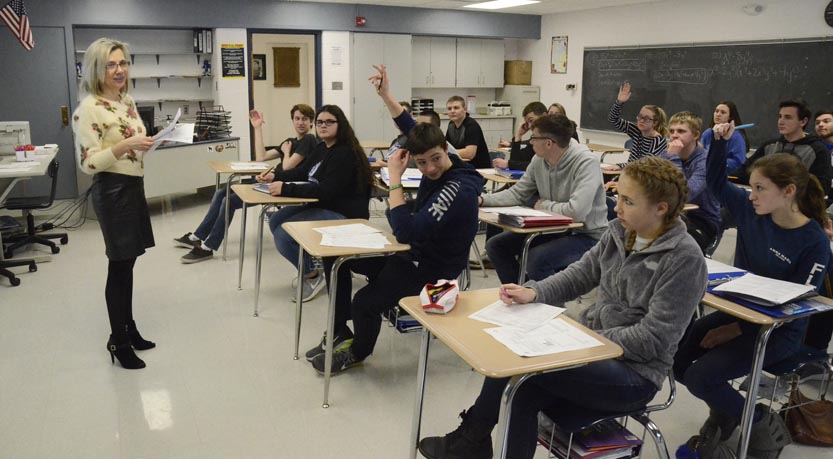
Tribune Chronicle / R. Michael Semple Maplewood High School upper level math teacher Lana Stechschulte, far left, teaches class at Maplewood High School. She said the district continuously receives high marks on the state report cards because teachers set high expectations for students.
MECCA — Maplewood High School sophomore Hannah Manning talks about state tests as if she were referring to the day’s lunch menu.
“If you pay attention in class, the teachers go over everything that you need to know,” Manning, 16, said coolly. It is not the expected reaction a student might have when talking about the tests that determine scores on the annual Ohio school report cards.
“They set you up for success and push you to try harder,” she said.
In the latest release of grades for schools across Ohio, the Maplewood Local School District again fared well, a position the rural district has staked claim to over the past several years despite changes in the report card system. They hope to pull it off again in August when the next round of test results will be released.
Teachers and administrators in this rural district with about 750 students said their success boils down to paying attention, working as a team and doing their jobs.
Report cards
According to the 2016-17 report card from the Ohio Department of Education, the district earned an A in K-3 literacy, which measures how well the district does to get struggling readers on track to proficiency in the third grade and beyond. It also earned an an A in graduation rate.
The same report card shows Maplewood received Bs in achievement, which measures student performance on state tests against a benchmark and how well those students overall did on the tests; in gap closing, which measures how well schools meet performance expectations for vulnerable students in English, math and graduation; and in progress, which looks at the growth of students based on past performances.
The district received one C, in the prepared for success category, which measures how well students are prepared for future opportunities.
The state won’t start giving districts an overall grade until this year’s report cards.
How they do it … the administrators
“Our success has all been data driven,” said Maplewood Superintendent Perry Nicholas. “Our administrators have done a great job staying in touch with the changes from the ODE and relaying these changes on the types of tests that will be delivered to the staff. The staff has done an excellent job of measuring student growth through the data.”
Student growth measures the amount of growth students have year to year based on 24 indicators, including third through eighth-grade language arts, math, social studies and science, and high school algebra, English, biology, government, geometry and history. Eighty-five percent of students in all grades must pass the indicator tests for the district to receive a passing grade.
In 2010, Maplewood began to focus on performance index, which measures the achievement of every student — and not just if they pass or are proficient, but if they score higher. Performance index is a category within the achievement grade.
Maplewood received a B for performance index on the 2016-17 report card. The district also earned Bs in this subcategory on the 2015-16 and 2014-15 report cards. The district received As in the two report cards prior.
“You want students to not just pass the test, but to be accelerated or advanced,” said Elizabeth Goerig, Maplewood Elementary School principal.
To that end, each building has leadership teams and staff constantly review data to determine where strengths and weaknesses exist. In addition, teachers study state standards and center their lessons around them.
“That’s the focus of our entire staff,” said Maplewood High School Principal Gordon Hitchcock. “Teachers make sure that every lesson is tied to those standards because they know at the end of the line are the assessments driven by the state.”
A move to double periods, or 90-minute block teaching of math and language arts in kindergarten through eighth grade, also has led to improved scores, according to Goerig.
“The teachers wanted it and it makes sense,” Goerig said. “Our staff always embraces any changes we need to make.”
Teachers’ perspective
High school math teacher Lana Stechschulte said teachers set high expectations and standards for students.
“Our kids respond well and they strive to reach the goals and expectations that we set,” said Stechschulte, in her 22nd year in the district.
But, Stechschulte said, setting high standards isn’t just a philosophy of teachers — it’s something everyone, from the administrators to custodial workers, has. It’s also not expected that all students and employees achieve the same results, but rather everyone makes progress and takes pride in the district and in their jobs.
Administrators also provide resources teachers need and allow them freedom to teach, which generally leads to great results, Stechschulte said.
“They know that we know what we’re doing,” she said. “They provide what we need to succeed, but they don’t stand there and look over our shoulder and micro-manage us.”
Middle school language arts teacher Michele Jennings said she stays current on changes to state testing by monitoring state legislation and news from ODE.
“I try to stay ahead of the curve,” said Jennings, with the district for 21 years. “There’s a lot of collaboration between the group of teachers I teach with in seventh and eighth grade, so I try to know what’s coming up.”
Jennings said one challenge schools face this year is there is no “human scoring” of state tests, meaning all tests are graded by computers, including essays and extended response questions. Doing it this way gets test results done faster, but leaves questions about what the computer is looking for in written essays and questions, said Jennings.
“It’s some kind of program that’s been around for awhile, but this is the first time we’re using it,” Jennings said. “As an English teacher, it’s challenging. Right now my students are writing essays and it’s a challenge trying to guess what the computer will be looking for.”
But changes from the state are something teachers must adapt to, said Stechschulte and Jennings. Also, Jennings said tests and standards are a reality and there is no reason to complain. It’s better to embrace that reality and focus on the students, she said.
“You can’t just do the same thing you did for 20 years and think that’s going to work,” she said. “It’s about the kids. That’s it. If you don’t like the kids anymore, then it’s time to find a new job.”
National recognition
Wednesday and Thursday of last week, Nicholas and Goerig traveled to Philadelphia for a national conference to accept an award for the elementary school being named a 2017 High Performing School of Honor.
The district was one of two schools in Ohio and one of 65 in the U.S. to receive the award for its performance in math and language arts, Nicholas said.
Such awards are an example of the district’s success, Nicholas said. Like state report cards, the national award is a reminder that the district is doing things the right way.
The honor reflects outstanding achievement and in the past five years, the elementary school serving 40 percent or more economically disadvantaged students has achieved an overall 90 percent or higher student proficiency rate in reading and math.
This is not the first time a Maplewood school has received the high performing award. The middle school received the award in 2011.
Local News
Maplewood softball headed to state championship
Alberini retains Trumbull Democratic chairman position
NILES — Things look to stay the same for the next four years for the county’s Democratic party, as party ...
State capital budget includes funds for Valley
Mahoning County would receive $13,178,601 from the state’s capital budget, with about $10.7 million going to ...

Ex-FirstEnergy executives reindicted in corruption scheme
Falls council questions mayor’s absence at Memorial Day event
NEWTON FALLS — Mayor David Hanson’s no-show at the village’s Memorial Day ceremony generated comment from ...