
Trending
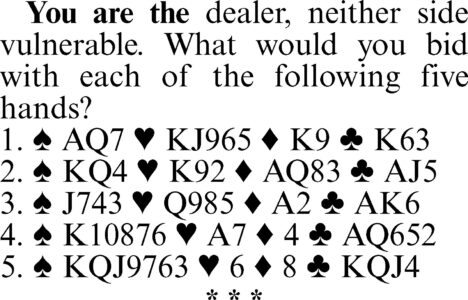
1. One notrump. This hand meets all the requirements for an opening one-notrump bid: 15 to 17 high-card points, balanced distribution (4-3-3-3, 4-4-3-2 or 5-3-3-2) and stoppers in at least three suits.
It is far better to open with one notrump than one heart. Perhaps the most important reason is that the bid immediately pinpoints the type of hand you hold. As opposed to this, an opening one-heart bid could be based on many different distributions and a wide range of high card points.
In addition, a one-heart opening would present a difficult rebid problem if partner responded with one spade, which would make an accurate rebid impossible. The way to avoid this problem is to open one notrump initially and let partner take it from there.
2. One diamond. Balanced hands containing 18 or 19 points do not fall into the category of a one- or two-notrump opening bid. Such hands are opened with one of a suit followed by a jump in notrump at the next opportunity.
3. One club. Here you have no legitimate suit with which to open the bidding, since your spades and hearts are not long enough or strong enough to mention, and you have only three clubs. But since a 14-point hand must be opened, something must be done. One club is easily the best choice, since it keeps the bidding low and allows for the discovery of a major-suit fit if there is one.
4. One club. Here also, the best initial bid is one club. This allows you to bid spades at your next turn if partner responds with a diamond or a heart and also serves to keep the bidding low. You plan to bid your spades again at your third turn, if necessary, to identify your 5-5 distribution. An opening one-spade bid would create an impossible rebid problem if partner responded with two of either red suit, as you do not have the extra points that would be implied by a three-club rebid.
5. Four spades. This bid serves a dual purpose. It is an offensive effort that might easily succeed if partner has as little as an ace.
But even more important in the long run is the defensive value of the bid. If partner has a poor hand, it is odds-on that the opponents can make a game. However, because of the high level at which they must begin their search to find a game (or even a slam), there is a good chance they will miss their best contract.
Tomorrow: Solution to a predicament.