
Niles OKs data center moratorium
Trending
NILES -- Residents in opposition of data centers will be able to rest easy for a while, as city officials took action to ease their concerns about one entering the community.
City council on Wednesday approved placing a 180-day moratorium on the granting or issuing of new permits for data centers and on the receipt and processing of their applications within corporate limits, and declared an emergency.
The moratorium comes after an April 15 pre-meeting presentation in which city officials heard from Paul Hanson, a senior project manager at Bitdeer, a Singapore-based technology company focused on cryptocurrency and AI cloud infrastructure.
The property where Bitdeer aims to build a facility is at 1047 Belmont Ave., which was purchased in May 2025.
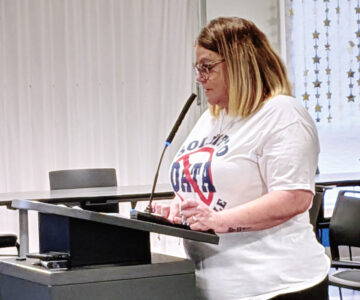
The meeting that followed featured 90 minutes of public comments, as many took to the podium to speak out against the potential data center.
Councilman Aaron Johnstone, D-2nd Ward, said during a public hearing regarding the moratorium before the meeting that the city lacks zoning laws or language that would address data centers, adding that Bitdeer having to do an annexation agreement allowed officials to look internally and see that they lacked protection.
Johnstone said the moratorium will allow officials to guarantee nothing will come in over its time frame.
"Within those six months, we will go to work and come back to you with changes that would heavily restrict and hopefully address all of your concerns," Johnstone said.
Councilman Edward Stredney, D-At Large, said it was worth mentioning that city council approved legislation to bring in a consultant to help city officials draft restrictive language for data centers at a May 6 meeting.
Johnstone said the company's name is CodeCraft Planning Studio, a group that has dealt with similar matters across the state.
They will not be the deciding vote, Johnstone said, adding that the final say will come from the city's housing and zoning team, city council and the administration.
Councilman James Sheely, D-3rd Ward, noted the threat of a lack of legislation, explaining that someone could buy up a small property and place a data center, and council wouldn't be able to do anything.
"This is why we're doing the moratorium, because my biggest concern was, being (the) third ward, this big one wanted to annex in," Sheely said. "My concern right now is we have no control over that whatsoever; we can't restrict anything, we can do nothing."
"If Weathersfield cannot prevent it or keep it out, it's going to be right up against me, right down the road from me, and right around all of our constituents, and it's going to be right over near our middle school."
Sheely said he did his research on data centers before jumping into the topic, and as soon as he knew the Bitdeer presentation was happening, noting that he was sensitive to certain stimuli, such as sounds or the buzzing of lights growing up.
"Now you have what's called infrasound; infrasound is the low-level sounds that we don't audibly hear a lot of times -- some of us can, like myself, I can hear some of those sounds," Sheely said. "They're low-level sounds, but those frequencies can affect people, and you have kids that are autistic and everything else, and it can probably possibly affect them in their actions and their behaviors. It can affect animals."
Sheely noted that he asked Bitdeer officials about infrasound, which they couldn't answer -- instead pivoting to discussing decibels.
"The wall that they do around those, the sound walls, do not stop infrasound; they don't slow it down, they don't stop it," Sheely said.
Sheely pointed out Bitdeer's potential water usage, 500,000 gallons daily, saying that his research showed that a 300 megawatt facility would instead use 1 million gallons of water a day.
"I have concerns there -- that's a red flag for me," Sheely said, adding that the city might be stuck with it next to them if Weathersfield cannot stop it.
PUBLIC COMMENT
Officials opened the floor to anyone who would like to speak in opposition of the moratorium for 20 minutes, but no one stepped forward.
In terms of people in favor of it, Nikki Gorkie, who lives on the city's south side, asked council to do everything in its power to prevent a data center from entering the community.
"These data centers are not small technology offices; they are massive industrial operations that consume enormous amounts of electricity, strain our already ancient infrastructures," Gorkie said. "Increase noise, and will permanently change the character of our community while simultaneously affecting our health."
Gorkie said they are constantly being told data centers bring jobs and innovation, but the reality is that data centers only employ a few people following construction.
"We, the residents of Niles, would be left with the burden of higher utility, demand and pricing," Gorkie said. "Loss of control over land use, environmental concerns, decreased property values, and health risks to our children and our pets."
"I am asking our city leaders to prioritize development that directly benefits families, small businesses, neighborhoods, and our quality of life, not projects that only serve giant foreign corporations with no accountability to the people who live here."
Amy Jo Giovannone, building upon Law Director Phil Zuzulo's remarks that a general law at the state level could prevent local municipalities from passing restrictions on data centers and the possibility of Weathersfield allowing it to come through, asked what Niles could do as a "Plan B."
"The way I look at this, the petition needs to be, is the most important thing right now; at the state level, that's a constitutional amendment that's not just a law, right?" Johnstone said. "A law is to get changed, to do a constitutional amendment is a big deal, so if they are successful, that evens the playing field for all of our communities."
"If they are unsuccessful to get on the ballot or they are unsuccessful in November on the ballot, we need to be prepared."
Johnstone was referring to the Ohio Prohibition of Data Center Construction Amendment, a ballot initiative that would prohibit the construction of data centers that are used for digital data processing with an aggregate power demand exceeding 25 megawatts.
The initiative was certified for signature gathering by Attorney General Dave Yost in March.
"To answer your question, I can't give you specifics at this day and time, but that's what I think we need to spend our next six months preparing for plan B," Johnstone said. "When it comes to that petition and that constitutional amendment, we will know the way that they have to have their signatures turned in and then certified."
Johnstone said officials should know if the initiative will be on the ballot by mid- to late August.