
Warren aims to boost school attendance
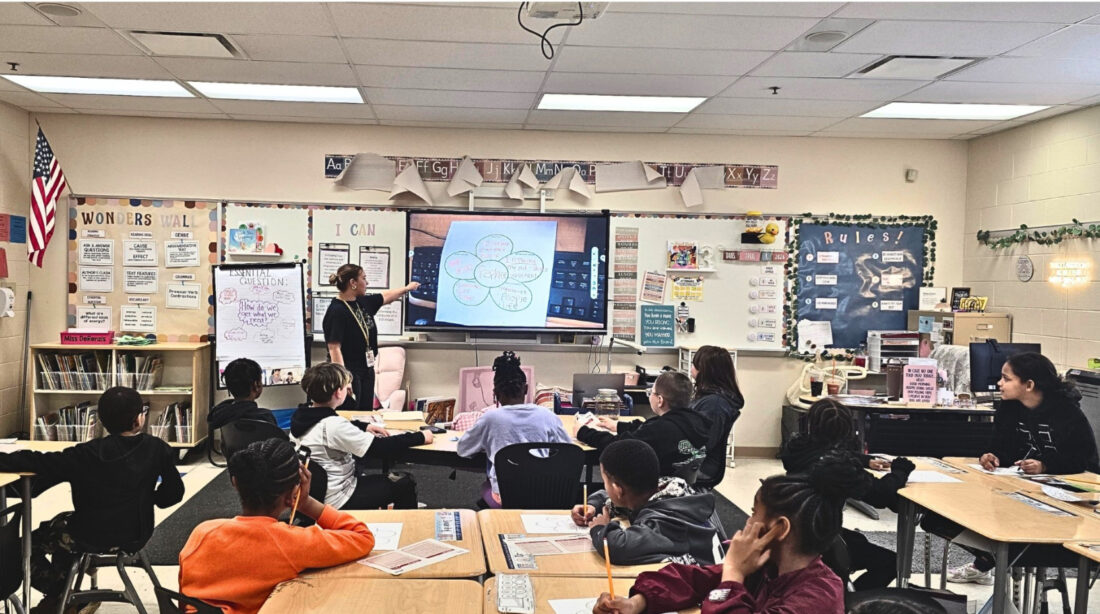
Submitted photo Rachel Derenzis’ class at Willard PK-8 School in Warren has experienced consistent attendance. Warren school district officials have a strategy in place to tackle chronic absenteeism, which the Ohio Department of Education and Workforce defines as missing 10% or more of school in an academic year.
WARREN – Sydney Johnson noticed a particular student had been missing from school: First one day, then two, then three.
The student’s absence raised Johnson’s concerns, especially after realizing the girl’s siblings also had been absent.
Not finding any explanation, such as illness, Johnson, a school/community liaison at Warren’s McGuffey PK-8 School, made a call to the family “just to check in” and see if there was anything she could do. Her goal was to encourage the girls to come back to school.
“It can be a fine line,” Johnson said. “What you consider true concern might be perceived as prying or interfering. And there’s only so much you can do. But you can pay attention and make that phone call.”
After that initial call was made, communication lines opened and all three girls made their way back to their classes.
Those phone calls, those inquiries, those deliberate and intentional steps to reach out to families can make all the difference to students and families who, for whatever reasons, are struggling to meet attendance expectations, said Dante Capers, Warren City School District Associate Superintendent of Student Services, Student Wellness & Success. This spring, additional steps are in place to increase awareness and improve attendance.
THE ‘SPRING SLIDE’
The Warren City School District is working with community partners to reduce what has become known nationally as the “spring slide” — a seasonal dip in student attendance.
The trend typically sprouts each spring as routines loosen and warmer weather competes for a student’s, and sometimes an entire family’s, attention.
But consistent attendance in the final quarter of the school year helps students stay on track academically, allows them the opportunity to perform better on state assessments, and helps them build strong habits, providing a solid foundation, as they finish the school year, said Jim Joseph, McGuffey 6-8 POD Principal and Campus Leader.
BY THE NUMBERS
National data shows attendance often declines in the final stretch of the school year, quietly impacting student achievement and long-term outcomes.
The Ohio Department of Education and Workforce reported that chronic absenteeism in the state remains a focus with approximately 25% of students missing more than 10% of school last year. This is down from the 30.2% post-pandemic peak in the 2021-2022 school year. However, this is still significantly higher than the prepandemic level of 16.7% in the 2018-19 academic year.
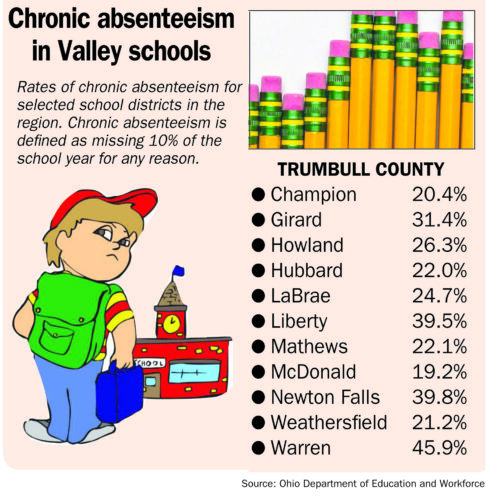
Capers said that nationally, one in four students miss too much school and in Warren as many as one in six students are missing, on average, one day per week or more. According to the 2025 state report cards released in September, Warren has a 45.9% chronic absenteeism rate, which is the highest in the county. The next highest district is Newton Falls at 39.8%, the state report cards showed.
However, efforts within Warren City Schools are about recapturing momentum, not decline.
“Our students and families responded well to our Attend Today, Succeed Tomorrow attendance campaign throughout the fall,” Capers said.
The campaign was part of Warren’s Stay in the Game! Attendance Network in partnership with the Cleveland Browns Foundation and the Ohio Department of Education and Workforce. The program provides districts with resources and strategies to tackle chronic absenteeism, which includes raising awareness, improving data tracking, and increasing family and community engagement. The goal is to increase student attendance and subsequently, their academic success.
As a result of those efforts, the district saw about a 5% decrease in absenteeism through January as compared to data from the 2024-25 school year and daily attendance was up 1.5% during that same time period.
Even so, this winter’s extended cold snap and significant snow presented obstacles for families. The weather disruptions, illness, and other barriers impacted attendance and caused many students to be absent and lose instructional time that cannot be replaced, Capers added.
WORKING TOGETHER
District leaders, school staff and community partners came together in February with renewed focus to ensure students finish strong. The meeting included members of the district’s Climate Workgroup, school-community liaisons, and representatives from a number of the district’s partner agencies, including Akron Children’s, Inspiring Minds, Thrive Counseling and Cadence Care Network.
The group reviewed attendance trends, identified spring risk factors and developed targeted strategies for the spring. Nikita Warfield-Owens of Cadence Care Network said, “as a community partner in the schools we can continue to help identify the gaps and barriers that are preventing the students from attending school. Once identified, we are in a position to create a trauma-informed space for open dialogue and help coordinate the community and school resources to support families and to check-in on progress and promote sustainability.”
Working together to raise awareness of what constitutes good attendance and consistently reinforcing that message was a key takeaway. Recognizing students who are meeting the attendance expectation and are showing progress toward the goal, and increasing communication to the home when students are absent are also areas of focus for the spring.
Eleanna Vlahos-Hall, school counselor for grades K-4 at Jefferson PK-8 School, said positive communication and interaction with families has been key to recent strides made in attendance. For example, the school sends postcards to families acknowledging good attendance and focuses on connecting with students to provide encouragement
This collaboration reflects a “Whole Child” approach — recognizing that attendance is often connected to broader social, emotional and family needs.
“When schools and community partners work together, families recognize that good attendance is expected from and valued by the broader community which helps to increase awareness. Once families realize the concern, we then have success in working together to address root causes,” Capers said.
Those causes can include transportation, mental health, housing instability and lack of awareness, among others.
“Many families do not realize that missing as little as two days of school per month is simply too much time missed and that it does impact a child’s academic growth. We also see that families, at times, may not realize how much time their child is missing as tardies and absences can add up quickly,” Capers said.
Sonya Williams, school/community liaison at Lincoln PK-8, stressed that the school district has been intentional about spotting risks early by tracking daily attendance, which allows staff to recognize as soon as possible which students need support.
“We are building a culture of attendance by engaging families,” she said. “We have been creating positive relationships and strengthening good communication about the importance of attendance.”
The schools use celebrations to help meet attendance goals by motivating students. Students are now setting attendance goals and engaging in fun attendance challenges and competitions with their peers, she added.
“We are grateful for our community partners for supporting our families with our attendance goals,” she said. “They have supported our school pantry with food, clothing and shoes to close the gap between barriers that may affect a student’s progress with school attendance.
“They have provided funding for attendance incentives and celebrations. They have supported students with school connectedness by engaging with our Special Education Lincoln Leaders Program.”
The district has worked to keep children in school by helping families overcome and remove barriers, including homelessness.
“We help with all the extended circumstances children, families and the school staff face by removing those barriers to keep children coming to school everyday,” said Angelena Baskins, school community liaison.
“We are working hard to beat the ‘spring slide’ by keeping the relationships we have built between children, families and staff very strong to finish the school year off strong.”
‘Attend Today, Succeed Tomorrow’
The district’s Attend Today, Succeed Tomorrow campaign is central to its success by reminding families that consistent attendance today builds the foundation for long-term academic success; emphasizes to students and families the importance of showing up everyday; keys in on early intervention by district staff when absence patterns first begin to emerge; and focuses on positive reinforcement.
“Our students and families are responding to the support we’ve put in place, and we are proud of the resilience that many of them have shown. We believe spring can be our strongest season yet, but it will take continued intentionality in the schools, families prioritizing a commitment to excellent attendance, and we are looking for our community to help us carry that momentum through the finish line,” Capers said.
Absenteeism in Ohio
Percentage of Ohio students missing more than 10% of school:
2024-25: 25.1%
2023-24: 25.6%
2022-23: 26.8%
2021-22: 30.2%
2018-19 (Prepandemic): 16.7%
Source: Ohio Department of Education and Workforce
Working on a fix
Warren City Schools attendance strategies:
* Analyzing root causes.
* Regular review of daily attendance and student data and trends.
* Acknowledging good attendance.
* Working with families to create attendance improvement plans.
* Gaining student perspective through surveys and meeting with students.
* Working with the juvenile diversion program in early intervention.
* Raising awareness.
Local News
Warren man, imprisoned twice, indicted again
Staff report WARREN — A city man who previously served two stints in prison was among more than three dozen ...

Transcribing local history
Cover Down Fund provides $5,000 for veterans for Easter
Staff report The Cover Down Fund, a nonprofit organization dedicated to supporting veterans in the Mahoning ...
Crash data highlights work zone risks
More than $137 million in construction work is about to get underway in Trumbull and Mahoning counties. Along with ...
Hubbard Township officials question gas aggregate status
HUBBARD TOWNSHIP — Nearly 2,700 residential properties could be left paying higher utility rates after trustees ...
Trumbull County courts: Marriages
Marriage licenses granted March 23-27 in Trumbull County: Willow F. DiGiacomo, 37, Vienna, and Christopher D. ...