
And the answer is: Mahoning Valley firsts
Program offers local trivia with bite of lunch
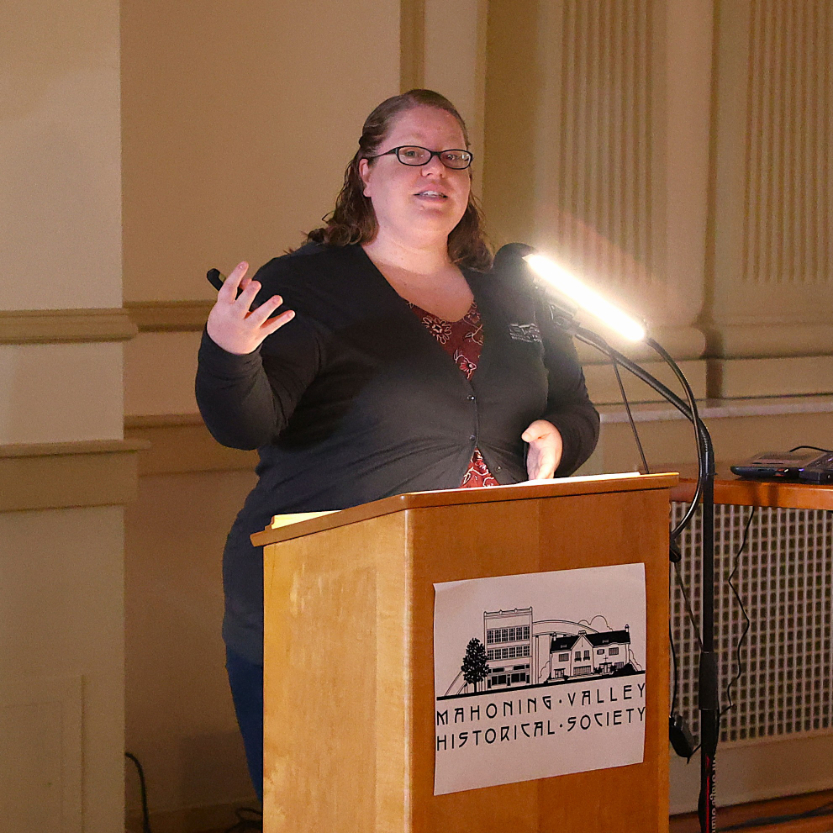
Taking an enjoyable dive into the area’s past, the Mahoning Valley Historical Society hosted its January “Bites and Bits of History” lunchtime program with a focus on “Made in the Mahoning Valley: Local Firsts” on Thursday afternoon at Tyler History Center.
The event corresponds with the nationwide America250 celebration of the Declaration of Independence’s signing. The Ohio America250 Monthly Themes start with “Ohio Firsts and Originals.”
Traci Manning, the society’s curator of education offered brief, but noteworthy, details on the 31 subjects that were highlighted as “firsts.” While she rushed through to make the program end in an hour, it could have gone on much longer.
“I had an idea what I wanted this program to look like, and I wanted it to feel very buffet style, if you will, a lot of very random things that maybe have no connection other than the fact that they were done first.”
She said that while this and the rest of the 2026 “Bites and Bits of History” programs will be based on themes from the state’s America250 festivities, all of them will focus on the Mahoning Valley.
Frequently, Manning asked the attendees if they knew who or what was the first of specific subjects. Some were easy such as the Butler Institute of American Art opening in 1919 and being the first museum to focus specifically on works created in this country, the first U.S. president from this region — William McKinley — and first licensed female pilot, Mary Campana.
Manning mentioned Harry Burt who invented the Good Humor ice cream bar and ran the company in the same building that now houses the Tyler History Center.
Many of the history buffs recognized the original WKBN transmitter, which carried the area’s first radio broadcasts.
During the question-and-answer session that followed Manning’s presentation, Kathy Fabrizio of Campbell asked about a longstanding rumor in regard to her former Youngstown residence — 26 E. Auburndale Ave. — and WKBN. Bill Lawson, the society’s executive director, confirmed that the house she and her husband bought in 1979 was, indeed, the place where the first radio broadcast occurred. Years later it was torn down.
Fabrizio said she had always wondered why there was a pole near the structure. Lawson replied that “it was a mast, and the antenna stretched from the house to that mast on the garage.”
WKBN also became the first to have a television broadcast in the Mahoning Valley.
Manning took the attendees on a journey back to the last major Ice Age through Native American tribes who lived here, the U.S. government sending them elsewhere and the earliest landowners who made an impact such as John Young.
She frequently exhibited her enthusiasm for local history by discussing specific people whose lives deserved an entire “Bites and Bits” program rather than the short time allotted on Thursday.
One of those subjects included Maggie E Harth Armstrong. “She and her husband, Fletcher, moved here to Youngstown in the nineteens. He was the first and only African-American business owner at the time. He operated their haberdashery on West Federal Street. The business closed in 1926 due to racial tension in the area.
“His wife will follow that business success and become the first African-American-owned and operated beauty shop and school licensed by the Ohio Department of Cosmetology. She operated that at their home on Belmont Avenue.”
Other “firsts” that Manning noted included a schoolhouse, mail route, iron blast furnace, steel mill, newspaper, Ohio governor from the area, integrated Rayen School, invention of the penalty flag in football and Arby’s founding in Boardman.
Next month the Mahoning Valley Historical Society “Bites and Bits of History” lunchtime program features Sean Posey’s presentation on “The Fight for Worker Rights in the Mahoning Valley.”
Local News
Liberty police investigating deaths
Staff report LIBERTY — Township police are investigating the deaths of two people at their residence Thursday ...
And the answer is: Mahoning Valley firsts
Juvenile court launches faith-based program
WARREN — Youth housed in the Trumbull County Juvenile Detention Center will have the opportunity to receive ...
Talk discusses shared history between Jews, blacks
Winter’s wrath pressures Howland’s salt supply
HOWLAND — With Thursday’s winter storm and its icy conditions long anticipated, officials were given a better ...
Bazetta, police ink 3-year pact
Bazetta Township police have a new contract. The board of trustees approved the new three-year contract this ...