
Game on
Hobby closes gap created by technology
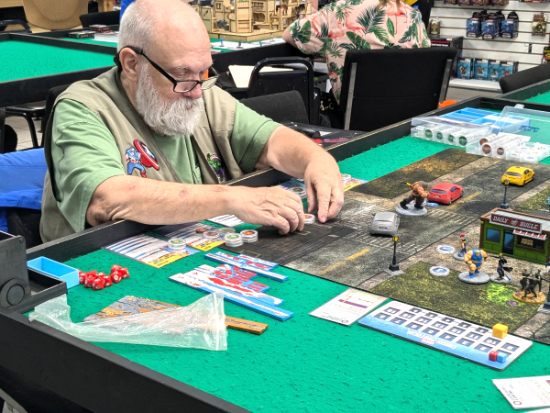
Staff photo / Brandon Cantwell Roger Blevins of Austintown moves tokens around in Marvel Crisis Protocol, a superhero-themed tabletop game in which players create Marvel-themed teams and throw and crash terrain around.
GIRARD — When thinking about tabletop games, the classic family favorites found in household cubby holes can include Monopoly, Sorry! and UNO.
Stepping foot into any hobby shop would reveal an expansive and diverse world, however, paints and blank figurines lining shelves, empty gridded tables waiting for unique adventures to be played upon them is found at a local spot dedicated to games.
Justin Miller, a co-owner of hobby shop Infinite Realms, explained the freedom of a nonconstricting rule set and immersive environment through gameplay drew him into the tabletop gaming hobby 27 years ago.
“Like most games, you have a rule set but it’s not like The Game of Life. The Game of Life, you have one decision and that’s whether you go to college or not,” he said. “Other than that, you just spin the little wheel and go.”
In more advanced games, each choice can impact different aspects, Miller said.
“A lot of them involve strategy. When it comes to miniature tabletop gaming, that’s something … it’s like advanced chess; you’re pitting your little plastic miniatures against the other person’s little plastic miniatures,” Miller said, adding no matter the game, strategy is required.
Miller said the hobby has grown immensely over time, noting there were a handful of games like Warhammer 40,000 and Dungeons & Dragons to choose from when he first started. Both franchises have held their ground, with Dungeons & Dragons celebrating its 50th anniversary this year.
Nearly every franchise has a tabletop miniature game nowadays, numbering nearly 150,000 in existence in 2024.
In an era where people are captivated by video games such as EA SPORTS’s widely anticipated College Football 25, drawing in 2.8 million players across both gaming consoles in its first week, Miller said tabletop gaming provides an experience that can’t be replicated at home.
“The best comparison that I usually put toward it is that it’s like, you can drink at home and spend a fraction of the cost, but why do people still go to the bar? It’s that interaction with people,” Miller said.
Playing video games, where conversation can still happen with other opponents, isn’t the same as being in-person.
“A different experience which I don’t feel that you get over an electronic connection,” he said.
And Miller isn’t the only one who shares that sentiment.
Roger Blevins of Austintown’s interest in tabletop games dates back to the early 1960s when communities formed by game stores didn’t exist and finding playing partners was very difficult.
“I’m here usually at least three nights a week to play games,” Blevins said. “It’s really nice to be able to do that, and do face-to-face interaction with people you’re gaming with instead of some nameless, faceless person on a video screen.”
Like other players, Erik Hartman of Liberty, one of Blevins’ favorite playing partners, paints figurines.
Hartman said the painting process can take two to three hours, depending on the number of colors or coats used to make it look right.
He chooses the color scheme, not always staying comic book accurate and instead adhering to his preferences.
Miniature figurines for games vary in price, as some companies gauge cost not on production costs, but the figure’s in-game impact. Because of this, figures can set the average player back anywhere from $25 to $40, Miller said.
Miller said diffusing the negative connotations surrounding being a geek was one of the bigger things to come with the industry’s growth.
“I do think … one of the big things with stores and gaming really taking off is, it’s okay to be a geek. It used to be, when I grew up and I was in my teens, you met people through going to the store and seeing them,” Miller said. “Now you can openly talk about it, and be like ‘Oh I play this’ and ‘I play this’ and then you meet up (with) people that way. There used to be like, a stigma behind it, and you don’t have that a lot anymore.”
Local News
Senior centers will open in Bristol and Champion in January
With help from SCOPE Senior Services, new senior centers will open in Bristol and Champion townships in early ...

Trumbull tourism plots path to success
Recorder’s office confronts internet breach
WARREN — The Trumbull County Recorder’s Office has temporarily suspended all e-filings and access to public ...
Ursuline facing 3rd federal suit
YOUNGSTOWN — A third federal lawsuit has been filed against Ursuline High School and the Catholic Diocese of ...
Warren man arraigned in overdose deaths
WARREN — A 29-year-old man accused of providing drugs that led to the overdose deaths of two people in 2023 was ...
Champion names Fee to JEDD board
CHAMPION — Township trustees at a special meeting Tuesday named Rex Fee as the township’s representative to the ...