
Police departments changing tactics to find, retain officers
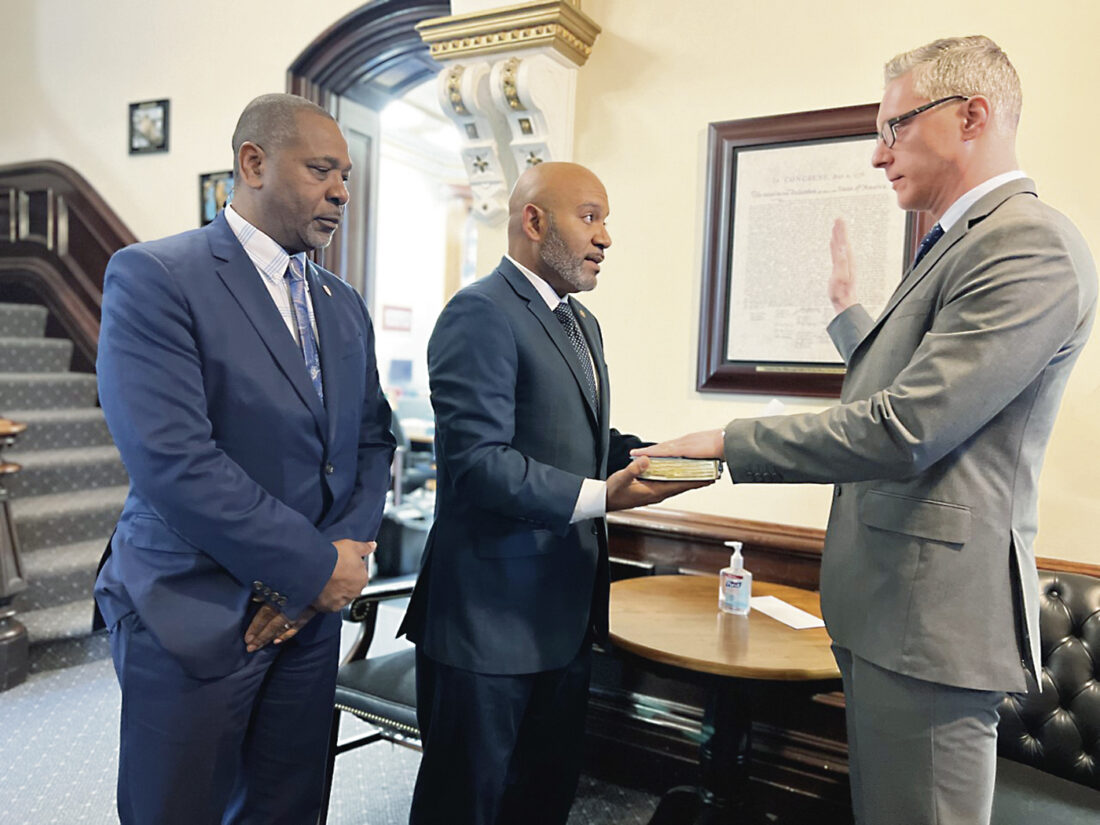
Staff photo / Chris McBride Warren Mayor Doug Franklin, left, and Safety Service Director Eddie Colbert swear in John McGinley as newly appointed police sergeant. The ceremony was Friday at city hall.
Mahoning Valley police chiefs say departments are having unprecedented hard times in finding new officers and keeping the experienced ones.
With the return of John P. McGinley to Warren’s police force on Friday, the city will have 58 officers — 12 short of the 70 that city leaders promised when they convinced voters to approve a half-percent income tax in 2016, and renew it in 2020.
McGinley was originally hired by the department in 2018 as part of the group of officers who came to Warren after the passage of the 2016 tax.
Warren was his first job as a police officer.
He left the department in 2022 to pursue other opportunities.
A portion of proceeds from the city’s 2016 income tax increase was aimed at recruiting new and retaining current officers.
The force was able to achieve the promised 70 officers in 2018 and, more or less, maintained that number for about a year-and-a-half , according to Safety Service Director Eddie Colbert.
“With the COPS grant (federal Community Oriented Policing Services) we’ve been as high as 72 officers,” Colbert said.
But the Warren Police Department has been experiencing a decline in the number of officers in recent years.
NOT ALONE
Warren is not alone in its struggle to get new officers to join its police force, and to keep those who already serve.
Mayor Doug Franklin attended a mayor’s conference in Washington D.C. last month, as did Youngstown Mayor Jamael Tito Brown, in which mayors from some 200 other municipalities all noted problems recruiting new officers and maintaining their departments at full staffing levels.
“This is happening across the country,” Franklin said. “Every municipality represented at that conference has had problems.”
Gov. Mike DeWine’s administration in 2020 established the Office of Law Enforcement Recruitment, to assist law enforcement agencies in increasing the number of candidates and retention of experienced officers, by providing competitive grants to departments.
Agencies that are awarded grants may use them to pay for the training of new officers, recruitment, providing college internships and marketing.
Applications for the grants were due in December.
POLICE ACADEMY
As part of his effort to establish a greater sense of trust between members of the police department and the community, Franklin in 2020 established the Police Community Trust Initiative. It consists of various community stakeholders that include law enforcement, clergy and representatives of area colleges and universities. Leaders of the Urban League and Trumbull NAACP also were invited to become involved
“We are in discussion with Kent State University (Trumbull campus) to talk about accelerating our hiring efforts, and, perhaps, institute a cadet program within our local school district,” Franklin said.
The city is considering a program of possibly paying for the Ohio Patrol Officer Training Academy up front for the training of potential officer candidates that would be hired on a non-certified basis. Once the officers complete their OPOTA training they would be contracted to work for the city for an established number of years.
Warren police Chief Eric Merkel noted some larger departments across the state already have been doing this sort of hiring arrangement for people interested in becoming police officers.
“This is increasingly becoming a standard across the state,” Merkel added. “We are in the discussion phase.”
James D. Willock Jr., director of the KSU Police Academy and Public Safety Training program, said there are fewer people applying to become police officers while — at the same time — more departments are looking fill their ranks.
Willock, who served as a police chief on two departments over a 20 year period, said he has never seen a time like this.
“There is a significant need for people to enter the field,” Willock said. “Agencies are coming to our job fairs and fighting one another to compete for students that have not graduated our program.
“It is tough for some departments, because we are seeing agencies offering entry level officers $80,000-a-year salaries,” Willock said. “Departments that offer $45,000 a year are having a hard time competing.”
In an effort to attract more young people into law enforcement, Willock said KSU this year stared a program with Warren City Schools, through which interested seniors are able to go to Kent’s campus to learn about the law enforcement program.
CIVIL SERVICE TESTS
With the city being 12 officers short, Merkel expects it will take time for the city to get to full staffing.
“We had six candidates pass our most recent civil service test,” Merkel said. “Even if we hire all six — which, likely, we will not — we’ll still be below the 70-officer goal.”
Merkel emphasized the department will not lower its standards just to get to that 70 goal.
One problem that Warren and other cities have experienced is there simply have been fewer people taking the civil service examinations required to become police officers.
Niles police Capt. John Marshall, whose department is only two short of having a full staff of 28, says one problem Niles is facing in hiring new officers is the number of people applying to take the civil service exam has diminished over the years. Marshall has worked as an officer for 26 years.
“When I applied, there were more than 200 taking the civil service test,” Marshall said. “Today, we sometimes have tests in which there are less than 10 taking it.”
Niles has the second-largest municipal police department in Trumbull county. Warren is the county’s largest municipal police department.
Marshall said Niles’ ability to stay at nearly full strength in recent years has been a combination of trying to prepare when a vacancy is expected, persistence — and some luck.
“Most of those that left retired,” Marshall said. “We have had very few people leave to go to other departments. Right now, our department is skewing young, with the majority having 10 years or less experience. We’ve had a number of retirements over the last five years.”
Marshall described Niles’ compensation package for new officers as being competitive to other cities of it size.
Merkel also described Warren’s total compensation package as competitive to other departments of its size.
A variety of other benefits, including pension pickups, health care and others can make the total hiring package more attractive.
IN YOUNGSTOWN
The Youngstown Police Department, too, is struggling with staffing shortages among police officers and civilian employees.
Lt. Brian Butler, staff inspector of the city’s police department, explained that civilian employees include 911 dispatchers, 911 supervisors and police clerical staff.
The Youngstown department has had a net loss of 37 police officers since 2013, including a loss of eight in 2014, eight in 2019 and nine in 2021. It gained two in 2015 and gained one in 2022, according to departmental statistics.
Chief Carl Davis said he has been with the police department 37 years, and the Youngstown Police Department has never had this few officers during his time there.
The department has added 65 officers since 2013 and lost 103. Thirty-one of the officers who have left since 2013 had less than 10 years experience with the department.
It currently has 87 patrol officers, and several more are scheduled to retire at the end of February, Butler said.
“We are facing an extreme shortage of police officers as never seen before,” said Butler. “We are always thinking of new ways to remove roadblocks and red tape in order to hire more police officers expeditiously, while still finding top quality applicants.”
The Youngstown department recently met with the police union and reached a draft memorandum of understanding that would allow the department to temporarily hire police officers without giving them a traditional written and physical civil service exam.
“This would permit us to recruit applicants and to immediately begin their background investigation, instead of waiting on a civil service exam to be given,” Butler said. “We would still advertise that we are hiring and conduct the same steps to ensure we have quality applicants,” Butler said.
That would include a background investigation, lie detector test and psychological exam, he said.
Local News
Pirates’ Hall of Famer Bill Mazeroski, known for walk-off home run in 1960 World Series, dies at 89

DownBeat center drums up support for aspiring musicians

Organization reaches out to stalking victims
Property transfers
Property transfers recorded Feb. 9 to 13 in Trumbull County: Bristol George L. White and Mindy E. White to ...
No charges filed against Belmont Pines runaways
LIBERTY — Police Chief Ray Buhala said no charges are being filed against juveniles after Liberty police were ...
Safecrackers tried to open bank vault with explosion
125 Years Ago, 1901 transcribed as originally published in the Youngstown Vindicator: “Safe crackers fail to ...