Organization reaches out to stalking victims
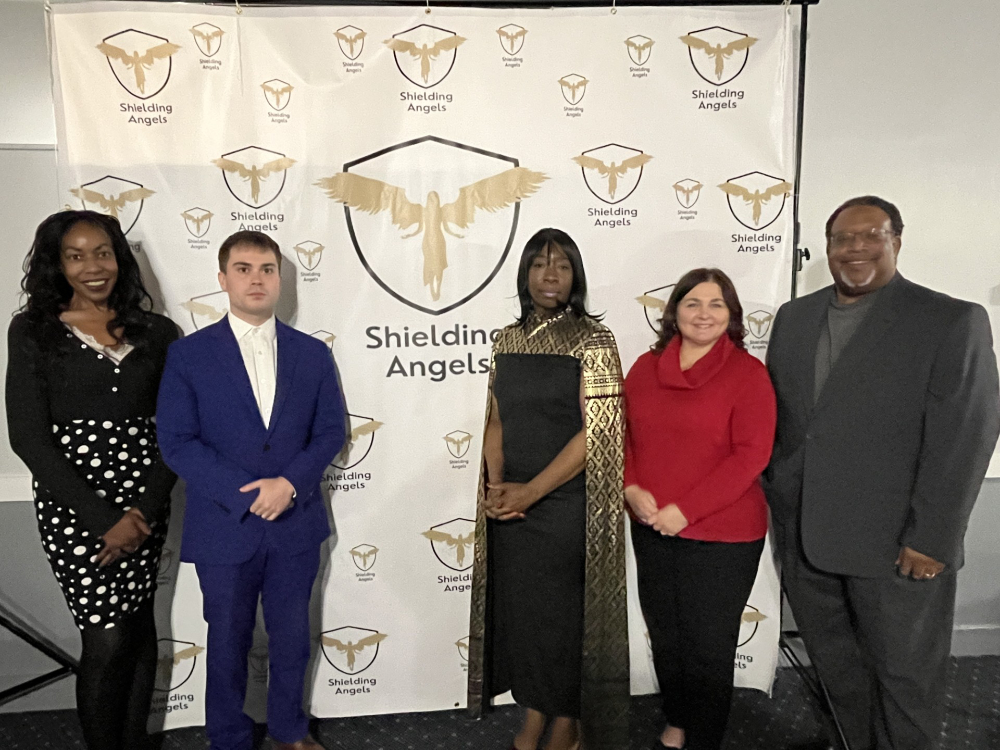
Staff photo / Bob Coupland Shielding Angels, a local organization in its second year to help victims of stalking, hosted its inaugural gala recently at the Hippodrome in Warren that also included a panel discussion. From left are Teaza Ingram, career services manager with Goodwill; Austin Mowry with Technical Surveillance Countermeasures; Angel Williams, president of Shielding Angels; Valerie Flanagan, social worker and author of “Safe and Sound”; and Darryl Rodgers, drug court coordinator for Trumbull County Common Pleas Court.
WARREN — Bringing stalking awareness to the general public is one of the goals of a new organization designed to create solutions that arm survivors against stalking, harassment and privacy violations.
Angel Williams, president of Shielding Angels, said the organization is in its second year.
The nonprofit organization assists those who are survivors of stalking, harassment and privacy violations, and grew from Williams, who is a survivor of stalking herself.
“While I was navigating my own situation, I wanted to use what I learned to help others,” she said.
The organization’s inaugural gala took place recently with a panel of experts in the field sharing their knowledge and skills.
Williams said in recent years she has found many cases similar to what she faced.
“What I found is there were no direct resources in the local area or at least not that I have heard of. I did hear Congresswoman Emilia Sykes (D-Akron) was doing something with Congress and I am attempting to connect with the people who represent our area,” Williams said.
She said the local area does have many advocates against human trafficking and domestic violence, but stalking resources are limited and she founded Shielding Angels to provide those resources.
“Often, stalking is interwoven into domestic violence situations but if it is not included in your situation, domestic violence shelters cannot house you and can’t relocate you,” Williams said. “What I do if someone contacts me is to assist them directly. I am certified to help people with ‘Safe at Home’ applications, which is a program by the secretary of state with each state having one to help keep your address private to any type of agency.”
Williams said a goal for 2026 is to provide relocation assistance and provide a sanctuary to victims that are facing stalking and menacing issues.
“A solution many victims are looking for is to get out of their location. We are looking for a property to provide this sanctuary to victims,” she said.
Williams said there is a stigma associated with stalking. She said when someone is a victim and trying to communicate to people who are expected to help, they sometimes don’t understand what the victim is dealing with and they attempt to revictimize them by convincing them it is all in their head.
“Sheilding Angels wants to provide that safe space. We have people who are survivors who are advocates or sit on our board to assist those who need help. We want those who need help to not feel like they are being judged,” she said.
Williams said Shielding Angels assists with safety planning, financial, relocation and legal services.
She said she was very grateful to the speakers who assisted at the gala who helped educate the community in becoming more aware of how stalking affects victims.
Williams said what is different with stalking now is the technology that is being used.
“Technology is a big component of stalking so for agencies trying to help, it takes a lot of time,” Williams said.
She said for 2025 the organization was able to get volunteers and advocates who are assisting victims.
“Our vision is to be the most trusted and key source for protection of distressed individuals in a world of misused technology and systems,” Williams said.
In 2025, Shielding Angels was able to help people dealing with stalking, harassment and privacy violations relocate; offer a safe space and listening ear to survivors that needed to talk without judgement; raise funds for programming and survivor tools; and have advocates take part in training to better assist survivors.
Williams said priorities for 2026 include safe spaces for survivors and better practices between victims and law enforcement.
STALKING STATISTICS
The Stalking Prevention Awareness and Resource Center provided the following statistics about stalking in the United States:
• 1 in 3 women and 1 in 6 men experience stalking at some point in their lives.
• 72% of stalking victims are threatened with physical harm and 84% felt fearful, threatened or concerned for their safety.
• Most common stalking tactics experienced by victims are 75% unwanted phone calls, 57% approached or showed up, 57% texts, emails and social media messages, 52% followed and watched, and 26% sent gifts, cards and letters. Most stalkers use multiple tactics.
• Stalkers are 42% acquaintances, 40% intimate partners (current or former), 19% strangers, 8% brief encounters, 8% family members and 4% a person of authority.
• 11% of stalking cases last five years.
• One in five stalkers uses weapons to threaten or harm their victims
• One in seven stalking victims relocates.
• Approximately 13.5 million people are stalked in a one-year period.
PANEL DISCUSSION
During the recent inaugural gala held at the Hippodrome a panel of individuals connected with stalking issues shared what they do and how they help.
Darryl Rodgers, drug court coordinator with Trumbull County Common Pleas Court, said there are dysfunctional people affected by alcohol or drugs and how they relate to others and who try to control or intimidate someone else through stalking.
He said as a local pastor and social worker working with people he hears from those who have had to deal with stalking and threats of violence.
“Stalking is a crime and it has become more dangerous with people having a jaded view that they are in control of someone else and the relationship. There was the golden rule of treat others the way you want to be treated but people are not kind and that rule often does not apply,” Rodgers said.
He and other panel members stressed the importance of not giving out personal information noting people do not need to know everything about someone.
Rodgers said in many situations protection orders can come from the courts to help the victims.
Valerie Flanagan, social worker and author “Safe and Sound,” said it is most important that the stalking victim, which can be a woman or man, be safe.
“There may be no reason why someone has targeted you. You are not at fault,” Flanagan said.
She said there are victims who feel unsafe all the time that can’t eat or sleep and fear going places.
It was advised that victims keep a log of what happens and contact 911 or police to get the matter on record and also have witnesses who can help.
Rodgers said most often the stalking is done by someone you know and not a stranger.
Williams said victims have shared stories of having anxiety and depression for what they are going through.
Flanagan said people can come out of violent situations.
”It is important to have support from people,” she said.
Austin Mowry with Technical Surveillance Countermeasures said it is important individuals document and maintain a record of what is happening to them.
For information call Williams at 330-978-5213 or facebook.com/shieldingangelz.info.
Local News
Property transfers
Property transfers recorded April 6-10 in Trumbull County: Bloomfield Christopher M. Yutzy and Mary Yutzy to ...
Drug task force acts on pair of search warrants
NILES — The Trumbull County Sheriff’s Office TAG Drug Task Force acted on a pair of warrants with the Niles ...
Three contend in GOP auditor race
Trumbull County’s race for the Republican nomination for the auditor’s seat will be contentious next month as ...
Trumbull County courts: Marriage licenses
Marriage licenses granted March 30-April 10 in Trumbull County: Shelby R. L. Rogers, 22, Warren, and Thane A. ...
Liberty board hears updates on road projects
LIBERTY — Township officials learned the status of a pair of community improvements that are moving forward as ...