
Trumbull County sets out to map transit plan
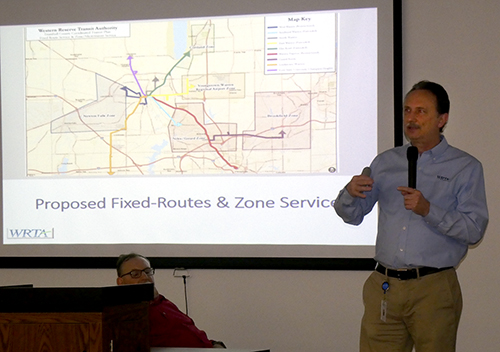
Staff photo / Bob Coupland Dean Harris, executive director of the Western Reserve Transit Authority, speaks Thursday at an informational meeting about future transit services for Trumbull County at the Trumbull County Educational Service Center.
NILES — The future of transit service in the county will depend on having a plan in place that tells what type of service will be offered, how it will be provided and how it will be funded, according to officials who spoke during a meeting Thursday.
More than 30 officials from the county, cities, villages and townships gathered at the Trumbull County Educational Service Center to look at future transit options and hear from representatives in the field.
Mike Salamone, Trumbull County transit administrator, said the first step is create a plan for transit services that can be offered to residents with different options and funding possibilities being key to its success.
“What do we want and how can we pay for it? That is why we need a plan,” he said, noting he would like to have a plan in place no later than September.
He said what needs to be answered is what type of service, such as door to door, on demand or fixed routes; how it will be provided, such as a contract with or joining the Western Reserve Transit Authority; and how it will be funded, such as local funds, American Rescue Plan funds, a sales tax or federal 5310 grants.
The 5310 grant provides formula funding to states for the purpose of assisting private nonprofit groups in meeting the transportation needs of older adults and people with disabilities when the transportation service provided is unavailable, insufficient or inappropriate, according to the Federal Transit Administration’s website.
Salamone recommended contracting with the WRTA for at least two years.
“I want to start putting together a plan and also look at where the money will come from by applying for grants,” he said, noting a follow-up meeting can be held in a month.
Salamone said in 2021, there were 60,730 transit trips and in 2020, there were 58,000 trips at an average of $29 per trip.
Carl Clemens, a former transit board member, said, “What is needed is to establish a plan of what we want in order to be able to continue moving forward. Regionalization is a must. We need to help Trumbull County regionalize.”
Cortland Mayor Deidre Petrosky said it has been almost 30 years without a plan for transit.
“We need a public transit system to draw employers into our area. We must let the taxpayers choose if they want to finance the transportation system with a sales tax. We need to educate our residents on what a public transportation system will do,” Petrosky said.
Mecca Trustee Christen Clemson said she is not sure township residents know the transit service is an option, noting 32 percent of Mecca residents are older than age 60.
“This is something that needs to go to the voters and educating them needs to be done before an executive decision is made on that they want,” Clemson said.
Commissioner Mauro Cantalamessa said the county is at a crossroads on where it wants to go with transit service but said it does want to expand options.
“We want to be able to do the best transportation system that we possibly can for a cost that we can afford,” Commissioner Frank Fuda said.
Dean Harris, WRTA executive director, said proposed is a five-year plan with WRTA covered by a 0.25 percent county sales tax that would offer either a fixed-route, countywide or zoned services.
He said 14 employees would be needed the first year, 43 the second year and 46 the third to fifth years, as well as three support staff.
“We would also need to build a transit center in Warren and a storage and service facility for 20 to 25 buses,” Harris said.
Officials previously have said the 0.25 percent sales tax would generate approximately $6 million per year for operating costs, but at the meeting, the estimated cost was much higher.
Commissioner Niki Frenchko said the county does not have the ability to apply for federal 5310 funds.
“What is important is that Trumbull County needs to have the opportunity to regionalize and we haven’t. We are missing the bus. There are federal transportation funds available to us and other federal funds, but it doesn’t come to Trumbull County because we are not part of the WRTA. If we are part of the WRTA, it will attract industry and get people in the township to their work,” Frenchko said.
She said what is needed is regionalizing and letting the people vote.
Diane Siskowic-Jurkovic, county senior levy administrator, said she handles the senior riders, and 50 percent of them use public transit for dialysis trips and the other 50 percent for other medical appointments. She said during the peak of the coronavirus pandemic, the demand for the service did go down while federal funds were provided to help with the costs.
Officials said in recent years the transit service has used $450,000 from the senior levy, $120,000 from the Trumbull County Board of Developmental Disabilities levy and $150,000 in a 5310 grant.
Vienna Trustee Phil Pegg said he spoke to officials in Mahoning County townships who told him they are not pleased with the WRTA service.
“If a 0.25 percent sales tax is put on, that money needs to come back to Trumbull County and provide service through all of the county,” he said.
A letter from Rebecca Whitman, secretary for the Trumbull Trustees Association, states the membership rejects the WRTA proposal to provide service to county residents funded by a 0.25 percent additional sales tax with the exception of Howland. Howland has a larger concentration of retail establishments compared to other townships.
Hubbard Mayor Ben Kyle said an advantage for the transit is college students who go to Youngstown State University could use the system. He said students could park in Hubbard and take the service to YSU.
Local News
Our Heritage: The man behind Pioneer Cemetery: Henry Lane Jr.
EDITOR’S NOTE: This is part of a weekly series on our region’s history coordinated by the Trumbull County ...
United Way of Trumbull County recognizes support
‘Today we remember …’
Grand jury indicts 48 in Trumbull County
WARREN — A Trumbull County grand jury on Thursday returned 48 indictments. The following cases will have ...
Rally in Valley welcomes all
On the record: Bristol
WHAT: Board of education meeting May 13 PRESENT: Jared Bilas, Brooke Vondrasek, Kristina Stephens and Candy ...