
Trending
CORTLAND -- Under overcast skies, a team of U.S. Army Corps of Engineers rangers and volunteers scoured Mosquito Creek Lake recently for bald eagles -- and found more than two dozen.
The nationwide bald eagle survey, held annually in January, this year counted 27 birds at Mosquito -- a sign that the eagle population is booming.
"Statewide in Ohio we have seen a dramatic increase in bald eagles that are not only visiting the area, but also nesting there," said Bill Spring, resource manager at the Mosquito Creek Reservoir Army Corps of Engineers. He said last year the survey identified 18 eagles at the lake. In 2018, only seven birds were spotted.
Bald eagles were considered an endangered species in the mid-20th century. According to the Ohio Department of Natural Resources, in 1979 there were just four bald eagle nests in Ohio. By 2018, ODNR estimated there were more than 280 nests in the state, with mature eagles raising nearly 450 young.
"It's a great testament to the federal protection agencies that are protecting these birds," Spring said. The federal Bald and Golden Eagle Protection Act, originally passed in 1940, made it illegal to disturb bald eagles.
"I mean, to see 27 bald eagles in one day is pretty fantastic," Spring said.
The survey
He said he believes the count at Mosquito Lake is pretty accurate despite the difficulties of spotting the often-moving birds.
"You know, we're not going to see them all. It's just not possible. There's also the small possibility of double counting. As we know, bald eagles fly, and they're not always stationary," Spring said. He said the team counting on Friday made an effort not to double-count, omitting a few birds they were relatively certain they'd already tallied.
Spring said weather plays a factor as well, as the birds are more active under certain conditions than others. He said the count is likely held in January because sparse foliage and the contrast of white feathers on a gray sky makes the eagles easier to see.
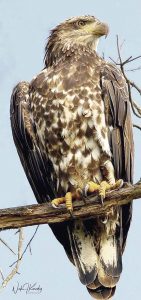
Of the 27 birds counted, 13 were immature bald eagles, which Spring said are often misidentified as hawks or other types of eagles.
"They don't look like a traditional bald eagle. Then we have our mature bald eagles which have the traditional white head. Eagles get their white head around four to five years."
At nearby Berlin Lake, a count held on the same day revealed just three eagles, all adults -- an apparent drop from past years where the count has been around nine or 10, according to Berlin Lake Army Corps Resource Manager Jason Quinn.
He said the birds may have been harder to spot this year because there is no ice on the lake.
"When there's no ice on the lake, it disperses them," Quinn said. When the lake partially freezes, eagles are forced to fish in the patches of open water, concentrating them in one place.
Quinn said the multi-agency survey is generally held on one day for all Army Corps of Engineers projects in a district, because it lowers the chance of double-counting the birds, which hunt and fish within a 100- mile radius.
The survey also counts golden eagles, but none were spotted at either lake this year or in the recent past.
Bald eagles
Spring said bald eagles tend to mate for life. They build a nest and produce two to three offspring per year. Younger eagles are often migratory before they find a mate.
"They'll migrate back and forth from here to Central America, even South America," Spring said.
He said the birds are "not very good hunters" and as much as 80 percent of their diet comes from scavenging food.
"Believe it or not, their diet comes from road kill and deaths that didn't come from their own hand," Spring said.
Bald eagles were removed from the federal list of threatened and endangered species in 2007 and from the Ohio listing in 2012, according to ODNR.
The popular birds attract attention from seasoned birders and the public alike. Spring said amateur birders looking to spot an eagle at Mosquito Creek should head to the causeway with a pair of binoculars and take a look around, especially to the north where more eagles have been spotted in the past.
Importance
Spring said the eagle survey helps keep tabs on biodiverisity, which is important for an ecosystem.
"The more diverse our ecosystem is, the healthier it can be and the more it will flourish for generations to enjoy," Spring said. "It's also a big economic factor…if we didn't have a beautiful lake, great fishing and recreation opportunities, it would affect the economy of the area."
Spring said this year, the Corps has gotten good feedback from the public from the count.
"It's really raised awareness from the community," Spring said. "They want to get out and see these bald eagles. That's what it's all about."
Spring said next year, he hopes to elevate the survey into a public event -- with the survey on Friday and a "Bald Eagle Fest" on Saturday to educate and involve the public.
avugrincic@tribtoday.com