Badger grad not slowed by handicap
Speaks to group at Canfield club
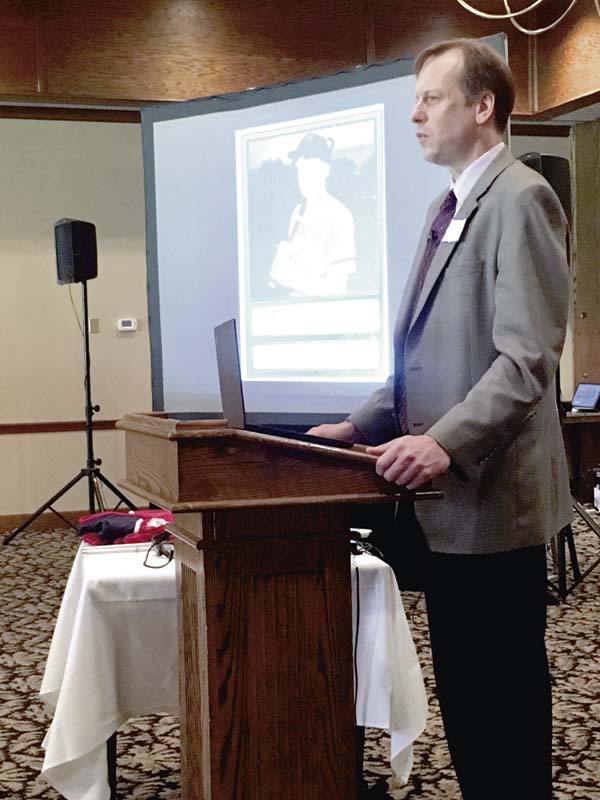
Doug Goist, 51, of Washington, D.C., formerly of Howland, speaks to a few hundred attendees Saturday at the Tippecanoe Country Club in Canfield about his experiences after having been declared legally blind at age 29.
CANFIELD — Doug Goist’s interests vary widely, from playing hockey to boating, wind surfing, deep-sea diving, scuba and guitar lessons and computers — and even having worked on a few movie sets.
Goist’s diverse list of activities and pursuits may seem unrelated, until you consider his underlying motivation for pursuing them and seeing the thread running through them: a desire to persevere despite having been declared legally blind at age 29.
“The ophthalmologist (in Cleveland) said, ‘There’s no cure, there’s no treatment, and there’s a 100 percent chance you’ll lose your vision. That left me kind of numb,” Goist, 51, said, referring to when he was diagnosed with retinitis pigmentosa.
RP is a genetic eye disorder that gradually causes vision loss. Typical symptoms include difficulty seeing at night and diminished peripheral vision.
Goist, a 1986 Badger High School graduate who lives in Washington, D.C., shared some challenges and triumphs related to his blindness during his 90-minute presentation to a few hundred people Saturday at the Tippecanoe Country Club in Canfield.
Sponsoring his talk was the Young Financial Group of Canfield.
Perhaps Goist’s most compelling triumph is playing goalie for the Leesburg, Va.-based Washington Blind Hockey Club, formerly the Washington Wheelers, which was founded about three years ago and has a roster of 20 players and 10 developmental skaters age 7 to 70. In addition to encouraging those with vision loss to play the sport, the WBHC has helped players lose weight and gain confidence as well as social opportunities, its mission statement says.
Blind hockey is similar in most respects to traditional ice hockey, except that the puck is about twice as large in blind hockey. The puck also is made of sheet metal and filled with ball bearings so players can more easily track it by sound — something that has helped Goist excel at the position.
In addition, the International Blind Sports Federation rates players as B1 (no vision), B2 (5 percent vision or less) and B3 (10 percent or less), Goist noted in his presentation.
Goist, an information-technology specialist for a nongovernmental program in Arlington called National Industries for the Blind, also recalled his bucolic suburban childhood, as well as living on a 55-acre farm near Gustavus. In high school, he developed an interest in science and occasionally wore overalls to school, he remembered.
“We came home (from school) pretty traumatized,” he said to laughter.
Around the same time, Goist played basketball, tennis, baseball and golf, but began to speculate that something was wrong when he began misjudging routine fly balls and often stepping out of bounds during a basketball game, he said. Problems with his vision became more difficult to ignore when, one day, he ran into the family’s dishwasher door while it was down, then had trouble seeing all of the food on his plate, he said.
Nevertheless, Goist refused to let his gradual vision loss stop him. In 1990, he graduated from Wake Forest University in Winston-Salem, N.C., with a degree in English. Later, he moved with a friend to Portland, Ore., and skied on Mount Hood before returning to the Mahoning Valley and dabbling in journalism, at one point writing for the Howland Ledger, at which time his eyesight continued to decrease.
“I realized I couldn’t deny this anymore,” Goist said, adding that he had difficulty having to adjust to no longer being able to drive. “I went into shut-down mode because I didn’t want to face that I was losing my vision.”
Goist also spent about four months at a rehabilitation center near Pittsburgh for those with vision loss, he added.
For about six years, Goist lived in Brooklyn, N.Y., where he began a transcription business and worked relentlessly to become more adept at it. While there, he used a lot of “creative avoidance” not to let on that he was blind, Goist said.
His mother, Jan Goist, remembered that for 10 to 12 years, her son’s vision gradually decreased, though she decided not to tell him what she knew, even though he suspected something was amiss.
“In his mind, he wondered what day he’d wake up blind,” Jan said. “He asked the doctor, ‘Will I need to know Braille?'”
Goist might not be able to see, but that doesn’t mean he lacks a clear vision of what he now views as important. By his own estimate, it’s taken Goist at least 20 years to realize that having a nice car, home and other material things he once saw as important really don’t matter, he told his audience.
Goist added a touch of levity to his talk by saying that being blind also has allowed visions of himself to remain frozen in time.
“The good news is that the last time I looked in the mirror, I was 29, so I think I still look like that now,” he said to laughter.
Local News
On the record: Bazetta and Lordstown
Bazetta WHAT: Township trustees meeting Tuesday PRESENT: Michael Hovis, Bob McBride and Joel ...
On the record: Trumbull County
Trumbull County WHAT: Trumbull Career / Technical Center May board meeting The board: • Heard from Nathan ...
Game Changers, TMHF partner for new scholarship
WARREN — Game Changers and the Trumbull Memorial Health Foundation have announced a new partnership to support ...
Officer-involved shooting to be investigated by BCI
Howland seeks applicants for vacant park board seat
HOWLAND — The township park board is seeking interest from residents who want to fill a vacancy on the board with ...