Life inspires heroes
Jim Steranko is an artist, musician and more
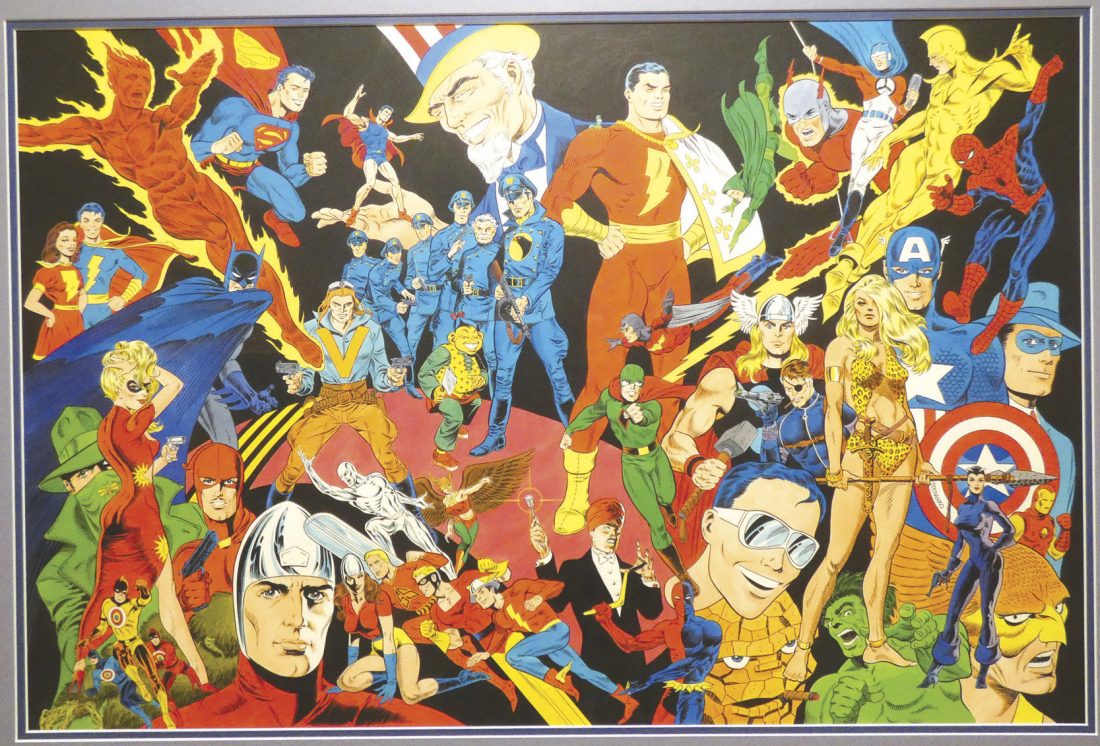
Jim Steranko’s “Cavalcade of Champions,” created with ink and aniline dye on illustration board, includes 51 characters from comic book history.
If you go …
WHAT: “Steranko and the American Hero”
WHEN: Sunday through May 29, with a reception for Steranko from 6 to 8 p.m. April 9. Hours are 11 a.m. to 4 p.m. Tuesday through Saturday and noon to 4 p.m. Sunday.
WHERE: Butler Institute of American Art, 524 Wick Ave., Youngstown
HOW MUCH: Admission to the museum is free. Tickets for the reception are $35 for Butler members and $50 for non-members and are available at www.butlerart.com.
Jim Steranko has a backstory to rival many of the Marvel Comics’ superheroes he helped popularize.
He played in rock bands, sharing stages with Bill Haley & the Comets, and worked as an escape artist. He’s collaborated with some of the biggest names in the film industry (Steven Spielberg, George Lucas, Francis Ford Coppola) and acclaimed authors (Harlan Ellison).
Not only did his work on such comic book characters as Nick Fury, Captain America and X-Men influence generations of artists and writers who followed him, but Steranko himself provided the inspiration for escape artist superhero Mister Miracle. He also inspired one the main characters in Michael Chabon’s Pulitzer Prize-winning novel “The Amazing Adventures of Kavalier & Clay.”
Not all of Steranko’s art was printed on newsprint-quality paper and sold for pocket change. Steranko did concept paintings for Spielberg and Lucas that shaped the look of Indiana Jones for “Raiders of the Lost Ark,” and his paintings have been used for books featuring famous literary characters.
That’s the work the Butler Institute of American Art will display starting Sunday. “Steranko and the American Hero” is the largest collection of Steranko’s paintings ever exhibited. Steranko, 83, will attend a reception April 9 at the Butler in conjunction with the show, and he will do an autograph signing later that night at the Doubletree Hotel in downtown Youngstown.
Steranko agreed to answer some questions via email in advance of Sunday’s opening. It has been edited for style and clarity.
TICKET: You said in our initial email exchange that the Butler exhibition is very important to you. Why?
STERANKO: I’ve had massive exhibitions around the world — the Semana Negra event drew 1 million viewers in a 10-day period, and a Canadian show traveled the country for three years — but the upcoming Butler exhibit is not only exceptionally upscale, but it exclusively showcases my painted imagery, not my narrative work. Viewers will be shocked at the volume of my work they never knew existed.
TICKET: Was there a museum growing up that helped foster your interest in art or was there a museum or museums that you would visit for inspiration during your career?
STERANKO: I grew up in a deeply-impoverished background. The closest I ever got to art was driving past billboards on a highway. I learned to draw as a child with the heat of my fingertips in the ice that formed on the inside of the windows of the tar-paper shack in which the family lived. My father denigrated my childhood dream of becoming an architect.
TICKET: Take me through the selection process in picking the pieces that you’ll be showing at the Butler.
STERANKO: All 65 paintings not only represent physical imagery — all created before the digital age — but were selected for their subject matter: ‘The American Hero!’ One of my art directors commented that I specialized in visualizing more heroes than any other artist with whom he worked. I knew all the top illustrators, from (Frank) Frazetta to (Robert) McGinnis to (Walter M.) Baumhofer, and I set what could be a world’s record for painting more famous historic and fictional heroes for book covers to film-production art than the rest of the brotherhood.
TICKET: In your email, you mentioned your encounters with some of the pop culture icons who will be seen in this show. How important are those personal encounters in helping you create something that is more than just a likeness? And if that first-hand knowledge is important, how do you compensate for it when painting a subject with whom you don’t have that experience?
STERANKO: Most of my images materialize on the canvas of my imagination, not through personal encounters with film stars — and I’ve known many. For example, I was hired by George Lucas and Steven Spielberg to create the look, the style of Indiana Jones, two years before the film was made, let alone cast. They wrote the story but didn’t know what Indy looked like until I delivered a series of paintings that captured his appearance and mannerisms — and then, I gave him my attitude!
Many artists can paint likenesses, but I envision heroic panoramas that bristle with energy, movement, sex appeal and tension. A woman who was viewing my art some time ago asked, “Do you know what you do?” I replied, “Why don’t you tell me.” She responded, ‘You make the grotesque beautiful!”
TICKET: Your resume includes stints as everything from an escape artist to a standup comic. Which of those life experiences had the biggest impact on your work as a visual artist and how?
STERANKO: I played rock ‘n’ roll for 12 years and extrapolated the elements of music — melody, harmony and rhythm — into my images. My experience as a art director and designer in an advertising agency still deeply informs my compositions. I boxed, fenced, earned a brown belt in judo and specialized in the flying rings and parallel bars, all of which gave me an advantage in drawing the human figure without reference. My magic history provided incentive for visual puzzles and illusions. Stage performances honed the craft of showmanship.
Because I’m ultimately self-taught, it’s impossible to isolate many of those elements.
TICKET: You brought a lot of cinematic influence to your comic book work. While comics were source material for film and television in the ’50s and ’60s, did you ever imagine the pop culture dominance the comics industry currently has on film, television, gaming, etc.?
STERANKO: It was relatively easy to predict that with the inevitable development of special FX technology, comic book spectacles would be readily adapted to cinematic production. Comics have become prime source material for a major part of today’s entertainment spectrum.
TICKET: You fought for autonomy and creative control in the comics industry, but you’ve also collaborated in your career with equally strong-willed people like Francis Ford Coppola, Harlan Ellison, George Lucas and Steven Spielberg. What do you look for in a collaborator and who are some of your favorites?
STERANKO: My rule is simple: To work with THE BEST! I’ve been fortunate to be able to make that happen.
TICKET: Comic book historians have created a list crediting you with 150 innovations in the comics industry. Are there one or two that you’re most proud of and that continued to influence your work?
STERANKO: Pride is a vulgar ostentation I reject about any of my work. I’m a severe critic of my creations, which is why nothing I’ve generated hangs in my studio or home.
Scenes I envision are always more dynamic, more energetic, more colorful than when they’re ultimately captured on canvas or board — which I find terminally disturbing. Fortunately, no one knows about those images but me. Nonetheless, I’ll never be satisfied until I create a work as perfect as Gershwin’s “Rhapsody in Blue” or as flawless as any Fred Astaire dance number.
TICKET: You drew huge crowds for your first appearance at All-AmeriCon in Warren in 2014 and at the Youngstown Comic Con in 2019. Any memories stand out from your past visits to the area?
STERANKO: I don’t live in the past; I leave that up to others. My only interest is in what kind of magic or electricity or passion I’ll be creating in the future — where I’ll be spending the rest of my life.
Ticket
Youngstown Playhouse sets season
Eight shows in three different venues will make up Youngstown Playhouse’s 2026-27 season, and a Broadway veteran ...
McGuffey series presents Poe program
Mark Dawidziak returns for a William Holmes McGuffey Historical Society Memories of a Lifetime program on author ...
Selah production takes a look at three generations of women
Gray Areas: Cameron teams with Eilish for 3D concert experience
Social media is filled with memes that are a variation of, “Find a man who looks at you like …” accompanied ...
Mahoning Valley arts and entertainment