
Trending
Suppose you had to make three tricks in a suit where dummy held J-x-x and you, as declarer, held A-K-9.
There would be only two practical ways to handle this combination. One would be to cash the A-K, and if either opponent had the singleton or doubleton queen, you would be home free.
The other way would be to lead low from dummy and, if the next player followed low, finesse the nine. This approach would succeed if your right-hand opponent had both the ten and queen.
The mathematics of the situation dictate that it is significantly better to try the double finesse than to cash the A-K. Playing the A-K will drop the queen in only one deal out of 10, while the double finesse will succeed in one deal out of four.
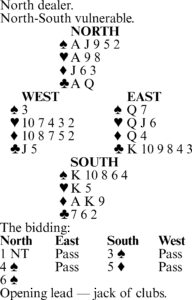
Jean Besse, the late Swiss star, played this hand in a match against Italy many years ago. He finessed the club lead, losing to East's king, and won the club return. After drawing trump, he cashed the king and ace of hearts and trumped a heart.
Next he ruffed a club, on which West showed out, and he was then faced with the proposition of making all three diamond tricks with the combination discussed above.
He led a low diamond from dummy, and East played the four. Besse thereupon played the ace, continued with the king, caught the queen and so made the slam.
Why did Besse abandon the percentage play? The answer is that he knew the double finesse could not succeed in this deal, and that the only chance he had was to drop the doubleton queen.
During the play, Besse had learned that East started with two spades, three hearts and six clubs. Hence, East could not possibly have the Q-10-4 of diamonds, which would give him 14 cards. The only hope, therefore, was that East had started with the Q-4 doubleton.
Tomorrow: Test your play.