
Trending
The idea of paying a small premium for insurance to guard against disaster has its bridge counterpart in the safety play, wherein declarer risks losing a trick he might not have to lose in order to safeguard his contract.
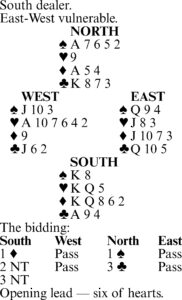
Today's deal provides a typical example. South arrives at three notrump, and West leads a heart. Declarer takes the jack with the king and has to find the approach that offers the best chance of scoring nine tricks.
If he makes the mistake of assuming that 10 tricks are just there for the taking, he will end up a very unhappy individual. All he has to do is to cash two top diamonds in any order, and he is certain to go down one.
Before tackling the diamonds, South should count his tricks and realize that he doesn't need to score five diamond tricks to make his game. With eight tricks already assured and only one more needed, he can afford to lose a diamond, provided East is not permitted to gain the lead for a potentially killing heart return.
Accordingly, at trick two South leads a diamond to the ace, on which West's nine appears. A diamond is returned, and when East follows low, the eight is played.
If West is able to win with the ten or jack, declarer will have lost a trick he didn't have to lose, but then he is certain to finish with no less than nine tricks. In the actual case, though, the eight holds, and South ends up with 10 tricks.
Note that East cannot thwart declarer by putting up the ten or jack at trick three. In that case, South simply wins the trick, re-enters dummy with a spade or a club and picks up East's remaining honor via a finesse.
Once West's nine appears on the first round of the suit, all roads lead to at least nine tricks, provided South applies the rule of safety first.
Tomorrow: Choosing the right line of play.