
Republicans face some big questions in 2026
“Are the Republicans going the way of the Whigs?”
During President Trump’s first term, this question was asked a lot. The answer then: No.
But one year into his second term it’s worth revisiting the question, not so much because the answer is different this time, but because the question illuminates how much our politics have changed in the last decade.
Just in case you forgot — or never knew — the Whigs were one of the two major American parties from the 1830s to the mid-1850s. We’ll return to them in a moment.
A decade ago, the conversation about the Whigs centered on the fact that Trump divided the GOP. Republican politicians — most notably Sens. Mitch McConnell, John McCain, Mitt Romney, Jeff Flake and Bob Corker — would periodically defy or criticize the Trump White House.
More relevant, members of the non-MAGA GOP establishment in Congress, and in the White House itself, constrained Trump and often shaped policy. For example, the 2017 tax reform was largely crafted and passed by GOP congressional leaders, and harsh sanctions against Russia were pushed by members of the administration. In short, Trump’s personality divided the right, but his policies, forged through compromise between MAGA loyalists and traditional Republicans, unified them.
A year into the second Trump administration, things look very different. Now his personality unifies the coalition, while issues divide it.
This administration is monolithically MAGA — perhaps not entirely in ideological terms, but certainly as a matter of personal and political loyalty to Trump.
Trump’s approval ratings among the broader public are reaching historic lows, but roughly nine in 10 Republicans still approve of him. Pledging fealty and support for Trump is a requirement in Republican primaries.
But on issues like trade, Ukraine and Israel, abortion and, to some extent, immigration, the Republican coalition is fractured like a cracked windshield. Some splits are generational — as with Israel and even antisemitism. Other divisions are driven by new GOP voters Trump brought into the coalition.
So, what does this have to do with the Whigs? For starters, the Whig Party was formed to oppose a Trump-like president — Andrew Jackson, a.k.a. “King Andrew The First.” Opposition to Jackson’s “Caesarism” united a diverse coalition under the Whig banner. When Jackson’s presidency ended and he faded away, the glue holding the coalition together dissolved and issues divided the Whigs. I say “issues,” but really it was just one issue: slavery.
Slavery divided the Whigs irreparably. So the Whigs died, and the newly minted Republican Party took their place.
There’s a lesson here for both parties. When Jackson dominated politics, he defined Democrats and Whigs alike. The Whigs tried to paint Jackson’s successors as wannabe dictators, too. And Democrats wanted to transfer Jackson’s cult of personality to his Democratic successors. Both sides failed. Jackson’s polarizing qualities were unique to him.
There’s no single issue that divides Americans the way slavery did in the 1850s — and that’s a good thing (unlike some MAGA hotheads, I’d like to avoid a civil war). Also, neither party is poised to go the way of the Whigs, in part because the two-party duopoly over election laws and ballot access is a huge barrier to entry for third parties.
But, at the end of 2025, the current coalitions of both parties look too fragile to survive the post-Trump era intact.
Jonah Goldberg is editor-in-chief of The Dispatch and the host of The Remnant podcast. His Twitter handle is @JonahDispatch.
Editorials
Be smart and safe during flu season
It is the season during which many of us simply accept that we will get the common cold or come down with the flu, ...
Republicans face some big questions in 2026
“Are the Republicans going the way of the Whigs?” During President Trump’s first term, this question was ...
Off to the races: Democrats get ready to rumble
A midterm election year is upon us, and that can mean only one thing: we have entered the realm of quickened ...
Economists got 2025 all wrong
Well, Donald Trump has done it again! He stumped the chumps. The “chumps” in this case were the ...
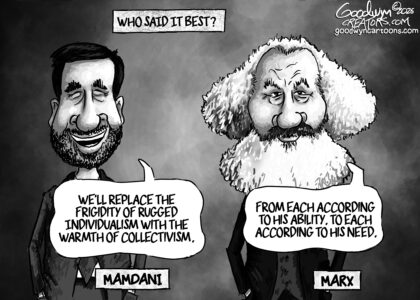
Editorial cartoon for Jan. 6
Aging Ohio population is a concern
Elected officials and policymakers in Ohio have plenty to work on in the coming years. We talk a lot about the loss ...