
Threats shake Iran talks
US-Iran negotiations end, technical talks will continue
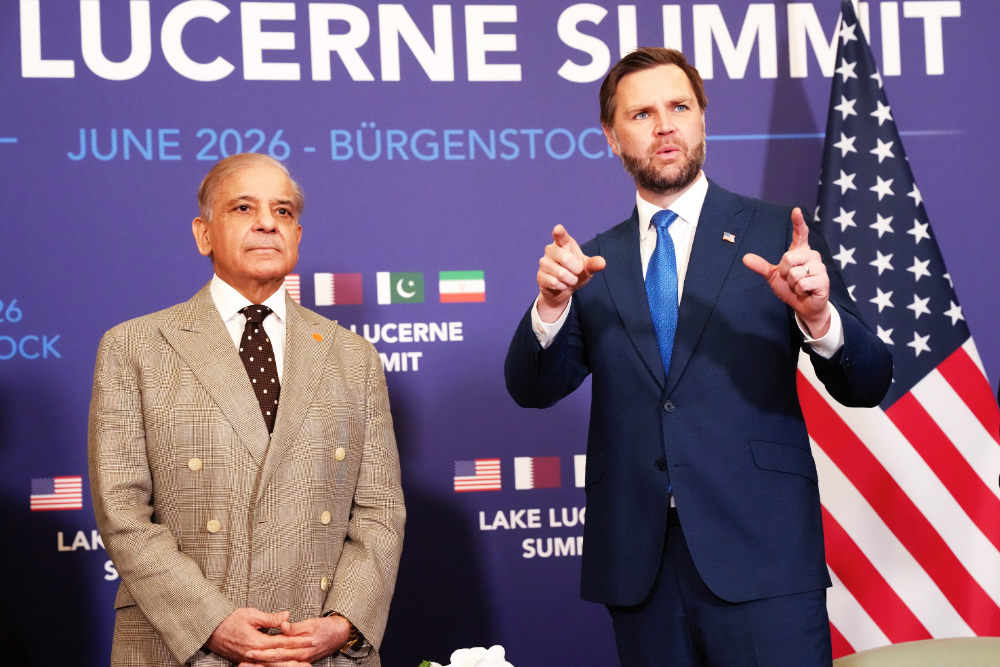
AP U.S. Vice President JD Vance, right, meets with Pakistan’s Prime Minister Shehbaz Sharif, during high-level talks aimed at advancing a deal to end the Middle East conflict, at the Bürgenstock Resort in Obbuergen, near Lucerne, in Switzerland on Sunday.
OBBUERGEN, Switzerland — High-level negotiations in Switzerland seeking a permanent end to the Iran war ended early Monday, with lower-level talks planned for the rest of the week as Iran and the United States agreed to create a “de-confliction cell” to address the fighting in Lebanon.
A statement from mediators Pakistan and Qatar said the cell would include the Lebanese government and would “ensure the adherence of the termination of military operations in Lebanon.” But it remains unclear whether that will be enough to stop fighting between the Iranian-backed militia Hezbollah and Israel, which occupies Lebanon and insists it must maintain a free hand to attack militants who are launching attacks into northern Israel.
The U.S. offered no immediate comment, while Iran praised the meditators’ work.
The talks marked the start of a 60-day diplomatic process that seeks to reach a permanent deal to end the Iran war. But the fighting in Lebanon remains one of the key sticking points.
Meanwhile, Iran insisted it had again shut the Strait of Hormuz over the weekend, the narrow mouth of the Persian Gulf crucial to energy shipments, while the U.S. said traffic continued.
The negotiations had a tense start Sunday in Switzerland, when Tehran took offense at U.S. President Donald Trump’s threat to attack and his warning that Iran’s president should watch what he says.
“Iran must immediately stop their highly paid PROXIES in Lebanon from causing trouble,” Trump said on social media. “If they don’t, we’ll hit Iran very hard again, just like we did last week, only harder!!!”
The comments from afar — on social media and to news outlets — complicated efforts by Vice President JD Vance and mediators Pakistan and Qatar to keep Iran engaged in discussions.
“They would do better to be careful about their statements,” Iran’s lead negotiator, Mohammad Bagher Qalibaf, said on X after Trump’s comments. “Our armed forces are prepared to respond to them in a different manner. They may keep talking, it is we who act.”
But later, Iranian Foreign Minister Abbas Araghchi wrote on X that “Tireless Pakistani and Qatari mediation has delivered major progress to end Lebanon War.” He said the first “real test” of negotiations would be whether the deconfliction cell succeeded in halting the fighting in Lebanon.
Vance and U.S. negotiators including Steve Witkoff and Jared Kushner, Trump’s son-in-law, had met with Qalibaf and Araghchi for what Iranian state media said was about 80 minutes.
Pakistan and Qatar after the meeting said lower-level technical talks would continue in Switzerland for the rest of the week. Such talks aim at producing the breakthroughs needed for high-level officials to return and sign agreements.
A senior U.S. diplomat engaged in the talks, speaking on condition of anonymity to describe private discussions, said the talks Sunday included clarifying what Iran meant by recent statements about the Strait of Hormuz. Negotiators also discussed “mechanisms” to ensure the strait remains open and that a ceasefire in southern Lebanon is enforced, along with “robust” discussions on the nuclear issue.
Negotiators are in a 60-day sprint to reach an agreement on the technical details that hold massive implications for the world economy and global security.
“The question before us now is how much more can we accomplish together? Can we turn over a new leaf?” Vance said as the talks began, and asked whether they could “change relations in the Middle East permanently.”
National News
Man falls to his death during rock concert at Madison Square Garden
NEW YORK (AP) — A 51-year-old Connecticut man fell to his death from an upper deck of Madison Square Garden ...
In Taylor Swift’s beach town, every clue becomes a wedding rumor
WESTERLY, R.I. (AP) — When a large tent appeared next door to Taylor Swift’s Watch Hill estate this week, it ...
Threats shake Iran talks
Nation & world at a glance
De la Espriella holds thin lead in Colombia’s election BOGOTA, Colombia — Political outsider Abelardo de la ...
Average mortage rate falls to 6.47%
WASHINGTON (AP) — The average long-term U.S. mortgage rate fell this week, tracking Treasury yields that have ...
Israel and Hezbollah agree to halt fighting
JERUSALEM (AP) — Israel and the Iranian-backed Hezbollah militant group agreed Friday to halt the heavy fighting ...