
Hegseth gets bipartisan grilling
Trending
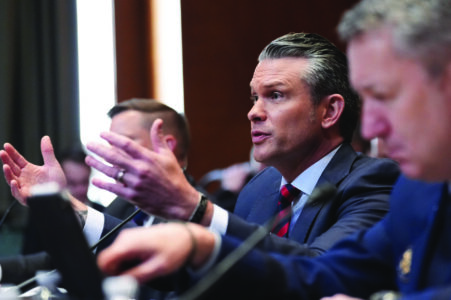
WASHINGTON (AP) -- Defense Secretary Pete Hegseth faced tough questions Tuesday from Republican and Democratic lawmakers about the Trump administration's end game for the Iran war, the conflict's rising $29 billion cost and its impact on diminishing U.S. weapons stockpiles.
While the Pentagon chief softened his tone from hearings before Congress nearly two weeks ago, notably avoiding the same pointed criticism of lawmakers, he got far more pushback from members of his own Republican Party about the levels of U.S. munitions used in the Iran war and President Donald Trump's intense criticism of traditional allies for not taking part in the conflict.
"I take issue with the characterization that munitions are depleted in a public forum," Hegseth said. "That's not true."
Even as he insisted that the U.S. military has plenty of missile defense systems and other munitions for the Iran war or future conflicts, Hegseth told House and Senate lawmakers overseeing defense spending that the Trump administration is working to ramp up production of weapons.
Pentagon officials also told lawmakers that the cost of the Iran war has risen to about $29 billion, the vast bulk of which -- roughly $24 billion -- is related to replacing munitions and repairing equipment but also includes operational costs to keep forces deployed. That is up from the overall total of $25 billion that Pentagon comptroller Jay Hurst revealed nearly two weeks ago. He said the updated estimate does not include the cost to repair or rebuild U.S. military sites damaged in the region.
Hegseth faced notable pushback from Republicans on the Trump administration's straining of relations with longtime allies, with Kentucky Sen. Mitch McConnell telling Hegseth that "NATO is the most important military alliance in world history."
"It seems to me that a lot of the European countries think that we're reducing our influence there, they're sort of on their own," said McConnell, the GOP chairman of the Senate Appropriations subcommittee on defense.
Trump has assailed NATO allies and others for not helping reopen the Strait of Hormuz, a vital global shipping corridor, or otherwise offering more support, saying he plans to pull thousands of troops out of Germany in the coming months.
Oklahoma Rep. Tom Cole, the Republican chairman of the House Appropriations Committee, voiced his concerns in a separate hearing, saying that "America First has never meant American alone."
"American power is most effective when it's exercised in concert with like-minded nations who share our interests and our values," Cole said.
Hegseth gets bipartisan pushback on munitions stockpiles
The hearings before the powerful House and Senate Appropriations defense subcommittees spanned four hours as they reviewed the Trump administration's 2027 military budget proposal, which calls for a historic allocation of $1.5 trillion.
The discussions quickly veered into the handling of a war that appears locked in a stalemate as higher fuel prices pose political problems for Republicans in the midterm congressional elections.
Republican Sen. Susan Collins, chair of the Senate Appropriations Committee, questioned whether the Trump administration anticipated Iran's closure of the strait, which has surged gasoline prices.
Gen. Dan Caine, chairman of the Joint Chiefs of Staff, said the president is briefed with carefully considered military options.
"It seems to me that there's been a different plan almost daily of, with dealing with this problem, which is why I ask," said Collins, who joined Democrats last month in a failed vote to halt the conflict and is facing a tough reelection fight.