Senate committee quizzes surgeon general nominee
Dr. Casey Means aims to stop ‘reactive sick care’
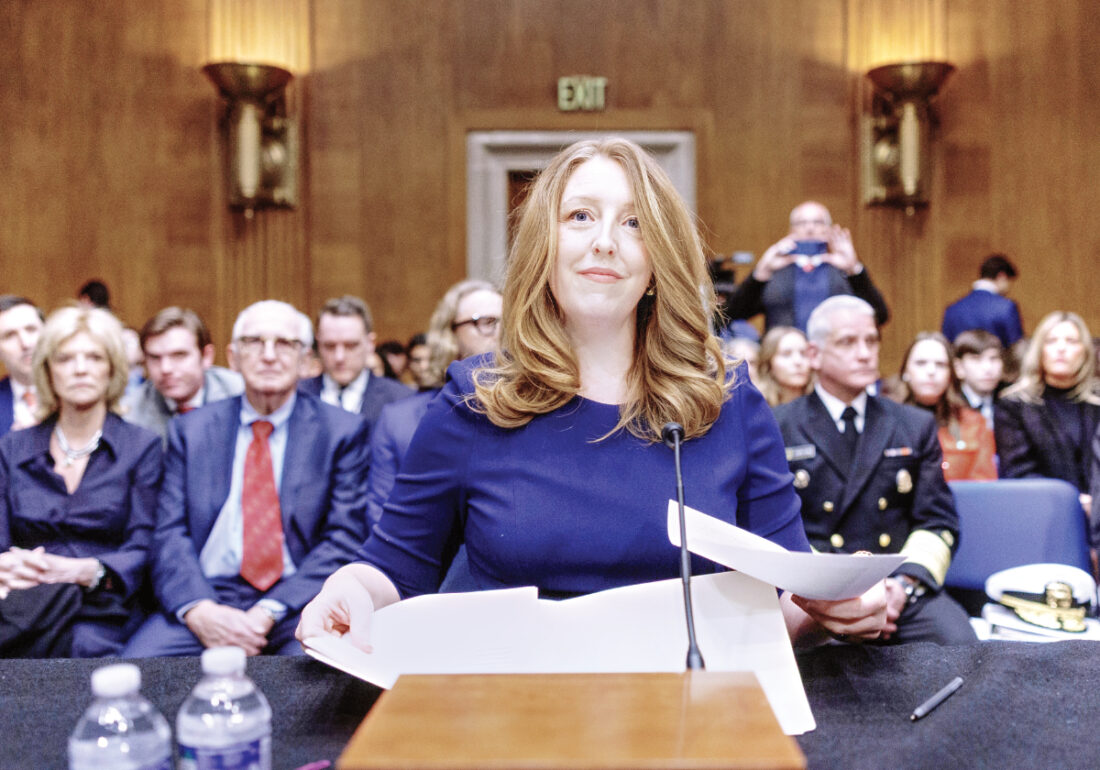
AP Dr. Casey Means takes her seat Wednesday at the start of a Senate Health, Education Labor and Pension Committee Conformation Hearing for U.S. Surgeon General on Capitol Hill in Washington.
NEW YORK (AP) — Wellness influencer, author and entrepreneur Dr. Casey Means on Wednesday shared a vision for addressing the root causes of chronic disease instead of feeding into “reactive sick care” during her confirmation hearing to become the nation’s next surgeon general.
“Our nation is angry, exhausted and hurting,” the 38-year-old said in Washington before the Senate health committee Wednesday. “If we’re addressing shared root causes, we’re going to be able to stop the whack-a-mole medicine that’s not working for us.”
It’s a message that dovetails with that of Means’ ally, Health Secretary Robert F. Kennedy Jr., and his “Make America Healthy Again” movement. It also has some bipartisan support, with many Democrats and Republicans agreeing that the rise in chronic disease is a problem that needs solving.
But Means also faced tough questions from senators about topics that have become divisive in recent years, such as vaccines and hormonal birth control, as well as about her qualifications and potential conflicts. The Stanford-educated physician’s disillusionment with traditional medicine drove her to a career in which she has promoted various products, at times without disclosing how she could benefit financially. She has no government experience, and her license to practice as a physician is not currently active.
“I have very serious questions about the ability of Dr. Means to be the kind of surgeon general this country needs,” Vermont independent Sen. Bernie Sanders, the ranking member of the Senate health committee, said Wednesday.
Next, the committee will consider whether to advance Means’ nomination, in which case it would go to a vote in the full Senate.
As the nation’s doctor, the surgeon general is a leader for Americans on public health issues. If confirmed, Means could issue advisories that warn of public health threats. She also would be tasked with promoting Kennedy’s sprawling MAHA agenda, which calls for removing food additives, rooting out conflicts of interest and promoting healthier eating.
Surgeons general also have sometimes used the office to advocate on issues related to vaccination — though the office has no role in creating vaccine policy. While Means has largely steered clear of Kennedy’s debunked views on vaccines, senators from both parties grilled her on how she would approach the issue if confirmed.
Sen. Bill Cassidy, the Louisiana Republican who chairs the Senate health committee, asked Means whether she would advise Americans to vaccinate against flu and measles amid outbreaks across the U.S. She didn’t make that commitment, instead emphasizing the importance of informed consent between patients and doctors.Cassidy, a doctor himself, then asked Means if she accepts evidence that shows vaccines don’t cause autism.
“I do accept that evidence,” she said, referring to the research. “I also think that science is never settled.”
Means said she looked forward to seeing the results of a federal effort to study environmental contributors to autism. The National Institutes of Health is funding such research, and it’s not clear when those findings will be made public.
Means also was asked about concerns she has raised about the birth dose of the hepatitis B vaccine, which the U.S. Centers for Disease Control and Prevention stopped recommending for all children in a move criticized by scientific and medical groups nationwide. She said she supports the CDC’s approach to the birth dose, but that promoting universal vaccination against the disease “at some point in childhood” was worthwhile.
Washington Democratic Sen. Patty Murray asked Means to address her past comments that birth control pills were being prescribed “like candy” and showed a “disrespect of things that create life.”
Means said she thinks oral contraceptives should be available to all women, but raised concerns about what she called “horrifying side effects” that can occur in certain populations.
“Doctors do not have enough time for a thorough informed consent conversation,” she said.
Latest News
Zetzer again withdraws from congressional race
For the second straight election, Republican Mark Zetzer filed and then withdrew as a candidate for the 14th ...
County delays abatement request
WARREN — An effort by a local manufacturing company to obtain a 10-year, 75% tax abatement for a $270,000 ...
Senate committee quizzes surgeon general nominee
Court hears ex-Vienna fiscal officer’s appeal
Vienna’s former fiscal officer had her appeal heard before the Ohio 11th District Court of Appeals — months ...
Collins, Carey, Vandross among 2026 Rock Hall nominees
NEW YORK (AP) — Phil Collins, Mariah Carey, Lauryn Hill, INXS, Iron Maiden, Luther Vandross and Shakira are some ...