Westminster marks 150 years of best in show
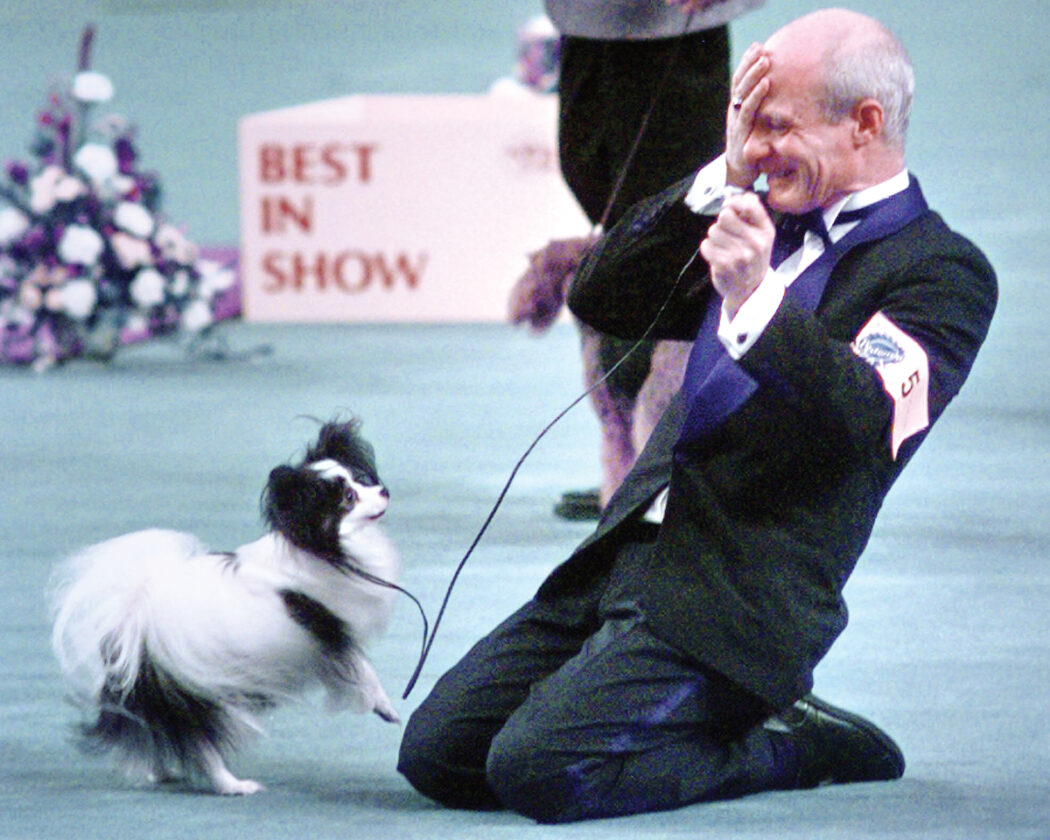
AP Kirby, a male Papillon, and his owner John Oulton react after winning best in show at the Westminster Kennel Club 1999 Dog Show at Madison Square Garden in New York on Feb. 9, 1999.
NEW YORK (AP) — When some Gilded Age gentleman hunters organized a New York event to compare their dogs, could they have imagined that people would someday call it the World Series of dogdom or the Super Bowl of dog shows?
Of course they couldn’t. The World Series and the Super Bowl didn’t exist. Nor, for that matter, did the Brooklyn Bridge or the Statue of Liberty.
But the Westminster Kennel Club’s dog show did, and still does. With the 150th annual show set to start today, here’s a then-and-now look at the United States’ most famous canine competition.
“The trappings, the window dressing, you know, changes over time. But what’s at the core, what’s the heart of it, which is the love of dogs … that has been the same,” says club President Donald Sturz.
The name comes from the Westminster Hotel, where the show’s founders liked to belly up to the bar and brag about their dogs. The hotel is long gone. The moniker stuck.
The club’s “First Annual New York Bench Show of Dogs,” in 1877, was no small thing. It featured about 1,200 dogs of a few dozen breeds, ranging from pugs to mastiffs. They included an English setter valued at $5,000, at a time when an average laborer in New York made about $1.30 a day. The Associated Press reported that “the bulldogs are represented by a number of noticeable delegates,” and a family of “Japanese spaniels” was “highly amusing.”
It wasn’t the first U.S. dog show, but it wowed and endured. Among U.S. sporting events, only the Kentucky Derby has a longer history of being held every year.
This year’s Westminster show boasts 2,500 dogs, representing as many as 212 breeds and 10 “varieties” (subsets of breeds, such as smooth vs. wirehaired dachshunds). Some likely hadn’t made it to the U.S. in 1877. Others didn’t exist yet anywhere.
But many are much the same as they were in Westminster’s early days, Sturz says. Some details — the length of muzzles, the thickness of coats — have shifted in this breed or that, and better canine nutrition may have led to “a little bit more size, or a little more bone” in some, he said.
Today, all the canines have champion rankings in a formalized sport with a complicated point system and official “standards” for judging each breed. They compete for best in show, a trophy that Westminster added in 1907. Earlier shows had no overall prize.
Hundreds of other dogs now vie for separate titles in agility and other sports, which kick off this year’s show today.
Over the years, the event drew entries from foreign royals, American tycoons and modern-day celebrities including Martha Stewart and Tim McGraw.
Westminster has carried a whiff of bygone, clubby gentility into the 21st century — handlers wear suits and dresses, upper-round judges black tie — and the competition is hardly casual. Many top contenders come in with hired professional handlers and a show record built on near-constant travel, with buzz built through dog-magazine ad campaigns.
Still, many people handle their own dogs and work or are retired from policing, medicine, the military, corporate jobs or other fields. Some of the animals also have jobs, including bomb-sniffing and search-and-rescue.
National News
Average mortgage rate ticks higher
The average long-term U.S. mortgage rate edged up for the second week in a row, but remains just above its lowest ...
Catherine O’Hara, Emmy-winning comedian, dies at 71
LOS ANGELES (AP) — Catherine O'Hara, a gifted Canadian-born comic actor and "SCTV" alum who starred as Macaulay ...
US approves major arms sales to Israel
WASHINGTON (AP) — The Trump administration has approved a massive new series of arms sales to Israel totaling ...
Westminster marks 150 years of best in show
Catherine O’Hara, Emmy-winning comedian of ‘Schitt’s Creek’ and ‘SCTV’ fame, dies at 71