
Paper crane project accompanies Tree of Life exhibit at JCC
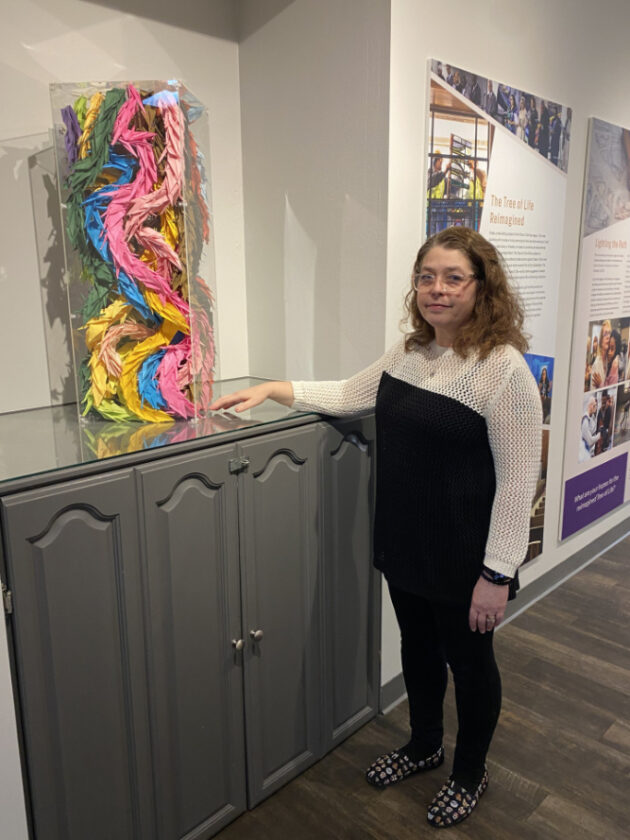
Correspondent photo / Karla Dines Barb Wilson, the Jewish Community Center of Youngstown’s Director of Cultural Arts and Jewish Engagement, explains the rationale behind the paper crane art project Thursday evening as part of the Tree of Life commemoration, while standing next to a showcase housing 1,000 paper cranes strung together.
YOUNGSTOWN — On Oct. 27, 2018, worshipers gathered at The Tree of Life Synagogue in the Squirrel Hill neighborhood of Pittsburgh.
That Sabbath morning, 11 of those worshipers were fatally shot. It was the deadliest attack on a Jewish community in the history of the United States.
A traveling exhibition was created containing artifacts and panels commemorating those who were murdered. The exhibit opened earlier this month at the Thomases Family Endowment of the Jewish Federation Art Gallery inside the Jewish Community Center on Gypsy Lane in Youngstown, and a second, related event took place Thursday.
“Anyone can stop in to see the exhibit. No guest pass is necessary,” said Barb Wilson, Director of Cultural Arts and Jewish Engagement at the JCC.
The JCC offers an open studio every Thursday from 5 to 7 p.m. Mike Hornyak, an art and shop teacher at Austintown Fitch High School, is one of the teachers who runs the class.
Thursday evening’s open studio involved a paper crane event as part of the Tree of Life commemoration. Tables were set up adjacent to the exhibit murals and artifacts relating to the people killed at Tree of Life. The event was organized by Wilson. Participants were given the opportunity to create origami paper cranes to add to the community senbazuru.
The Japanese term “senbazuru” translates to “one thousand cranes.” The Japanese have a tradition in which individuals fold 1,000 origami cranes, which is rooted in Japanese folklore, where cranes are believed to live 1,000 years. The cranes are held together by string.
Participants created origami cranes Thursday evening while reflecting on a wish of hope, peace and healing for the world today. A showcase at the JCC contains 1,000 paper cranes tied together with string. Japanese legend promises that anyone who folds 1,000 cranes will be granted a wish by the crane.
Ginger Macali of Niles came to participate in the paper crane event.
“I have seen the exhibit and wanted to come back to participate in making a paper crane,” Macali said.
Ashley Sevens of Champion also participated in the origami project. Stevens is the JCC Facilities and Operations Manager and Rentals Director.
Panels in the exhibit depict the shooting and include pictures of the 11 people murdered, as well as many photos of events following the murders — candlelight vigils, the SWAT team and bouquets of flowers. Seven people also were wounded that morning, including five members of law enforcement.
Pictures and information about a rebuilding project are part of the exhibit. The rebuilding project includes a living memorial to the lives that were lost, and includes a sanctuary, museum and a theatre.
Exhibit panels also include the history of antisemitism, which as explained in the posters, has been a persistent part of the American tradition throughout its history. The roots of antisemitism are discussed in the panels, from the 1880s to the 1920s as well as during the Great Depression, World War II and the Holocaust.
Artists worldwide sent their work to the Tree of Life in the days following the murders. The artwork is housed in Pittsburgh. People from around the world also sent senbazuru to the grieving Jewish community as an expression of deep solidarity, compassion and lasting healing. A few of the pieces of artwork from the Tree of Life collection is in showcases at the JCC exhibit.
“We hand-selected pieces of artwork from the collection based on what we wanted to show,” Wilson said.
The exhibit runs through April 9.
Local News
Property transfers
Property transfers recorded March 9-13 in Trumbull County: Bazetta Nicholas J. Kwasniewski and Deonna M. ...
Valley fire departments awarded state grants totaling $200K
Staff report The Ohio State Fire Marshal, a division of the Ohio Department of Commerce, has announced several ...
ODOT announces road adjustments in county
Staff report The Ohio Department of Transportation has announced several road closures and adjustments in Trumbull ...
League of Women Voters inducts 9 into Hall of Fame
Frenchko website seeks to ‘expose everything’
Seeking to capitalize on the reaction to nude photos she’s posted on Facebook, though nothing inappropriate is ...
Attorneys wrangle over timing of evidence in postal worker killing
WARREN — With an Aug. 17 trial set for Kaprise and Thomas Sledge in Cleveland Federal Court in the March 2, 2024, ...