
Library puts Great Railroad Strike program in the books
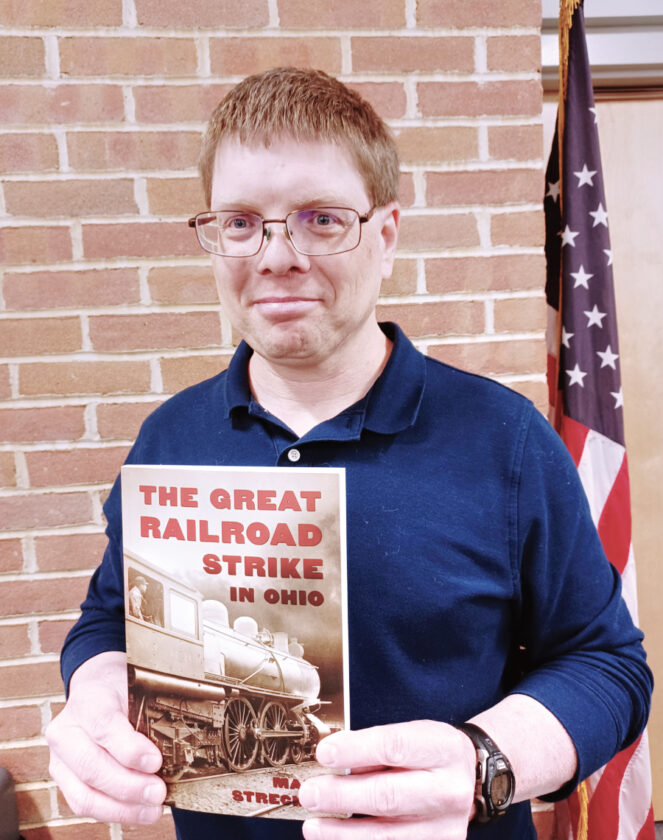
Correspondent photo / Susan Wojnar Author and historian Mark Strecker spoke on his book, “The Great Railroad Strike in Ohio” at the Brookfield branch of the Warren Trumbull County Public Library on Saturday. More than 30 people were in attendance. Strecker has penned several other historical books, including “Lost Ohio Treasures,” “Shanghaing Sailors: A Maritime History of Forced Labor,” “Americans in a Splintering Europe” and “Hidden Treasures of Northeast Ohio.”
BROOKFIELD — Author and historian Mark Strecker discussed his latest book, “The Great Railroad Strike in Ohio,” on Saturday, but what unfolded was not just a book talk, but a vivid exploration of one of the most turbulent and transformative moments in American labor history — the Great Railroad Strike of 1877 — and Ohio’s central role in it.
Strecker’s connection to the subject is both personal and professional. Born and raised in Bellevue — home to what was once one of the largest railroad yards in the country — he grew up in a railroad family, with his great-grandfather, father, and uncle all employed by the industry.
Yet, railroads did not initially capture his interest.
“I wanted to be a writer since I’d learned to read,” he said, noting that his passion for history began in elementary school. After holding a wide range of jobs — from dishwasher to graphic designer — he eventually found his way into book printing, where he still works in prepress. His path toward historical writing took shape in 2006 while pursuing a master’s degree in library science, where research training helped him transition into nonfiction.
Ironically, Strecker’s journey into the 1877 strike began with a different subject: Standard Oil. While researching the company’s rise, he encountered an 1881 Atlantic article by Henry Demarest Lloyd, who argued that Standard Oil had helped spark the strike, calling it “an American reign of terror.”
That claim led Strecker down a new path.
While Standard Oil’s role proved to be indirect — rooted in its close ties to railroads, preferential shipping rates and the perception of corporate favoritism — it revealed a broader truth: the strike was the product of multiple, overlapping forces.
Chief among those forces was the economic devastation following the Panic of 1873.
Railroad companies, including powerful lines such as the Baltimore and Ohio Railroad, responded with repeated wage cuts, sometimes exceeding 20%, while maintaining grueling and dangerous working conditions. With no strong unions to advocate for them, workers reached a breaking point.
The strike began in Martinsburg in July 1877 and spread rapidly along the nation’s network into Ohio, which was a critical transportation hub. As Strecker emphasized, Ohio’s geography and industrial strength made it especially vulnerable. When rail traffic stopped, the effects rippled outward. Freight movement halted across the state, including in the Mahoning Valley and Youngstown, where mines and mills were forced to shut down because they could no longer ship goods.
From there, the strike unfolded differently in each major Ohio city, offering what Strecker described as a kind of “spectrum of unrest.”
In Cleveland, the situation was tense but largely contained. Thousands gathered in rail yards, blocking trains and halting commerce, but despite the volatility, large-scale bloodshed was avoided. It was, in many ways, a standoff — a city on the brink that never quite tipped into full social unrest.
That contrast becomes stark when compared to Columbus. There, the situation escalated rapidly when militia troops attempted to disperse crowds and ultimately fired into them, killing several civilians.
That pivotal moment transformed protest into riot almost instantly. Rail yards were attacked, fires broke out and chaos ensued. Columbus became one of the deadliest flashpoints of the strike in Ohio, illustrating how quickly events could spiral when force was used against civilians.
If Columbus was an explosion, Cincinnati was a sustained fire. What began as a railroad strike evolved into something much broader — a citywide uprising fueled by economic frustration and social inequality. Crowds clashed with police and militia over several days, barricades went up and unrest spread beyond rail yards into neighborhoods.
While not as physically destructive as events in Pittsburgh, Cincinnati’s unrest was among the most prolonged and socially expansive in the state. It was no longer just about wages; it had become an expression of working-class anger.
Across Ohio, authorities struggled to respond. Local militias often sympathized with strikers or hesitated to act, forcing stronger intervention. Gov. Richard M. Bishop mobilized state forces, while President Rutherford B. Hayes ultimately authorized federal troops to restore order nationwide. Within weeks, the strike was suppressed, and rail service resumed — but not before exposing deep fractures in American society.
Strecker emphasized that while Standard Oil was not a direct actor in the violence, it symbolized the larger system that workers were reacting against: one of concentrated wealth, corporate influence over railroads and perceived economic injustice. For many in 1877, the strike was about far more than wages. It was about fairness in a rapidly industrializing nation.
His latest book, and the presentation that accompanied it, offers a compelling reminder that the events of 1877 were not distant or abstract. They unfolded in places like Youngstown, Cleveland, Columbus, and Cincinnati, shaping the region’s history and leaving echoes that still resonate today.
Local News
Howland crews respond to weekend house fire
HOWLAND — Township fire crews were called out Saturday evening to a house on Dawson Drive. Reports state a house ...
Easter egg hunts
TRUMBULL COUNTY Thursday: • Niles — 6 p.m., ages 1-12, Eastwood Event Centre, Niles, hosted by the Mahoning ...
On the record: Niles
WHAT: Board of Education regular meeting Tuesday PRESENT: Kimberly Barrell, Michele Lamb, Sarah Conroy, Mary Ann ...
On the record: Trumbull County
What: Commissioners regular meeting Wednesday Present: Denny Malloy, Rick Hernandez and Tony ...
Area students gain a deeper understanding of Ohio history
Traffic signal projects coming in 2027
WARREN — The Trumbull County Engineer’s Office, in cooperation with the Ohio Department of Transportation, ...