
What could we do better?
City, county officials are calling for a regional summit on juvenile crime
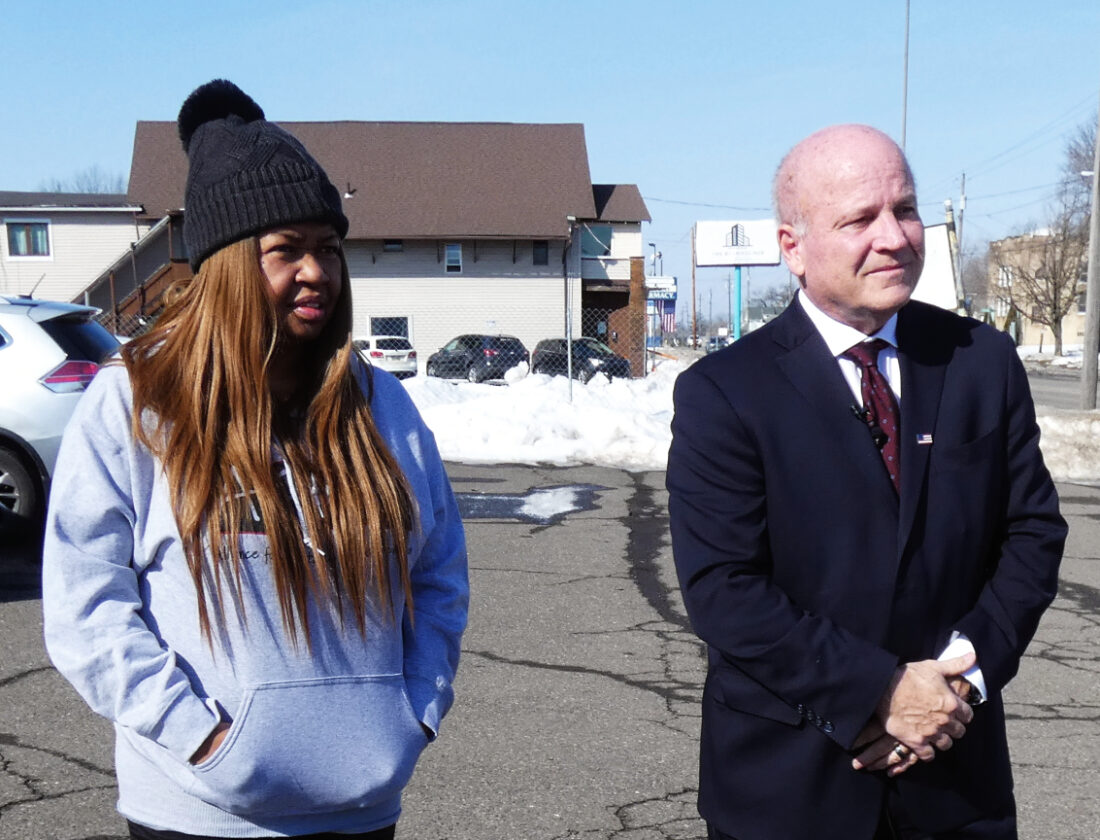
Correspondent photo / Chris McBride Warren 6th Ward Councilwoman Honeya Price, left, and Trumbull County Family Court Judge David Engler hosted a news conference Saturday at Odds in Warren, where he called for a regional summit to address youth violence, especially gun violence. The news conference came just days after a 17-year-old boy was shot to death at Packard Park apartments. Two 18-year-olds have been charged with murder in the case.
WARREN — A judge from Trumbull County’s juvenile court called Saturday for a regional summit to address rising concerns over youth violence, days after a 17-year-old was fatally shot in Warren.
The announcement came during a news conference in the parking lot of Odds, where Trumbull County Family Court Judge David Engler, joined by fellow Juvenile Division Judge Sam Bluedorn and Warren City Councilwoman Honeya Price, D-6th Ward, outlined plans for a gathering of educators, law enforcement, social service providers and community groups.
The call followed the Wednesday night shooting death of a juvenile boy on Mahoning Avenue NW, in which two adults — Ashaud Duane Lee Johnson and Willis Leroy Smith IV, both 18 — were subsequently charged in connection with the case, according to court records.
Engler described the shooting as part of a pattern of juvenile-related violence that demands proactive community response.
“We owe a duty to the community and to these young people to see what happened,” Engler said in opening remarks. “Is there something that we could do better? Is there something that could have been done differently?”
The proposed summit would convene representatives from local school districts, children services agencies, juvenile court officials, law enforcement, mental health and social service providers, and community and faith-based organizations.
The summit’s first steps include data collection on recidivism and assessments, followed by a smaller planning committee of stakeholders.
Organizers estimate 60 to 90 days to convene, with sessions potentially at Warren G. Harding High School’s stadium. Engler said he envisions educational breakouts on topics like school obligations, Child Protective Services case management and a proposed assessment center for triage-like evaluations.
By summer’s end, Engler said, the group aims for a “complete Community Action Plan,” potentially including better disability screenings in schools and integrated services under one roof. He drew parallels to past preventive measures, like reshaping a steep hill after a fatal juvenile car accident.
No date has been set for the summit, but Engler pledged updates as planning advances.
Engler and Bluedorn shared recent changes in court practices, including mandatory assessments for juveniles charged with serious offenses.
These evaluations screen for underlying issues like family dysfunction, mental health challenges, physical health problems or educational barriers.
“The idea is that we do not want to have someone put into the criminal justice system at a young age,” Engler said. “What we want to happen is take a look at that person and see if there is a reason that this conduct happened.”
He stressed the need for interventions starting as early as ages 11 to 13, when impacts are most effective, rather than waiting until 16 or 17. Schools play a central role, Engler noted, citing federal obligations under the Individuals with Disabilities Education Act to determine if disciplinary issues stem from disabilities.
Price echoed the call for collaboration. “We’ve been trying to look for a solution” for two years, she said, referencing her own experiences with gun violence on both sides of her family — a relative who stole a gun in eighth grade and another who was shot. She described ongoing initiatives, including no-school-day basketball tournaments in partnership with groups like Community Connection and expressed frustration over stagnant efforts to bring a change.
“I’m angry at the gun violence,” Price said. “An epidemic of gun violence right here, where our kids are selling guns as early as eighth grade.”
The conference drew input from residents, including Danielle Burns, a Warren mother who detailed challenges accessing timely services despite utilizing OhioRISE, a state-funded program for youth with complex behavioral needs, and Valley Counseling. Burns advocated for stricter curfew enforcement and expanded funding for the county’s Juvenile Justice Center, or JJC, to allow police greater authority in handling at-risk youth.
“My child hasn’t destroyed the house, my child hasn’t hurt somebody else, but my child’s having a problem,” Burns said. “When I call the police, they’re not allowed to do their job.”
Bluedorn talked about their data-driven approaches, including tracking recidivism rates for court programs like the Juvenile Alternative Detention Initiative Court, which receives funding from Ohio’s Division of Youth Services. He described “high-fidelity wraparound” services encompassing families and warned against incarceration’s long-term harms, such as trauma-induced developmental delays.
“When you get a child behind bars, you create trauma,” Bluedorn said. “Trauma creates developmental brain delays and all kinds of issues that affect the child later on in life.”
Post-conference interviews revealed broader community efforts.
Tony Johnson of Community Connection described peer-to-peer events for 80 youths aged 10 to 18, focusing on topics like suicide prevention and healthy dating, set today at Shalom Church of God in Christ.
Satora Johnson, a nurse practitioner on St. Elizabeth Hospital’s trauma team and a Community Connection member, spoke about the emotional toll of treating gunshot victims.
“It’s very, very personal when I see a young individual suffering from gunshot wounds,” she said. “Children don’t have things to do outside of social media, getting involved, just having too much time on their hands.”
Price outlined plans for a youth reentry program post-JJC, peer support for affected families and an initiative that provides stipends, financial literacy and mental health training to at-risk youth in her ward.
Chuck Parks, a county maintenance worker with 25 years of police experience, pointed to social media’s role in normalizing violence through music and reels, urging more activities like sports or art.
Engler attributed much of the violence to “chaotic home environments” and broken family systems, where children often fend for themselves. He cited a Penn State study linking childhood exposure to violence with lifelong health issues like elevated cortisol levels leading to diabetes or heart disease.
Local News
On the record
Maplewood WHAT: Board of education meeting Wednesday PRESENT: Kevin Blair, Dan Denman, Tori Wiltrout, Tom ...
Black History Month events in Mahoning Valley
February is Black History Month, and events and programs are scheduled throughout the Mahoning Valley. • Today ...
W.Va. Senate passes bill banning media monitoring services
African American Achievers to enter hall of fame
WARREN — As part of Black History Month, the Trumbull County African Americans Achievers Association will induct ...
Love on four feet
Warren Civic Music Association has place in history
EDITOR’S NOTE: This is part of a weekly series on our region’s history coordinated by the Trumbull County ...