
Pot tax funds finally reach communities
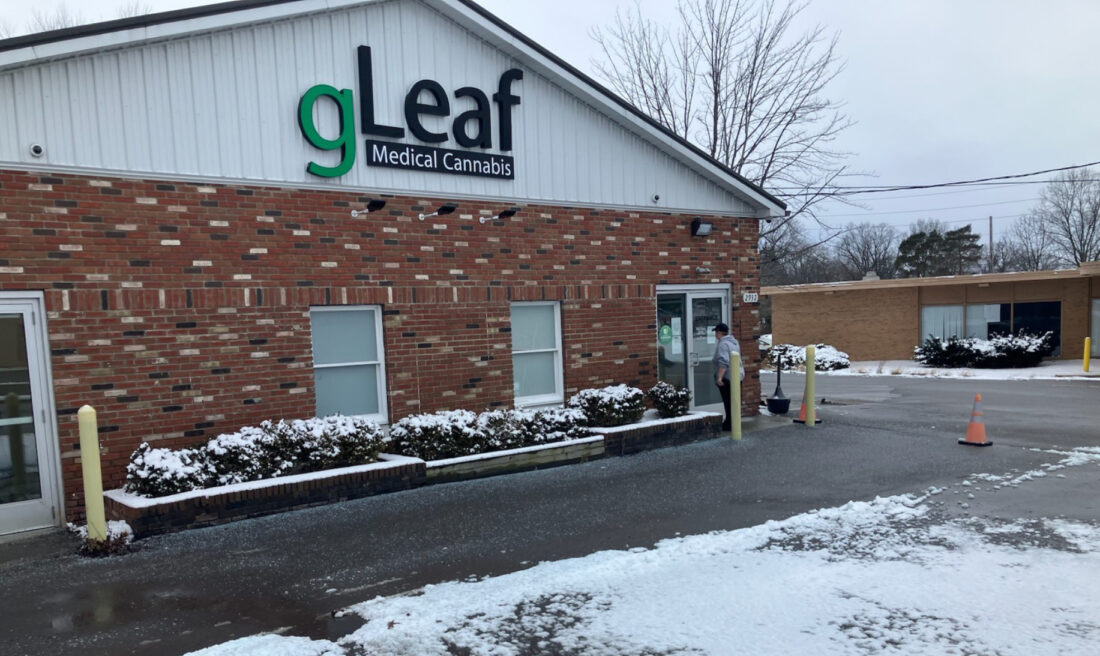
Staff photo / Richard Logan The gLeaf cannabis dispensary along Youngstown Warren Road in Warren. Ohio communities that are home to recreational marijuana dispensaries are finally receiving their share of sales tax collected since September 2024.
After a lengthy dispute with state officials, local communities that house recreational marijuana dispensaries finally are receiving their share of sales tax collected since September 2024.
The state began distributing the money Jan. 7 to the communities for the collection period between September 2024 and November 2025, said Pete LuPiba, spokesman for the Ohio Office of Budget and Management.
When a statewide initiative to legalize recreational marijuana was approved by Ohio voters in November 2023, the ballot language called for communities that have dispensaries to receive 36% of the sales tax revenue. But because it was a ballot initiative and not a constitutional amendment, the state Legislature was able to do what it wanted with the sales tax revenue.
Gov. Mike DeWine, a Republican, on Dec. 19 signed a bill into law that pays the 36% to host communities.
It also made changes to the initiative approved by voters. That includes making it illegal to bring legally purchased marijuana from another state into Ohio, reducing the maximum THC levels in marijuana extracts from 90% to 70% and prohibiting possession in anything besides its original packaging.
That revenue has been sitting in a state fund.
The tax took effect in August 2024 on sales occurring during that month, but because the tax is paid by dispensaries to the state during the month immediately following the sales month, the first tax payments were received in September 2024, LuPiba said.
There was $33.2 million in the fund that was distributed to more than 100 communities across the state housing dispensaries. Columbus received the single largest cannabis tax revenue disbursement this month of more than $4.24 million.
DeWine had pushed for the state to keep the funding. But the state Legislature, which is controlled by Republicans, approved legislation to give it to the host communities at the 36% level.
Because the money has been held for more than a year by the state, the initial payment to the local communities was for 15 months.
Beginning later this month, a regular monthly payment schedule will start, LuPiba said.
“Each month, the host communities will receive their appropriate share of the tax receipts collected by the state during the previous month,” he said.
WARREN
The city of Warren received $334,893 in initial allocations of tax revenue from recreational marijuana sales, which was the highest among the six cities in Mahoning and Trumbull counties. That figure covers sales through November 2025.
No immediate proposals for spending were detailed by Warren City Council during its Wednesday meeting.
Warren’s entry into the cannabis market began with the opening of Green Leaf (also known as gLeaf) on Youngstown Warren Road in April 2019, initially serving medical cannabis patients. The city’s second dispensary, Beyond Hello on Elm Road, arrived in March 2025. Recreational sales kicked off in August 2024 at these dispensaries, paving the way for new tax revenues.
City council opted to create a dedicated general ledger (GL) line item to track the revenue separately within the budget, even as it flows into the general fund.
City Auditor Vincent Flask outlined the reasoning behind this approach.
Flask elaborated on the tracking benefits, saying it would allow year-over-year comparisons to see how much revenue is generated.
Flask said that unlike opioid settlement funds, which come with specific restrictions, these marijuana tax dollars have no mandated uses under state law.
NILES
Niles Auditor Giovanne Merlo said at last week’s city council meeting that the city received its first distribution of the cannabis tax.
The city received $167,520 for its first distribution — $61,010 and $64,696 in its first two quarters and $19,781 and $22,032 for October and November 2025.
The city has one dispensary, AYR Wellness, which opened in February on Youngstown Warren Road.
“At that pace, we’ll see what happens; as you know, more and more locations are opening across the Valley, so we just don’t know how it’ll affect us,” Merlo said. “But right now, $20,000 per month should be coming back to the city, based on these numbers.”
Councilman Aaron Johnstone, D-2nd Ward, thanked council and the public for not letting the tax money issue go away, noting the persistence of making sure elected officials are held to their word paid off.
“I know council, last year, we did a project that was originally slated for that money, so I want to remind council that we still owe the general fund for that project,” Johnstone said. “I’d like to pay the general fund back — that was our original planning, that was our original budgeting.”
Niles Mayor Steven Mientkiewicz said the city recognized a “long-term revenue stream” in permitting a dispensary to open, noting that the funding will offset taxpayer dollars to support police and fire resources, and other quality of life enhancements.
“I commend our local state representatives for listening to the concerns that we passed along when we were at risk of being cut or losing host community cannabis funds,” Mientkiewicz said. “We are now actually seeing dollars come in and will monitor the financial trends.”
“I believe Council passed responsible legislation to not oversaturate the city and allow for cannabis funding to materialize.”
HUBBARD
Hubbard residents voted to support recreational marijuana in the city, with only 34% opposing the issue — allowing A Cut Above dispensary, its lone medical marijuana facility, to broaden itself.
The city received $65,278 for its first payment, with a majority of it coming from the 2025 fiscal year’s fourth quarter, and the 2026 fiscal year’s first quarter — $16,410 and $18,595, respectively.
The individual quarters encompassed April to June 2025 and July to September 2025.
Acting Mayor Michael Mogg said Friday that he’s spoken with city Auditor Michael Villano, who confirmed that the city has received its first deposit.
“Right now, it’s just going into the general fund, to help with operating costs and everything,” Mogg said.
Mogg said officials “really had to thank” the residents for having recreational marijuana to begin with, because they had the vote and it passed by a 2-1 margin.
Mogg confirmed that each of the city’s committees will discuss spending plans for the money, noting that he plans to bring the money up at Tuesday’s city council meeting — and things will proceed from there.
“You really can’t start to spend money when you don’t know what you’re getting,” Mogg said.
GIRARD
With Curealeaf just opening in September, Girard officials said they did not see as much money this round from the marijuana dispensaries as other communities like Niles and Struthers where the dispensaries have been open much longer. Girard received $10,451.23.
Safety Service Director Mark Ragozine said he, Mayor Mark Zuppo and other officials have had initial talks and discussed where the money will be used, but no official plan has been finalized.
“We have discussed having a special fund set up for the monies we receive. Right now we may use the money where it is most needed. The facility in Girard is new, and what I have been told (is) doing well (with customers),” Ragozine said.
“If we need money for street paving or road improvements, we can check there for the funds. If we need something for recreation, we can check there. We can have funds available to help us whatever the need may be. We can also look at downtown revitalization,” Ragozine said.
He said officials are planning to keep the money flexible.
“We will see where the most need is and where the biggest impact from using the money can be. Keeping the money flexible is best right now,” Ragozine said.
Ragozine said as the fund builds over time, he and Zuppo will work with city council, and Zuppo said he, Ragozine and Coggins have talked about setting up some sort of capital and special projects fund with the money the city receives.
“We don’t have a whole lot of it in our corner yet, but it’s starting to flow, so that’s a good thing,” he said.
Zuppo said the idea was presented that each year council would pick a project to hone in on and use the marijuana funds either for seed money or to fulfill an entire project, depending upon the cost.
YOUNGSTOWN
Youngstown received $291,151 for the period between September 2024 and last November.
The city has one marijuana dispensary — Leaf Relief, 4323 Market St. — which expanded to selling recreational marijuana after it became legal in the state. Before that, it sold only medical marijuana.
Youngstown Finance Director Kyle Miasek said his department is working on the city’s 2026 budget, and the marijuana tax collections will be included.
“This is money that we will end up budgeting on a calendar year,” Miasek said. “It will be larger in the first year because it will be retroactive. It will be identified as a new revenue source for the first year and then revert back to a normal cycle.”
He added: “When we receive it, it will be part of our operating budget. It will be deposited into the general fund just as we do with the casino tax.”
The city received $1,648,744 last year in casino tax revenue and $1,615,699 in 2024.
City council on June 20, 2024, passed a moratorium on the expansion of marijuana dispensaries beyond Leaf Relief. Youngstown’s moratorium ends May 1.
The language in the statewide issue to legalize adult recreational marijuana included a provision allowing communities to prohibit the location of businesses that sell it. If that were to happen, the owner or operator of a dispensary could attempt to place the matter on the ballot for voters in that community to decide through a petition initiative.
That occurred in November 2024 in Hubbard where voters overturned city council’s ban on recreational marijuana.
STRUTHERS
In Struthers, Mayor Catherine Cercone-Miller said the city’s $307,837 deposit is the culmination of years of work, driven by collaboration.
“Just from the beginning, Green Leaf has been such a good partner, and we cannot be more thankful for the relationship with them, and our city council has been on the same page with administration from the beginning, since before the licensure,” she said. “The outcome we’ve had, that was the main reason why we wanted to be ahead of the curve when it came to having one of the first dispensaries in the area. To see it finally get deposited is huge because that’s what we’ve spent the last few years working toward.”
She said Green Leaf’s professionalism and care for the community brings customers from all over the Mahoning Valley, who prefer it to dispensaries closer to their homes.
One resident, she said, lives with chronic pain. When he struggled to remove the staples from the bag containing his order, Cercone-Miller said Green Leaf made special accommodations to ensure the problem didn’t happen again. She said that kind of treatment is what everyone has come to expect, which may be why the city has not received even a fraction of the pushback it had expected.
Cercone-Miller said the city has not determined exactly how the money will be spent.
“Because everything was in limbo, it’s going into our general fund, but we have to discuss it with our city council, to see if there are projects we can pursue or issues in the city we can solve with that money,” she said.
The total deposit represents revenue from Green Leaf for more than 16 months, and future annual deposits will be less, but Cercone-Miller said the revenue means a great deal to a city like hers.
What means perhaps just as much, is the effort of local officials to pressure Columbus into leaving the local government share of the marijuana tax alone, and one leader comes readily to her mind.
“I want to give a shout out to (Austintown trustee) Rob Santos who took the lead in challenging them on the issues we were all having, and if he didn’t do that, the city would have lost so much money,” she said. “He was a great partner to have, to make sure we got what we were owed.”
Local News

Among the stacks

Library reports most popular of 2025
Niles enters natural gas aggregation program
NILES — The city has entered an agreement with Eastern Power and Gas LLC to provide a natural gas aggregation ...
Hubbard hears gas aggregate pitch from former provider to Trumbull
HUBBARD TOWNSHIP — While the county voted to go in a different direction with its gas aggregation program this ...

Snapshot of Ohio’s landscapes
