
Man goes from homelessness to helping
VA Peer Support Program builds recovery through shared experience
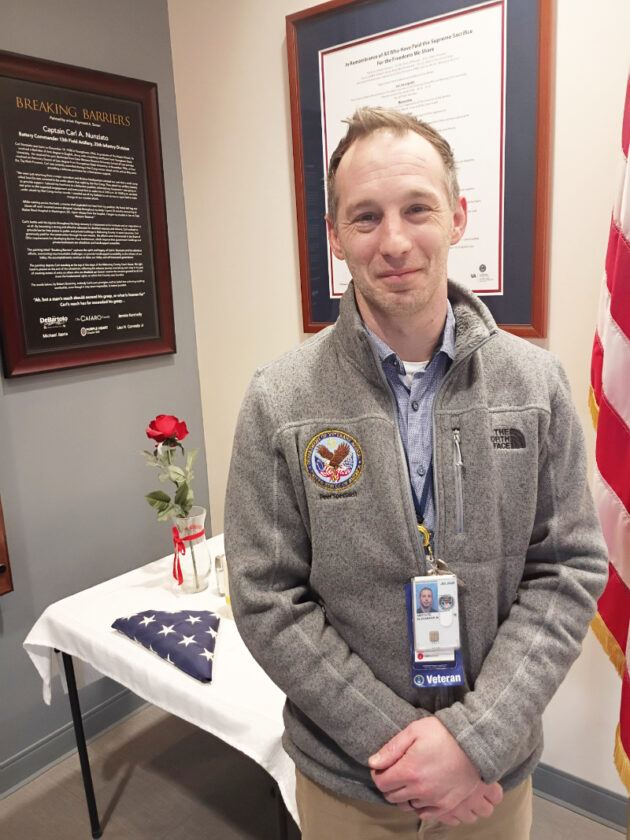
Correspondent photo / Susan Wojnar Alexander Amstutz of Cortland, a peer support specialist at the Carl Nunziato VA Clinic in Youngstown, stands by the Missing Man Table and the American flag.
For many veterans, recovery from mental health challenges, substance use, trauma or major life transitions does not begin with a diagnosis. It begins with connection.
At the VA Northeast Ohio Healthcare System (VANEOHS), that connection is often made through peer support specialists — veterans who draw on their own lived experience to help fellow veterans find hope, purpose and a path forward.
“Peer support is about walking alongside veterans,” said Catherine Golden, psychology program manager for Peer Support Services and local recovery coordinator with the U.S. Department of Veterans Affairs. “It’s not about labels or diagnoses. It’s about helping veterans identify what they want their lives to look like and supporting them as they work toward that.”
The VA Northeast Ohio Healthcare System, which includes the Carl Nunziato VA Clinic in Youngstown, employs 21 peer support specialists. All are veterans in long-term recovery. Seventeen work within psychology services, while others work in programs such as Veterans Justice Outreach and Mental Health Intensive Case Management.
Peer specialists are integrated throughout the VA system, working in outpatient mental health clinics — now known as Behavioral Health Interdisciplinary Programs (BHIP) — as well as substance use disorder treatment, intensive outpatient services, residential programs, trauma-focused clinics, vocational rehabilitation, wellness programs and medical clinics.
“This integration allows peers to meet veterans where they are,” Golden said. “Whether a veteran is seeking help for mental health, addiction recovery, trauma or medical challenges, peer support is available.”
PROGRAM HAS DEEP ROOTS
Peer support has long been part of VA care. VANEOHS hired its first “peer counselor” in 1995, well before peer support was widely recognized as a profession. In 2010, the system formally established a Peer Support Services section, solidifying the role of peers as a vital component of veteran care.
“All of our peer support staff are veterans,” Golden said. “They bring professional training, but also lived experience with mental health, substance use, medical or disability challenges. That shared experience builds trust in a way traditional services alone often cannot.”
Peer specialists work in a variety of settings, making precise numbers difficult to track. Some work intensively with smaller groups, while others connect with hundreds of veterans each month in outpatient clinics.
In the past year alone, peer support staff at VANEOHS served more than 3,000 veterans, reflecting both the reach of the program and the growing demand for recovery-oriented support.
FOCUS ON RECOVERY
What sets peer support apart is its emphasis on recovery rather than a purely medical model. Peer specialists are trained to share their experiences ethically and intentionally to foster hope, motivation and self-advocacy.
“They serve as advocates within the treatment team,” Golden said. “Just as importantly, they teach veterans how to advocate for themselves.”
Peer support is especially effective for veterans who feel hesitant about treatment. By addressing stigma — both societal and internal — peer specialists help veterans overcome barriers that might otherwise keep them from seeking help.
Trauma remains one of the most common challenges among veterans served in the region, along with substance use and relapse prevention. VANEOHS also serves a growing population of aging veterans with increasing needs related to grief, mobility and disability.
At the same time, more women veterans are enrolling in VA care. The system now employs three women peer specialists, including one assigned full-time to the Women’s Clinic.
“There has also been a significant increase in isolation since the pandemic,” Golden said. “Peer support focuses heavily on helping veterans reconnect — with family, community and meaningful activities that reduce loneliness.”
Success in peer support is not measured by standardized outcomes alone. Instead, veterans define their own goals.
“For one veteran, success might mean attending an outdoor concert again after years of PTSD-related avoidance,” Golden said. “For another, it might mean spending more time with their children. Recovery looks different for everyone.”
Funded entirely through the VA budget, peer support specialists are full-time federal employees. Still, Golden emphasized the importance of community partnerships.
“Recovery doesn’t happen in isolation,” she said. “It happens through connection.”
CORTLAND MAN’S JOURNEY
A powerful example of peer support in action can be found in Alexander Amstutz of Cortland, a peer support specialist at the Carl Nunziato VA Clinic in Youngstown.
Amstutz’s journey to helping others has been shaped by both hardship and resilience. Today, he uses his lived experience as a veteran in recovery to guide fellow veterans through some of the most difficult chapters of their lives.
Amstutz served in the U.S. Air Force with the Ohio Air National Guard from 2006 to 2012, working on C-130H aircraft with the 179th Airlift Wing in Mansfield. In 2009, he deployed to Afghanistan in support of Operation Enduring Freedom.
Returning home proved far more challenging than expected.
“After deployment, I had a tough time readjusting to school, work and social life,” Amstutz said. “I turned to drugs and alcohol to cope.”
His struggles escalated, culminating in a suicide attempt in December 2010. He was admitted to the Brecksville VA Hospital for mental health and substance use treatment and was homeless at the time.
Over the next seven months, Amstutz transitioned through inpatient psychiatric care, the Veterans Addiction Rehabilitation Center and the VA domiciliary program. With continued case management, health care and housing support through HUD-VASH, he was able to rebuild his life.
“I felt I went through all of that for a reason,” he said. “That’s what motivated me to help other veterans.”
Amstutz began his peer support journey through training with the Ohio Empowerment Coalition and Ohio Mental Health and Addiction Services. After volunteering with the VA for three years beginning in 2012, he was hired in 2015 as a peer support apprentice.
Today, he works primarily with veterans facing substance use disorders, offering both one-on-one and group support. Initial sessions focus on building rapport and identifying goals, while ongoing sessions provide encouragement, accountability and progress toward recovery.
Group sessions may follow structured, evidence-based programs such as Wellness Recovery Action Plan (WRAP), My Recovery Plan or Honoring Our PACT, while others offer open discussion and shared connection.
“The challenges veterans bring are wide-ranging,” Amstutz said. “One of the biggest is a loss of purpose.”
For many veterans, the sense of mission felt during military service fades after discharge, creating a void that can affect veterans of all ages.
One moment stands out for Amstutz. While discussing loneliness with a veteran who loved animals, he suggested adopting a pet. Later, the veteran experienced another major loss and contemplated suicide.
“He told me he was about to take all his medication, but his pet was sitting next to the pill bottle,” Amstutz said. “He didn’t want to abandon it. That pet saved his life.”
Amstutz stresses the importance of boundaries and safety. When veterans express crisis or suicidal thoughts, peer specialists follow established protocols and connect veterans to licensed providers and immediate resources, including the Veterans Crisis Line by dialing 988 and pressing 1.
He also helps veterans explore recovery beyond the VA, connecting them with community resources such as NAMI, county mental health boards, recovery programs, Team RWB, Team Rubicon and others, with many available virtually.
“The VA does an incredible job reducing barriers,” Amstutz said. “Peer support helps veterans navigate the system and believe recovery is possible.”
The most rewarding part of his work, he said, is simple: “Hearing a veteran say that my story helped them.”
As for public perceptions of veteran mental health, Amstutz hopes to change them.
“It’s not taboo,” he said. “We can talk about it. We’re just people.”
His message to struggling veterans is clear and urgent: “Get help. Don’t wait.”
And for the community, he added, continued conversation and understanding can make all the difference — for veterans and civilians alike.
Local News

Mahoning Valley digs out
Young artists in spotlight at YSU
YOUNGSTOWN — Student artists from across the Mahoning Valley took center stage Saturday as the Regional ...
Man goes from homelessness to helping
Six sentenced in separate cases
WARREN — Six people were sentenced this week to a total of nearly 25 years in prison for various convictions, ...
Teams come together in Academic Prep Bowl
Our Heritage: Braceville marks patriotic past as America’s 250th approaches
EDITOR’S NOTE: This is part of a weekly series on our region’s history coordinated by the Trumbull County ...