
COG hears from energy council rep
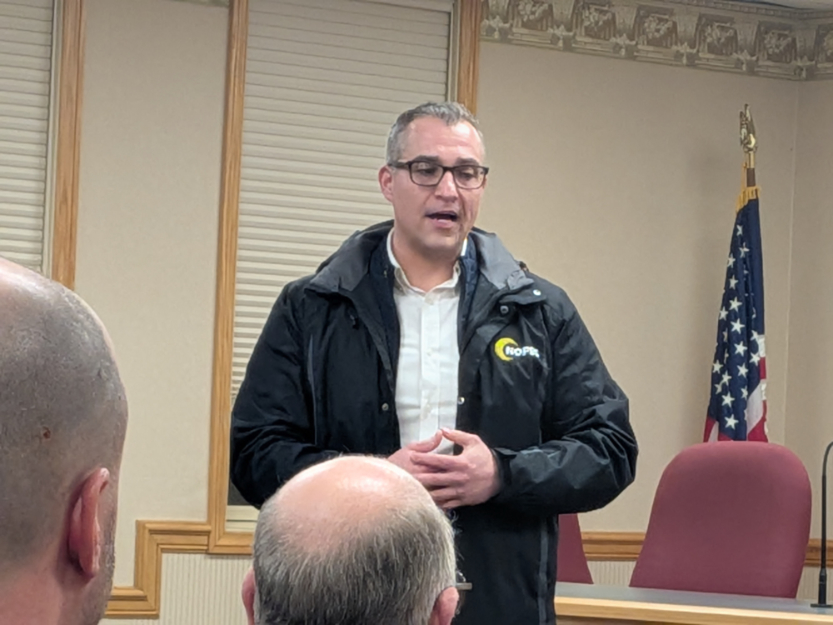
Staff photo / Brandon Cantwell Ross McDonald, director of community expansion for NOPEC, gives a presentation Thursday to officials from the Trumbull County Council of Governments on energy costs.
HOWLAND — Energy was the evening’s main focus, as the Trumbull County Council of Governments met Thursday for the first time this year.
While the council could not vote on anything, such as officers, because not enough representatives were present to have a quorum, officials listened to a presentation from Ross McDonald, director of community expansion for the Northeast Ohio Public Energy Council, the largest nonprofit governmental energy aggregator in the state.
McDonald said he understands that energy has been a topic of discussion in the area, referring to reports that commissioners approved moving the county’s electric aggregation and gas facilities plan to Palmer Energy Company in a 2-1 vote several weeks ago. Commissioner Rick Hernandez cast the no vote, wanting other companies to submit bids.
He said NOPEC has “long coveted” an opportunity to be considered for a countywide program. McDonald said his company does not have Lordstown, but noted Liberty and McDonald are NOPEC members, too, after naming Howland, Champion and Brookfield as some of the townships that put joining NOPEC to a ballot vote.
McDonald recalled a time in 2008 when a countywide vote was presented to township voters.
“Countywide, it passed; however, in certain townships, it actually did not pass at the local level,” he said. “I had a meeting with Farmington on Friday (Jan. 16) and that’s a case where they got grouped in because it passed when you poured in all those votes at the top — it passed as a countywide measure, but locally it was kind of hit and miss.”
McDonald said more than half of their 250 member groups are townships, covering all of the ones in Lake, Ashtabula and Geauga counties and nearly all of Portage County.
McDonald said NOPEC provides annual grants directly back to townships.
“To understand what that number might be for you, it’s $5 for every household who’s enrolled in the program, so that gives you a sense of how much in annual grant projects you’re talking about,” McDonald said. “That grant money does have restrictions, but they’re sort of loose. They’re to be used for building upgrades that create energy savings.”
McDonald said such funds could be used for leaky windows, damaged roofs or improving HVAC systems.
McDonald said he spoke with Farmington Fiscal Officer Angelo Bizzarro, who said the township was “really close” to passing its fire levy, which was defeated by a single vote.
“NOPEC became really attractive as a concept to help with some of the cost of their new fire department,” McDonald said. “I explained how NOPEC could help with that sort of capital stack in creating this new awesome fire department.”
With how things were timed, McDonald said Farmington would have to place the matter on the ballot alone, but ultimately recommended against it because it would add an extra decision, with respect to approving opt-out aggregation.
McDonald said if other townships wanted to join NOPEC, they could do so “seamlessly”, having to issue a notice to the county informing them of plans to not reenroll with the countywide aggregation.
Vienna Trustee Phil Pegg said townships already have received pricing for the county’s natural gas program, but McDonald admitted that NOPEC would “probably” be in the strongest pursuit of the electric program.
He added that they already know their price, 8.99 cents per kilowatt for the first three months.
“We’re going to go through a new anniversary term, so we don’t know in June what our pricing would be, but all of you are on a May term if you’re in the county program,” McDonald said. “We would hold that $8.99 price through the anniversary so that it didn’t feel like you were being, you know, given a price and then the month later in June when we set the new aggregation, here’s a brand new price.”
McDonald said residents also would have the freedom to choose how long their contracts with the company would be, explaining that they have 12 to 24-month products.
He said NOPEC was “pretty conservative” with how they pursued business, but they also felt there wasn’t a chance to be evaluated, resulting in them approaching townships independently.
“We sought a chance to be considered for the countywide program — for whatever reason that didn’t happen. I respect the authority and decision-making of commissioners, that’s their approval, that’s their purview,” McDonald said. “We also, as a company, are permitted to attend meetings and have discussions about what could be an equally good option or a better option for townships.”
Hubbard Trustee Eric Lamb recalled speaking to Commissioner Denny Malloy, who said that if the township wanted to go into its own aggregate, trustees had to put it on a ballot and let residents vote on it.
He said he also spoke with Howland Administrator James Pantalone, who said the ruling goes back to the 2008 election, submitting it to the Public Utilities Commission of Ohio, who would then validate whether the population voted positively.
“Doing a precinct analysis within the township, totaling up the votes, and if it passed, then that is as good as the gospel with the PUCO, is the legal analysis,” McDonald said.
McDonald said NOPEC has analyzed the topic, explaining that when voters cast their ballots in 2008, the ballot language said “shall the county be authorized to aggregate the retail loads of electric or, in the other case, natural gas.”
“When you propose it at the township level, what do you think it says? ‘Shall the township be authorized?’ When you go down that line of thought,” McDonald said. “In the case of those voters, they would authorize the commissioners in the case of ’08, but perhaps they would not have authorized their township trustees.”
McDonald said NOPEC’s guidance has been getting it passed at the ballot box first and creating a program with a broker or with their group afterward.
McDonald said aggregations were separate, and townships would have to pass gas and electricity aggregates separately on the ballot.
He said there were no fees to residents who wished to switch to a new company.
“You could be in a 12-month fixed rate in a contract with us, and in month seven, you think you find a better product in the retail market, you can abandon the duration of that fixed term and receive no penalty, no termination fee, no hard feelings even,” McDonald said.
Local News
Community Star nominations sought
WARREN — The Tribune Chronicle is seeking nominations for its 24th annual Community Stars program, which ...
COG hears from energy council rep
Warren blessing of the waters rescheduled
WARREN — The annual Blessing of the Waters by members of Warren area Orthodox churches has been rescheduled ...

Nonprofit strives to help immigrants thrive in the Valley
Youngstown man indicted on drug, tampering charges
WARREN — A Youngstown man was among more than four dozen people indicted Thursday by a Trumbull County grand ...
Harlem Globetrotters postpones Sunday show at Covelli Centre
YOUNGSTOWN — Sunday’s Harlem Globetrotters game at the Covelli Centre has been postponed because of heavy ...