
Warren man was among first deployed to Vietnam
EDITOR’S NOTE: This is part of a series highlighting local veterans that runs every Monday through Veterans Day. To suggest a veteran, call Metro Editor Marly Reichert at 330-841-1737 or email her at mreichert@tribtoday.com.
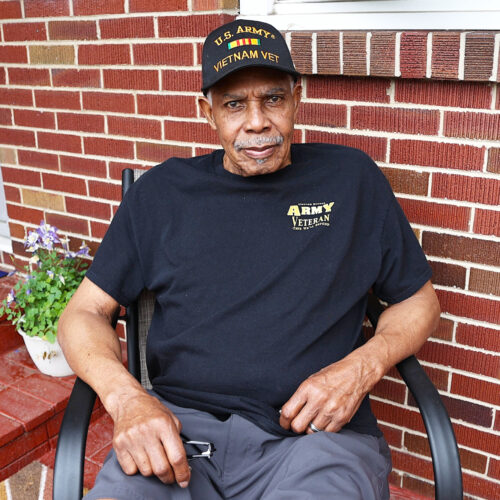
Correspondent photo / John Patrick Gatta
Walter T. Toles, 85, of Warren, talks about his time in Vietnam with the Army. After his discharge, he spent 40 years working at Denman Tire in Leavittsburg and he said he is now fighting mesothelioma from the asbestos he was exposed to at the factory.
“I didn’t stay in Vietnam that long. I was there for about three months, but I was the first 1,100 to go. When they sent the first full division, 20, 000 of us left,” Toles said.
He recalled what he went through when the 1st Cavalry Division left from Fort Benning, Georgia.
“The gyms were huge, and you took shots in both arms. You did pushups to get the soreness out when you went back to the base. Then, they started loading buses. First night, I saw 52 buses. The next night was 104. I was on one. They were sending us all over, wherever ships or planes took off.”
Initially, he flew for five days on a C-130 military transport plane, the same class of aircraft that’s been at the Youngstown Air Reserve Station (YARS) for more than 40 years.
Eventually, the troops arrived in Okinawa, Japan — 1,500 miles from Vietnam. After another flight to Cam Ranh Bay, he got on another C-130 to his destination in the central highlands of An Khe.
“The runway was 300 yards. It was built by the French. They landed a C-130 on that. That thing dropped down out of the mountains and hit the brakes immediately,” Toles said.
His immediate reaction to his new surroundings concerned the climate and native species.
“They shut the base down at Fort Benning at 95 degrees because it’s too hot. We go to Vietnam. It’s 118, 120 degrees. All that can wipe you out the first day or two. You had to let your body get adjusted. It was an experience. You got mosquitoes, ants about an inch long. Everything’s huge. Ant hills were about three feet high,” he said.
Immediately, he and others in the 1st Cavalry went to work transforming the jungle into a military base. Toles’ job, as a pole lineman, focused on communications and installing telephone lines and cable.
“We started setting up the base; what we call ‘the golf course.’ It was six miles in circumference.”
Cutting down bamboo then digging a hole in order to install a transmission pole, followed by wiring, took much longer than the military expected. In a decision that still amuses Toles to this day for its foolishness, he explained what happened.
“They hired about 4,000 Vietnamese to help clean it up the next day. About a thousand ‘black pajamas’ (slang for Viet Cong fighters) in that crowd infiltrated, and they marked the areas. So, at night you get hit all around that area. Every night, they would wake you up,” Toles said.
He said that his tasks didn’t end when the sun went down.
“You worked all day; you pulled guard (duty) at night. That was before the division got there. So, you had to go out on the perimeter. Talk about scary. You hear noises. You hear a little bit of everything on (nearby) Hong Kong Mountain, which was behind us, and the VC could climb that probably three, four hours. It would take us at least six hours because we were bigger and every tree had thorns.
Even with the other soldiers in the 1st Cavalry working alongside him, it was still treacherous. “Somebody would be trying to lay wire, and somebody had to have a weapon to watch out. When we got there, we had live ammo. Then, when the rest of the division came in, we couldn’t lock and load unless you were on a mission or something like that. We weren’t allowed in order to protect the civilians. They were moving in right up against the fence. It was quite an ordeal,” Toles said. “One night, the 101st (Airborne Division) came in to secure the area and then 14 got killed at night. You see the bodies. I’ve never seen anything like this. You’re dumbfounded.”
Prior to his Vietnam experience, Toles left his hometown of Braceville to attend The Ohio State University, where his freshman class included future basketball stars Jerry Lucas and John Havlicek, golf legend Jack Nicklaus and College Football Hall of Famer Bob Ferguson.
Homesick, Toles felt college wasn’t for him. When he was drafted in November of 1962, physical illness fatefully influenced his military career.
“I was drafted. I got so sick that day and showed up a day late. That cost me. I had that extra year to do and that caused me to go to Vietnam,” Toles said.
While stationed at Fort Gordon, the U.S. Army taught him what was needed for its communications as part of Signal Corps. He also learned, firsthand, the racial division of the Deep South.
“Every time we’d go into town, we’d get arrested for trying to integrate at a restaurant. We weren’t trying to integrate, but the police picked you up. Some white guys had never been around black people and thought less of you and called you names. If you had a white buddy, he was a ‘lover.’ You know what I’m saying? Because he was with you. We had a lot of that,” Toles said.
He recalled while at Fort Benning, he and two other soldiers visited a nearby town where they saw an old couple and a young girl being harassed by young white youths. Because of the respect given to the Army uniforms, they were able to walk the three to their home.
When he returned from Vietnam, he discovered that his uniform also could provoke a negative reaction.
“Since I went to Ohio State, I wanted to see USC and UCLA. So, like dummies, we had on our uniforms and went there. We didn’t know they were protesting. They jumped all over us. They called us all kinds of names. Like, we had a choice. We didn’t have a choice. We were told where to go. We were in the service. They said, ‘You’re going to Vietnam.'”
A destructive fire at the family home necessitated his eventual move to Warren. Having defeated cancer because of the military’s use of Agent Orange in Vietnam, Toles is now fighting another health battle with mesothelioma as a result of being exposed to asbestos during the manufacturing process at the now-closed Denman Tire in Leavittsburg.
Although Toles did not re-enlist after his time in Vietnam, his son, Scott, was in the Army for 22 years and now works for the U.S. Defense Department. His grandson also joined and became an Army Ranger while his stepdaughter, Andrea, became a U.S. Army Reserve Petroleum Supply Specialist.
Walter T. Toles
AGE: 85
RESIDENCE: Warren
SERVICE BRANCH: Army
MILITARY HONORS: Armed Forces Expeditionary Medal
OCCUPATION: Retired from Denman Tire in Leavittsburg after 40 years of service
FAMILY: Wife, Ursula, two sons, two stepdaughters, five grandchildren and two great-grandchildren.
Local News
California congressman’s tour makes stop at Ultium
ODOT announces road adjustments
The Ohio Department of Transportation has announced several road closures and lane adjustments for various projects ...
Judge adjusts Liberty trustee’s bond conditions
WARREN — Devon Stanley’s jury trial is still set to begin July 8, but he received some good news at Friday’s ...
Belmont Pines launches Kids in Care & Kindness campaign
LIBERTY — In honor of Mental Health Awareness Month, Belmont Pines Hospital has joined schools, community ...
Trumbull County marriages
Marriage licenses granted April 27 to May 1 in Trumbull County: Zachery J. Thurmond, 36, Leavittsburg, and Krista ...
Youngstown Playhouse sets season
Eight shows in three different venues will make up Youngstown Playhouse’s 2026-27 season, and a Broadway veteran ...