
Well company looks to sink ODNR ruling
The injection well company AWMS Solutions of Howland is back for a third time before a Franklin County Common Pleas Court judge, asking for a ruling that it hopes will enable the company to reopen its Weathersfield Township injection well.
AWMS, a wholly owned subsidiary of Avalon Holdings Corp., is represented by attorney Matthew Vansuch, who also is a Howland Township trustee. Injection wells force the wastewater from the oil and gas well industry deep underground as a means of disposal.
In a filing last week, Vansuch asked Judge Kimberly Cocroft to hold the Ohio Department of Natural Resources accountable for any future decisions it makes to order the closure of the injection well because of seismic activity — earthquakes. The company seeks to reopen the injection well in a manner that is fair to the company.
“The reason for accountability is clear, as inconsistency is the only thing consistent about (ODNR’s) actions toward AWMS,” the filing alleges. Vansuch cited an Ohio Supreme Court decision earlier in the case when it said AWMS “could not have reasonably anticipated when it acquired (the injection well property) that the state’s inconsistent regulatory approach or its lack of responsiveness to AWMS’s attempts (to reopen the well) would leave AWMS in limbo for years with an indefinite suspensions of its operations.”
The well has been closed since shortly after two small earthquakes caused by the well on state Route 169 just north of Niles caused the ODNR to shut it down.
BACK IN COURT
The matter has been litigated in Franklin County Common Pleas Court twice before. It also went before an appeals court, the Ohio Supreme Court and the Ohio Oil and Gas Commission, which ruled in June in favor of rules the ODNR wrote for what actions the ODNR would take if the well reopened and it caused future earthquakes.
It is that decision that AWMS is now appealing in Franklin County and asking to be overturned.
On May 21, 2021, Eric Vendel, chief of the ODNR Division of Oil and Gas Resources, ordered that after the AWMS well reopens, it must shut down again if an earthquake of a magnitude 2.1 or greater occurs within a 3-mile radius of the facility, as occurred in 2014 not long after it first opened.
The Oil and Gas Commission said it found the restart orders lawful and reasonable.
But Vansuch’s filing argues that it is not reasonable for ODNR to “impose an automatic shutdown of AWMS’s operations for seismic events unrelated to AWMS’s operations,” and it is not lawful and reasonable for the ODNR to “impose an automatic shutdown of AWMS’s operations for a 2.1 (magnitude) seismic event” compared to AWMS’s proposed “risk mitigation plan” and “yellow light” adjustments.
Vansuch argues it is not lawful and reasonable for ODNR to “keep AWMS’s operations shut down indefinitely with no timelines to keep the (ODNR) accountable and responsive.”
He argues that if another earthquake occurred and ODNR shut down the well again, ODNR would have no “time frames” for the ODNR to review the seismic event and provide AWMS with a path toward reopening of the well.
He stated that the ODNR plan “allows for AWMS to be shut down for an indefinite period of time and without requiring the (ODNR Oil and Gas Division) chief to make any decision for which AWMS would have any redress. There is no enforcement mechanism by which to enforce the (Oil and Gas Commission’s) idealistic expectation that the (ODNR division) will review any submission “in a reasonable amount of time.”
‘REGULATORY PURGATORY’
Vansuch noted that Cocroft “rightfully called out the (ODNR)’s stall tactics in the first appeal.” Vansuch said AWMS wants “reasonable benchmarks at set points in time at which the suspension would be lifted unless the (ODNR division) chief entered an order extending the suspension for a specific period of time.”
He added, “That avoids the regulatory purgatory to which AWMR was condemned while perserving for the (ODNR) the ability to evaluate and reasonably regulate the injection activity” at the AWMS well.
The ODNR has argued it needs an indefinite amount of time to review seismic activity because “it is unknown what specific circumstances will occur or what data will be available.” Vansuch noted.
Furthermore, the current reopening framework would allow ODNR to shut down the AWMR well “on the basis of pure speculation,” such as the area around the well not previously having had seismic activity and that the seismic activity ended after the well was closed.
The ODNR “presumes that seismic activity must be caused by AWMS and require AWMS to disprove the presumption … and then the (ODNR) can take as long as it wants to review information without any appeal avenues for AWMS,” Vansuch wrote.
And lastly, the requirement that the well shut down if a 2.1 magnitude earthquake occurs is an arbitrary number, Vansuch argues. Officials have said the 2.1 earthquake was felt by just one person.
The ODNR has argued that it chose 2.1 because that is the level where an earthquake “may be felt by the community ad raise anxiety over safety.”
The ODNR also has mentioned its concerns for the safety of the dam at the Meander Reservoir in Mineral Ridge, which is scheduled for $45 million in upgrades in the coming years, some of them specifically designed to address the need for the dam to withstand earthquakes that might result from injection wells in the Youngstown area.
“The (ODNR rules) impose an appropriately conservative margin for safety in the face of great hazard to the well-being, lives and property of innocent people,” the ODNR has stated.
The ODNR has argued that the subsurface conditions in Northeast Ohio require that only low-level earthquakes be allowed to happen because in Northeast Ohio, “earthquakes begin to be felt at lower magnitudes … This is due to the underlying soil and geologic conditions in the Mahoning River Valley.”
The ODNR has until Nov. 8 to respond in writing to Vansuch’s filing unless a deadline extension is granted.
Local News
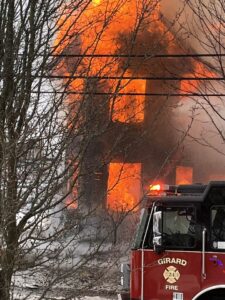
Firefighters battle Girard blaze
7 plead guilty to Warren-area human trafficking charges
WARREN — Six women and a man who participated in the operation of the Tiger Spa, 420 W. Market Street, and the ...
DeWine visits Valley to promote glasses program
BOARDMAN — Gov. Mike DeWine said he opposes President Donald Trump’s consideration of nationalizing ...
Girard officials discuss downtown parking
GIRARD — City officials are reviewing ideas to improve parking in the downtown area, including diagonal parking ...
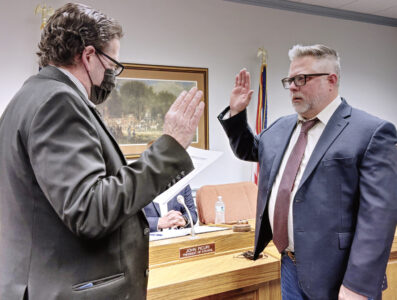
Cortland chooses new mayor
W.Va. data plant’s air quality permit upheld
CHARLESTON — The West Virginia Air Quality Board has upheld an air quality permit for the proposed Ridgeline ...