
Harding High facade’s face-lift reveal next week
Project hampered by limestone delivery
Trending
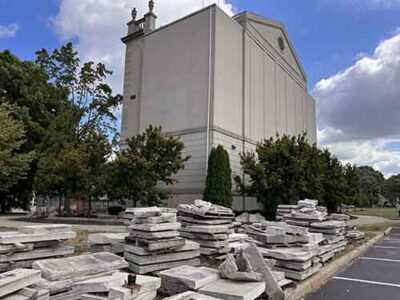
WARREN -- The historical Warren G. Harding High School facade has been under repair since July 2021, but the restoration project finally will be completed next week.
The work is being done on the only remaining portion of the old Harding building, erected in 1925 and first occupied in 1926. The facade was saved from demolition in 2008 when the new high school was built behind it. The three-story facade was the front office entrance of the original school.
Initially, the project was set to be completed last winter. Warren Schools Director of Business Operations John Lacy cited supply-chain issues involved with getting the limestone as one of the reasons for the delay.
"First it comes via the railroad through City Limestone and then from there we pick it up in trucks from Youngstown," said David Grayson, owner of Miller-Yount Paving Inc., the company overseeing the restoration project. "The limestone has to be first mined and then shipped, but we've had trouble with getting it over through the railroad," Grayson added.
City Limestone is a New York City-based company that manufactures architectural limestone products. There was a recommendation to switch to concrete, which would have come at a lower price.
"Concrete is easier because you're pouring it and leveling it," Lacy said. "The limestone needs to be set, each block is about 8 to 12 inches thick so you're setting, leveling and filling because you don't want the seams to leak."
Leaking seams contributed to the porches' deterioration because when the water leaked through the seams, the moisture got in and cracked the stone. Lacy explained this happened because the pillars tilted at an angle away from the building.
"The pillars needed to be tilted a certain way to filter water, but the way that it was laid caused the water to flow into the foundation of the facade," Lacy said.
The project cost approximately $120,000, which came from the Historic Respect Fund that set aside $1 million allocated on an as-needed basis and was voted for by the residents.
Despite the delays, no change orders were filed that would have caused the budget to increase, Lacy said.