
Declassifying the many jobs of a Marine at NSA
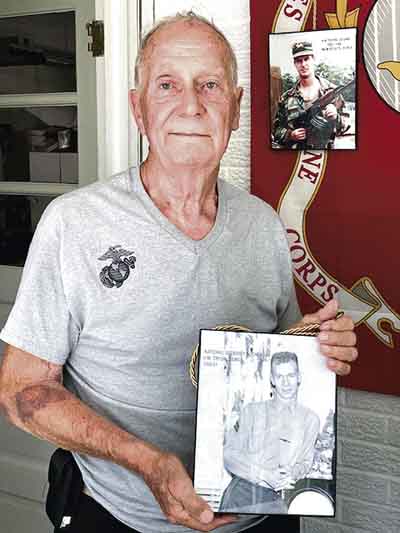
Staff photo Harold Tryon, 81, of Howland, served in the Marine Corps from 1957-60. He served in Fort Meade, Md., at the NSA building. There, he held various jobs dealing with the security and destruction of classified materials.
HOWLAND — Harold Tryon wants people to know that opportunities in the military are unlimited. Tryon never saw battle, but he stayed busy nonetheless.
Tryon, 81, comes from a long line of military servicemen and thought he was going to be shipped overseas after he joined the Marine Corps. Instead, he was stationed in Fort Meade, Md., with the National Security Agency, or as he was told to call it, “No Such Agency.”
According to Tryon, boot camp is meant to test you, to make you quit.
“I went to boot camp in the spring of ’57. We started out with 75. At the end of that four-month boot camp, we were just shy of 50. … All you had to do is raise your hand and say, ‘I can’t take it; I want to go home.’ They (drill instructors) prepare you in every way. You’d think he was your worst enemy, but he was your best friend because he was concentrating on making you resistant to anything anybody throw at you.”
After boot camp at Parris Island, S.C., Tryon found out that he was going to be tested.
“They didn’t use IQ. They use GCT in the Marines, general competency tests,” said Tryon. “And so they tested you, not so much how much arithmetic you knew, because they can teach you that, as how you solve problems in these tests.”
Tryon said he was the only one pulled out for this test and when he asked what this was about, he was told “I can’t tell you.” He had heard that those who were tested usually went off to be an airline pilot or to Annapolis. He didn’t have 20 / 20 vision so he knew he was headed to Maryland.
Tryon and a few other Marines guarded the NSA building to make sure no one without proper clearance got in and that nothing classified got out.
“No one came or went without a badge,” Tryon said.
“We would look through and make sure that nothing was marked classified. Then if some captain or something came through and said, ‘I’m in a hurry,’ we’d go, ‘Oh, is that right,'” Tryon said.
Not only would he patrol the thick double fence that surrounded the NSA building, Tryon held a variety of other jobs, including supervising the cleaning crew.
“Another job was what they called the ‘burn bag.’ Classified materials came out of there in semi truck loads every day. They took it to what I think was an old iron ore furnace that they used to make years ago and they dumped it in the top. There the stuff burned. A laborer took a rake and pulled it all out of the bottom of the furnace, spread it out and hosed it down with water. They did that because, you know, if you burn a newspaper, you can still see the letters. So everything was completely destroyed.”
Tryon also worked at the NCO panel where he would sit in the alarm room and send runners if someone tripped an alarm anywhere in the building. He said this job was his favorite because he could be by himself and because he had access to the giant NSA library and was able to read as much as he wanted.
“We also had roving patrol at night. We went to every office, we had keys to everything in that building, including the three star general’s office. We went through his office every day and looked to see that all cabinets were locked and that no classified material was left out anywhere. And if they did, I don’t recall having an occasion to do that because they were very strict about it, but you would write up a report,” Tryon said.
Tryon said the Marines took their jobs seriously. They weren’t allowed to talk to anyone while on duty and searched every one of the 18,000 NSA employees twice per day to make sure classified materials remained classified.
After leaving the Marines in 1960, Tryon came back to the Valley and has been self-employed ever since.
news@tribtoday.com
Local News

California congressman’s tour makes stop at Ultium
ODOT announces road adjustments
The Ohio Department of Transportation has announced several road closures and lane adjustments for various projects ...
Judge adjusts Liberty trustee’s bond conditions
WARREN — Devon Stanley’s jury trial is still set to begin July 8, but he received some good news at Friday’s ...
Belmont Pines launches Kids in Care & Kindness campaign
LIBERTY — In honor of Mental Health Awareness Month, Belmont Pines Hospital has joined schools, community ...
Trumbull County marriages
Marriage licenses granted April 27 to May 1 in Trumbull County: Zachery J. Thurmond, 36, Leavittsburg, and Krista ...
Youngstown Playhouse sets season
Eight shows in three different venues will make up Youngstown Playhouse’s 2026-27 season, and a Broadway veteran ...