
Pothole repairs pick up with nice weather
ODOT, local street officials patch up roads after winter
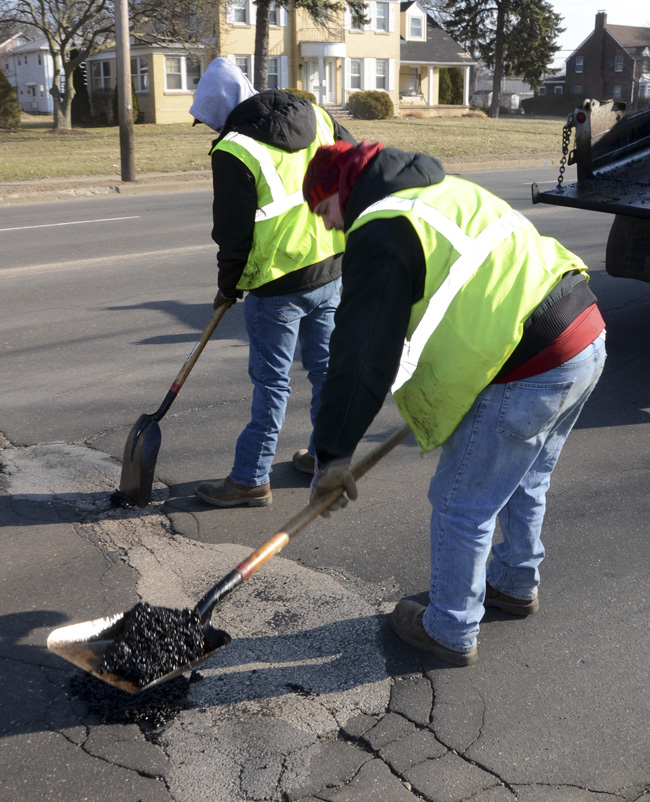
Tribune Chronicle / R. Michael Semple Warren city employees fill potholes along East Market Street. Area road crews use cold-mix asphalt to patch roads until hot-mix asphalt is available later in the spring.
NILES — The arrival of spring can indicate a variety of things — longer days, warmer weather, new beginnings and, of course, potholes.
Those motorists traveling our roadways — or any roadway for that matter — likely already are aware as local road crews have been out filling potholes throughout the month.
“I have six guys out everyday, weather permitting, to patch potholes. We’ve gone through about 125 tons of cold mix so far,” said Sam Mollica, Niles street department director. “We keep up with our roads.”
The extreme swing in temperatures kept road crews busy throughout the winter and will continue with the beginning of spring.
“When we’re not shoveling snow, road crews are out patching potholes,” said ODOT press secretary Matt Bruning.
Potholes form when moisture collects in small holes and cracks in the road surface, a release from the AAA explains. The moisture expands and contracts when temperatures go up and down. This breaks up the pavement and, combined with the weight of passing cars, eventually results in a pothole.
Road crews use a cold-mix asphalt to temporarily patch the roads until hot-mix asphalt companies open later in the spring to place a more permanent hot-mix patch on potholes, Bruning said. This usually begins in April unless the weather stays cold into the month.
Bruning explained the amount of cold mix used depends on a number of factors including snowfall, temperature, public reports and the amount of traffic, among other reasons.
If the winter is milder, like in 2017, road crews patch potholes more often than during harsher winters, Bruning said, adding the amount of material used doesn’t directly correlate to the number of potholes or their depth as cold mix often is applied more than once per season.
“We don’t count potholes, we measure the amount of materials we use. So far, across Ohio we’ve used 6,732 tons,” Bruning said. ODOT is responsible for maintaining interstate, U.S. and state routes outside city and township limits.
Justin Chesnic, public information officer for District 4, which includes Trumbull County, says the ODOT outpost in Cortland has used about 168 tons of cold mix since Nov. 1.
“The condition of our roads have been considerably better because of our recent paving projects. So, our usage of cold mix has been quite a bit less than previous years,” Chesnic said. “We always concentrate on our high traffic four-lane areas first because of the volume of traffic. Then we prioritize the other routes by pavement condition.”
The cold mix and the “plow or patch” routine is used by ODOT and local street departments.
Niles has 87 miles of roadway, and Mollica said the amount of cold mix used this year aligns with the amount used last year. He said this is because the department created a routine where it prioritizes roadways.
“I have guys out now making a list of roads that need redone so we know which ones we won’t have to hit next year,” Mollica said.
Girard crews have repaved many roadways in the recent past, said Mike Hanna, street supervisor, adding crews have used around 20 tons of mix since Jan.1.
“That’s about average, and when the weather stays cold, the cold mix stays better. But when it rains or heats up, we end up having to redo the patches a lot,” Hanna said. “We do prioritize the main roads, but we work from one end of town to the other.”
Not only do potholes damage roads, they can damage vehicles as well.
“Potholes pose a safety risk to motorists; they can really leave a dent in your wallet,” said Mike Hoshaw, vice president of automotive services at AAA East Central, in a press release. “Even if the damage isn’t as obvious as a flat tire, vehicles can end up with bent wheels or damaged suspension parts.”
To minimize vehicle damage from potholes, Hoshaw suggests motorists make sure vehicle tires are properly inflated (and also carry a spare tire), be aware of oncoming hazards by scanning the roadway for potholes and deep puddles, drive at a slower speed and be aware of unusual noises coming from your vehicle.
“This is all reactionary. There is no way to prevent potholes,” Bruning said. “Our goal is to get the roads patched quickly and get them back into good condition.”
Local News

California congressman’s tour makes stop at Ultium
ODOT announces road adjustments
The Ohio Department of Transportation has announced several road closures and lane adjustments for various projects ...
Judge adjusts Liberty trustee’s bond conditions
WARREN — Devon Stanley’s jury trial is still set to begin July 8, but he received some good news at Friday’s ...
Belmont Pines launches Kids in Care & Kindness campaign
LIBERTY — In honor of Mental Health Awareness Month, Belmont Pines Hospital has joined schools, community ...
Trumbull County marriages
Marriage licenses granted April 27 to May 1 in Trumbull County: Zachery J. Thurmond, 36, Leavittsburg, and Krista ...
Youngstown Playhouse sets season
Eight shows in three different venues will make up Youngstown Playhouse’s 2026-27 season, and a Broadway veteran ...