Youngstown’s ‘Sacred Landmarks’
Photographer documents Youngstown history
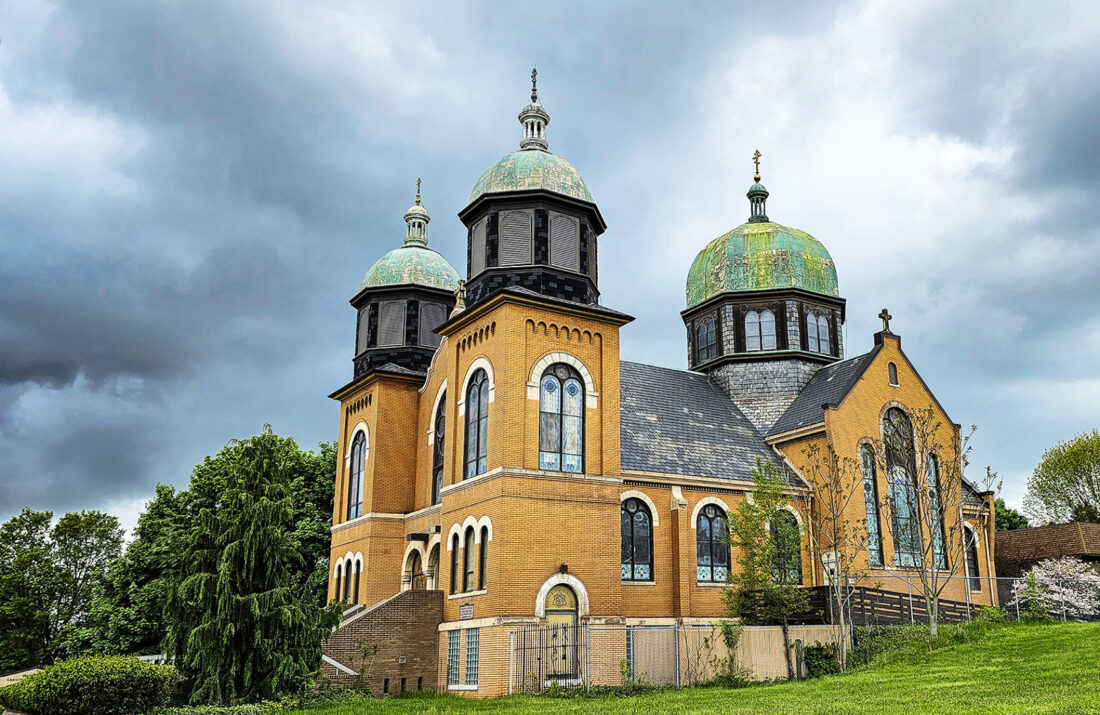
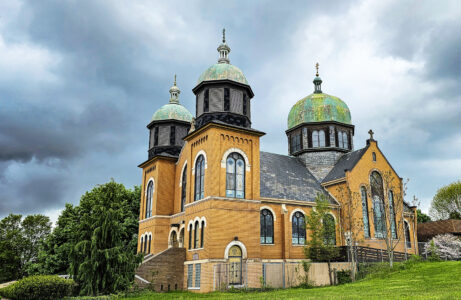
Submitted photo / Lisa Frederick Holy Trinity Ukrainian Catholic Church, built in 1909, is one of 12 churches photographed by Lisa Frederick for her “Sacred Landmarks” exhibition at the Butler Institute of American Art.
Lisa Frederick saw an important part of Youngstown’s history slowly disappearing.
“In downtown Youngtown and downtown Warren, on every corner there used to be a church,” the artist / photographer said. “We’ve already lost quite a few churches. There’s been a lot of consolidation, but a lot of them are already gone. They’ve already closed them, they’ve already torn them down. They’re already gone. They’re not even around anymore, and it seems like, on the news every time you’re listening, there’s another church closing, another one’s merging.”
Frederick decided to document those majestic structures while they still exist with a project called “Sacred Landmarks: A Photographic Tribute to Youngstown’s Churches and Immigrant Heritage.” The photography exhibition features images of 12 Youngstown churches — some still thriving, some now empty and two that have been leveled — and will be on display through April 25 at the Butler Institute of American Art. A meet-the-artist reception is scheduled 1 to 3 p.m. March 1.
The project started with a house of worship built at 117 E. Rayen Ave. Built in 1912 as El Emmanuel Congregation Temple, the synagogue was established by Russian Jewish immigrants to the Mahoning Valley, and it later became St. Andrews African Methodist Episcopal Church from 1949 until 2001.
“El Emmanuel was razed in 2019,” Frederick said. “They tore it down with all the strained glass windows in it. At the time, I thought, oh my gosh, they’re tearing it down. We have to save the windows. They tore it down with all the windows in.”
Welsh Congregational Temple at 220 N. Elm St. was torn down in 2022. Built in 1861, it was the city’s oldest still-standing church. It had been damaged in a fire in 1997.
Frederick, who retired in 2021 as a visual arts teacher in Salem, was shocked that many of these buildings hadn’t been declared state or federal landmarks.
“Out of these 12 churches, only two are registered on the National Historic Places and even on Ohio’s Registry of Historic Places,” Frederick said. “I find that extremely surprising, because when I worked in Salem, and this is back in the late ’80s, early ’90s, every single building in downtown Salem and every church — and not only every church but the homes on South Lincoln and State streets — was registered in Ohio and on the national registry … These churches have way more historical significance than in Salem.”
Also featured in “Sacred Landmarks” are Basilica of Our Lady of Mount Carmel Church, Holy Name of Jesus Church, Holy Trinity Romanian Orthodox Church, Holy Trinity Serbian Orthodox Church, Holy Trinity Ukrainian Catholic Church, Hungarian Presbyterian Church, St. John’s Episcopal Church, Sts. Peter and Paul Catholic Church /Holy Apostles Parish, Sts. Peter and Paul Ukrainian Orthodox Church and Trinity United Methodist Church.
Frederick said these churches represent many of the different immigrant communities that settled in the Mahoning Valley and worked in the steel mills and other businesses that thrived in the area.
This is Frederick’s second exhibition at the Butler in a year.
Her exhibit in 2025 had to close early because of a schedule conflict. She was given the option of reinstalling the 2025 show or exhibiting different work, and she chose to feature “Sacred Landmarks.”
Frederick teaches art classes at the Butler, and one of the classes she taught there focused on church photography. Four of the churches in the exhibit were part of that class.
The Butler show features three images from each church and were chosen from about 150 to 200 images Frederick estimated she shot at each locale. Those viewing the exhibition can scan a QR code displayed with the photos to see some additional shots from each church.
Some of the churches are closed but still standing, and some look as if they could host a congregation this Sunday.
“When you go into the buildings, what’s very sad is they just close the doors and they leave everything there,” Frederick said. “When I went into the Hungarian Presbyterian Church, that one’s for sale on Mahoning Avenue that’s right next to the Calvin Center, I met the real estate agent who let my husband and I in, and everything’s still there. The Bibles and the hymnals are still in the pews, The smocks that the choir people wear, those are still hanging up. You could walk in and you can have a service right there. It’s just kind of weird and eerie that they did that to me.”
A second volume of “Sacred Landmarks” already is in the works, Frederick said, and she also would like to work with someone, perhaps the history department at Youngstown State University, to start the application process to get the churches on the National Register of Historic Places.
“All of these churches really need to get on the registry because they all have historical significance,” she said.
If you go …
WHAT: “Sacred Landmarks: A Photographic Tribute to Youngstown’s Churches and Immigrant Heritage” by Lisa Frederick
WHEN: On display through April 25 with meet-the-artist reception from 1 to 3 p.m. March 1. Hours are 11 a.m. to 4 p.m. Tuesday through Saturday and noon to 4 p.m. Sunday.
WHERE: Butler Institute of American Art, 524 Wick Ave., Youngstown
HOW MUCH: Admission is free. For more information, go to www.butlerart.com or call 330-743-1107.
Ticket
‘Arsenic and Old Lace’ opens in Ashtabula
Joyce Manor album delivers nostalgia, polish and punk
LOS ANGELES — In his seminal 1981 book “Simulacra and Simulation,” cultural theorist Jean Baudrillard argued ...
YSU takes part in celebration of author Toni Morrison
YSU Theatre turns sci-fi spoof into radio play
Gray Areas: Penguin City hosts group wedding, fest merges punk with craft beer
Assorted ramblings from the world of entertainment: • It’s Valentine’s Day weekend. Love is in the air, ...