
Trending
Basically, a defender's falsecard is designed to mislead declarer without fooling partner at the same time. On rare occasions, however, the intent is exactly the opposite, with the falsecard deliberately aimed at deceiving partner without trying to mislead declarer at all.
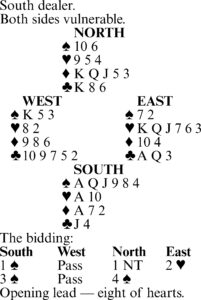
Witness today's deal, where South wound up in four spades after East had overcalled in hearts. West led the eight of hearts, but instead of making the normal play of the jack at trick one -- the lowest card from equals by a defender not on lead -- East played the king!
This violation of standard procedure by East was designed to create the impression in West's mind that declarer had the queen of hearts. East's purpose was to encourage West to shift to another suit --namely, clubs -- if West gained the lead.
Declarer took the first trick with the ace of hearts, crossed to dummy with a diamond and tried a spade finesse. West won and, having credited South with the queen of hearts after the play to the first trick, naturally decided to look elsewhere for additional tricks. The only realistic possibility seemed to lie in clubs, so he shifted to the club ten, whereupon East took two clubs and a heart to set the contract one trick.
Had East not intentionally deceived his partner at trick one, West might well have returned a second heart after taking the spade king. Declarer would then have made the contract, since East could collect no more than a heart and a club before South claimed the rest.
But, as East hoped, his partner fell right into the trap he had so skillfully laid for him.
Tomorrow: Bidding quiz.
(c)2026 King Features Syndicate Inc.