
Learn about the pawpaw tree
Trending
Every Monday through Aug. 11, Ohio State University Extension will sponsor the Veggies and More Tour, visiting local community gardens throughout the area. Open to all, these tours provide helpful gardening information, answer questions and create opportunities to connect with fellow gardeners in the community. On June 8, we visited Noble Creature's pawpaw orchard on Youngstown's North Side. During the tour, we learned about pawpaws, which are a native fruit to Ohio, and observed the young green fruits developing beneath the leaves.
A native North American tree from the Annonaceae family, this deciduous tree is found in every Ohio county. Although commonly found in tropical and subtropical areas, it grows well in our 6A zone, sending rhizomes (underground roots) that produce new trees.
Historically, George Washington planted them at Mount Vernon, as well as Thomas Jefferson at Monticello. According to Penn State, the name originated from a Portuguese explorer who thought the fruit resembled a papaya, and the name pawpaw stuck.
The bark on a young tree is smooth and gray, while aging bark becomes rough and bumpy with increased growth. Large ovate entire (toothless) leaves hang from branches with a tropical appearance, turning yellow/gold in autumn.
Ohio State University states this tree is commonly found in a forest understory, near stream banks. At 20 to 35 feet in height, they reproduce by rhizomes (underground roots) or by insect pollination, and until the tap root is well established, a water source is essential. If planted in full sun, it will require deep irrigation.
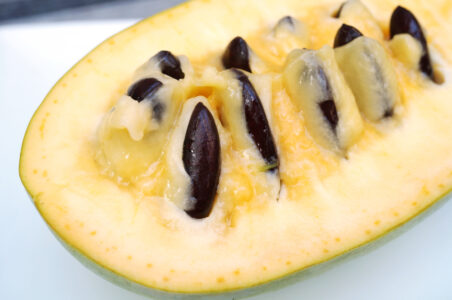
A minimum of two trees are needed for cross pollination. Violet/purple flowers form in spring, ready to be pollinated by beetles and flies, but interestingly, not bees! Tiny green fruit grows throughout summer, turning yellow/brown when ready to harvest in September or October. Each fruit, weighing 6 to 12 ounces, is sweet and fragrant with a banana taste, hinting also of mango, pineapple or vanilla flavor. Some have compared its appearance to a small potato once it is ripe.
It can be enjoyed raw or added to pies and custards, and even ice cream!
Rarely found in grocery stores, the pawpaw has a very short shelf life of 48 to 72 hours at room temperature. Because of its fragrant scent, raccoons, squirrels and birds are attracted to the fruit, so picking the fruit at its peak can be a race as to who will enjoy it first.
With space and time, this low-maintenance fruit tree can be a welcome and interesting addition to your garden.
After our tour of the orchard, we enjoyed a sample of pawpaw beer and a tour of Noble Creature brewery. We also learned about the brewing process and how pawpaw is incorporated into the beer, making for a wonderful evening of learning and laughter.