
Trending
Precisely when to win a trick is a problem that often determines the outcome of a hand. The holdup play, so often utilized in notrump contracts, might defeat its purpose unless it is applied at exactly the right time and place.
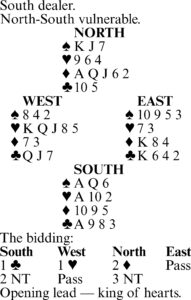
Take this case where West leads the king of hearts against three notrump. If South wins with the ace, he sooner or later goes down one. Whenever he gets around to the diamond finesse, East takes the king and returns a heart, and declarer finishes a trick short of his goal.
South should realize that there can be no advantage -- and that there might be a serious disadvantage --in taking the first heart. He should therefore duck in order to sever East-West communication in the suit.
When West continues with the queen, South is again faced with the question of whether or not to win the trick. But this time he should take the ace, as there is no reason to duck and every good reason to take it.
Winning the second heart assures the contract, while ducking it jeopardizes the contract. Declarer plans to take a diamond finesse next, not caring a whoop or a holler where the king is actually located.
If the finesse wins, he is virtually certain to finish with 10 tricks; if it loses, he is sure to make nine tricks. This is because, if East has another heart to lead, West started with at most four hearts, so the defenders cannot score more than four tricks.
Note that if South refuses to win the second heart, he subjects himself to potential defeat. West might then shrewdly shift to the queen of clubs at trick three, and down the drain the contract would go.
Tomorrow: Two shots are better than one.
(c)2026 King Features Syndicate Inc.