
Trending
It may at times seem amazing how some declarers are able to figure out what to do when they are faced with a difficult decision. While many might attribute this to a mystical quality known as "table feel," in reality it is simply the ability to place the cards from clues gleaned during the bidding and play.
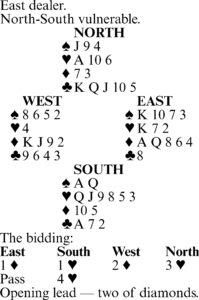
Consider this deal where South got to four hearts as shown and West led the diamond deuce. East won with the ace and returned the eight of clubs, a play that had all the earmarks of a singleton.
Given this development, declarer realized that the contract was in serious danger. East's play of the ace of diamonds had marked West with the king and simultaneously indicated that East had to have the king of hearts (as well as the king of spades) for his opening bid. There was consequently a strong possibility that whenever East gained the lead with the king of trump, he would lead a diamond to West's king and get a club ruff to defeat the contract.
But South worked out a sly solution to this problem. He took East's club return in dummy, led the four of spades to the queen and cashed the ace of spades. He then led the queen of trump to the ace and returned the jack of spades, discarding his remaining diamond when East covered the jack with the king.
By thus exchanging his diamond loser for a spade loser, declarer assured that East could no longer put his partner on lead to return a club. As a result, South lost only a diamond, a spade and a trump to make his contract.
In effect, declarer played the entire hand as though he had seen all 52 cards from the word "go." In a sense, he did -- after East's first two plays -- but that is typical of any declarer who makes the effort to read the cards from the clues he obtains. The critical information he needs is frequently right there if he simply stops to think about it.
Tomorrow: The possible vs. the impossible.