
Trending
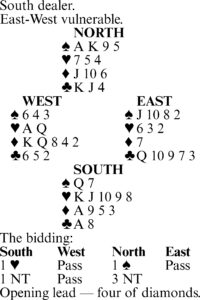
It's easy enough to see that with a low diamond lead, the declarer has the suit doubly stopped. It is far less obvious, though, that after a low diamond lead the suit is triply stopped with proper play. South failed to recognize this and, as a result, lost the contract.
He covered the diamond four with dummy's six and won East's seven with the nine. After playing a spade to the king, he finessed the jack of hearts, losing to West's queen.
Back came the king of diamonds, which declarer ducked, followed by the queen. South won but could do no better than lead another heart. West took the ace and cashed the 8-2 of diamonds to set the contract.
South should have made four notrump, however. His only real concern was to establish his hearts before West could establish his diamonds, and he should have concentrated all his efforts on this one goal.
By applying the Rule of Eleven (assuming that West's diamond lead is fourth-best), declarer can tell that East has only one diamond higher than the four. (South deducts four -- the card led -- from 11, leaving seven cards higher than the four in the North, East and South hands. With six of those cards in plain view, East can have only one card higher than the four.)
South should therefore play the ten from dummy on the opening lead. If East's diamond is the seven or eight, the ten wins, and South is certain of a triple stopper. If East's diamond is the king or queen, South wins with the ace and is again sure to have the suit triply stopped.
By playing high from dummy at trick one, South makes certain of winning the race for the establishment of his long suit. He starts out a step ahead and makes sure he stays there the rest of the way.
Tomorrow: From bad to worse.
(c)2026 King Features Syndicate Inc.