Bridge by Steve Becker
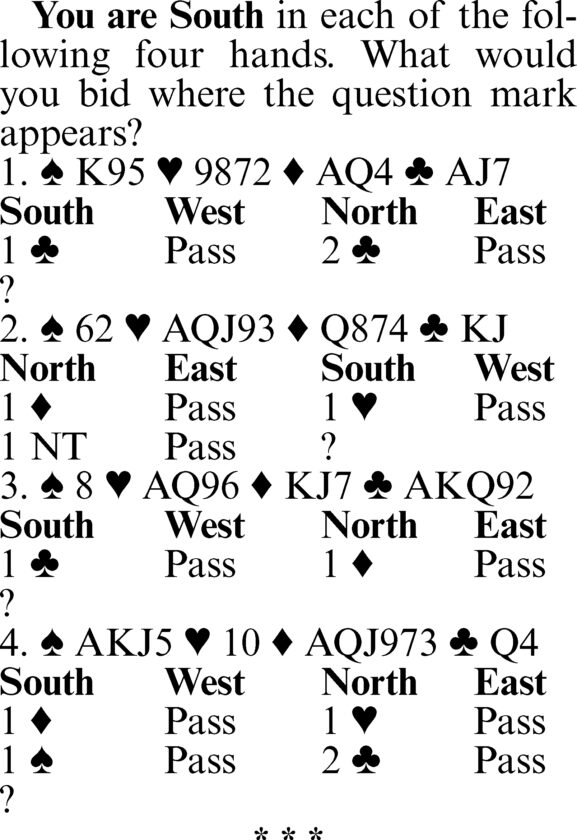
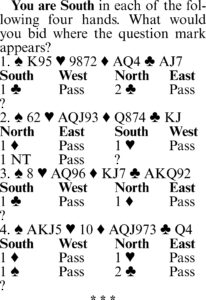
1. Pass. Hands containing 14 high card points are mandatory opening bids, even though they might contain no attractive suit to name. Here, you had no choice but to start by bidding a three-card club suit.
When partner raises to two clubs, indicating six to 10 points, it is obvious that there is no game in the offing. Since partner has guaranteed at least four clubs for his raise and at the same time denied possession of a four-card major, you have no better alternative than to settle for a partscore with clubs as trump. To bid again at this point would indicate game-going aspirations and would probably result in a minus score.
2. Three diamonds. You can’t be certain whether the best game contract is in hearts, diamonds or notrump, so you jump to three diamonds (forcing) to compel partner to help make the choice. You plan to bid four hearts over three hearts, five diamonds over four diamonds, and to pass if partner bids three notrump.
3. Two hearts. The jump-shift tells partner there is a game in the combined hands and forces partner to bid again, which you can well afford to do even though partner might have only six points. Game, and possibly a slam, is very likely, but you have no idea whether it is in clubs, diamonds, hearts or notrump. If you were to bid only one heart (not forcing) and partner passed, you’d almost surely have missed a game in hearts or some other denomination.
4. Three diamonds. You have values well above a minimum opening bid, and it is now time to let partner know. Although you have the high-card values for a jump to three notrump, you don’t have the balanced distribution that this would indicate.
Three diamonds strongly suggests a 6-4-2-1 pattern and might pave the way to a good slam. You might still wind up in three notrump, if that is what partner bids next, but at least he will know the type of dummy to expect when it appears.
Tomorrow: Planning the play.
Lifestyles
Friday evening TV
Scams bilking Medicare out of $100 billion annually
By DAVE LONG Elder Scam Consultant Medicare is a wonderful plan, helping seniors shoulder health care costs at ...
Dear Annie: Growing impatient with friend’s ingratitude
This column previously appeared in 2023. Annie Lane is off this week. DEAR ANNIE: I am struggling with what to do ...
To Your Good Health: Weighing a do not resuscitate clause
DEAR DR. ROACH: I am an 80-year-old man in reasonably good health. The only medications that I take are Eliquis for ...
BBB releases guide for seniors
For more than a century, the Better Business Bureau (BBB) has stood for one essential value: trust. That ...