
Sweet-smelling tree attracts pollinators
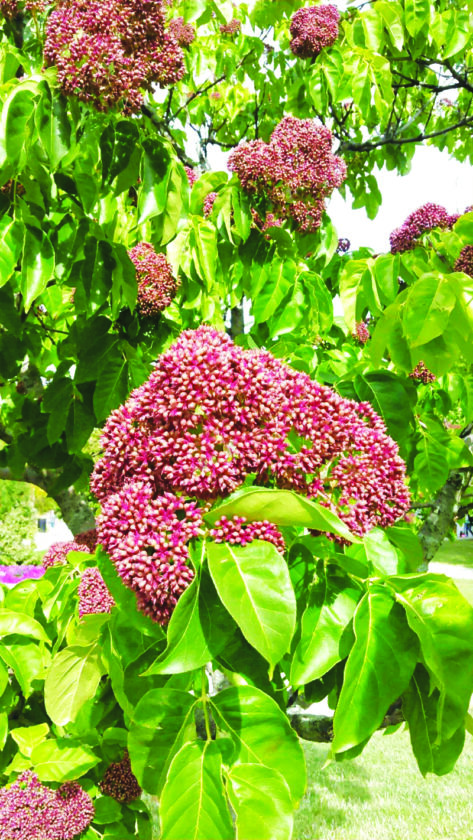
As the season wears on, the white flowers of the seven sons tree give way to bright red calyces, producing what looks like a second blooming. The tree is a member of the honeysuckle family. (Submitted photo)
While I worked at the Canfield fair years ago, a lady asked me a question about a seven sons tree (Heptacodium miconiodes) she had. Not ever hearing of this tree, I went home and began researching.
This tree sounded fascinating — patio-size small, easy maintenance, no insects or pathogens to worry about, and the flowers! Each clump has six small flowers, clumps of sweet-smelling, beautiful white small flowers. These clumps completely cover the whole tree, attracting every pollinator around. The aroma is magnificent.
Then, these blooms give rise to bright red calyces (the center of each bloom that harbors seeds) that look like another bloom. Amazing!
My husband bought me a seven sons tree for the next Mother’s Day and I was thrilled. This tree performs again and again. We both love this tree so much that when we downsized three years ago, he dug it up and brought it with us to our new home.
This year it is doing its thing and I have pictures to prove it.
This “crape myrtle of the North” is a small deciduous tree or large shrub, growing fast from 10 to 20 feet tall. It likes moist soil, but not wet. It does best in sunny to part shade and thrives in Zones 5 to 9 — perfect for our touchy winter weather and up-and-down temperature fluctuations in early spring.
This “autumn lilac” hails from China and one source claims that “the reintroduction of the plant to the horticultural world in 1980 has helped to save the plant from extinction.”
The glossy green leaves of this beautiful tree are 3 to 6 inches long. It is a member of the honeysuckle family. It is considered a four-season tree, blooming in September, but its exfoliating shreddy gray bark is stunning in winter. It sheds its bark in long strips revealing light inner bark.
It is considered multi-stemmed, but can easily be pruned to conform to other shapes.
This patio tree can be used as a specimen tree, in the back of a bed or more naturalized in a parklike setting. It can be propagated by seeds and cuttings. Suckers can be a problem.
We are already wondering where we can plant another seven sons tree to promote pollinators as well as to thoroughly enjoy this incredible tree throughout the year.
For complete photos of this from Geauga County and more details about this tree, go to http://go.osu.edu/sevensons.
Hughes is an Ohio State University Master Gardener Volunteer in Mahoning County.
Lifestyles
Bridge by Steve Becker
Point count can be used not only during the bidding, but also during the play. In this deal from a team match, ...
Woman’s efforts to increase sodium levels cause frustration
DEAR DR. ROACH: I’m a 71-year-old female. I weigh about 96 pounds, and I’m 4 feet, 9 inches tall. My blood ...
Spouse is biting tongue over husband’s habit
DEAR ANNIE: My otherwise extremely well-mannered husband, “Ted,” has developed an unspeakably disgusting habit, ...
Lovina shares memories of the move to Michigan
We will be extra busy cleaning and preparing to host communion services here in three weeks, so I decided to get an ...

Make roasted carrots pop on an Easter table
TO YOUR GOOD HEALTH: Probiotics not always needed for gut health
DEAR DR. ROACH: I read your recent column about a person who was refusing antibiotics due to a fear of a ...