Long-legged harvestman (not a) spider hunts stink bugs
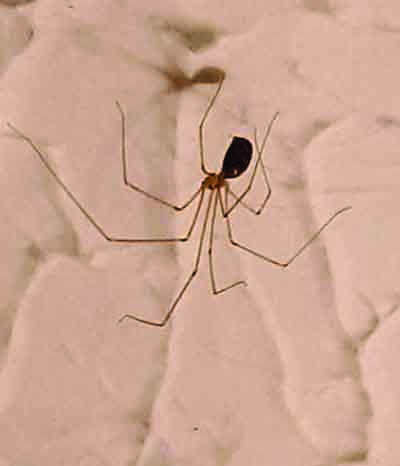
The harvestman is similar to the daddy longlegs, but neither is a true spider. (Submitted photo)
This was our first full winter in our down-sized home. I am used to the sounds of the house, but something new started a few weeks ago — stink bugs.
They were hiding all over, and on warm days they came out, hitting the windows, walls and anything they flew into. Well, I noticed up in the corner of our living room a small spider. I did not say a word as my husband believes in killing them. One evening a stink bug flew over to that corner and we got to witness that spider catch and eat that darn stink bug.
Oh, it was such a joy to watch my husband become a believer.
Harvestmen, commonly known as daddy longlegs, are found in fields, porches, basements and other locations. Worldwide there are 37 families, and surprisingly they are not spiders. Spiders are of the family Arachnida, having eight legs, two-part body of cephalothorax (head fused with thorax) and abdomen. They also have fang-like mouths with chelicerae for venom delivery, two antenna-like appendages called pedipalps, six to eight eyes, and have spinerets for silk production.
Daddy longlegs, Phalangium, are arachnids and have one body part, two eyes and eight legs. They live in moist habitat, with long flexible legs, and do not have spinnerets and therefore do not make silk for webs.
This is what I always called the daddy longlegs. But no. My harvestman can also be called daddy longlegs. Confused? Me, too.
Arachnidae is a large grouping for spiders, ticks, mites, scorpions and pseudoscorpions. It focuses into opilionids for true daddy longlegs.
Then we have the group Phalangium opiliones, or harvestman. They have two body parts, eight legs, no antennae, no spinerets, no silk production, and long slender legs on a short body. Their eyes are on top of the head like a pedestal for good eyesight. They lay eggs in bark, on the ground, in moss. This is a very efficient predator of crops, plants, etc.
There can be two or more generations depending on weather, with incomplete metamorphosis of egg, nymphs and adult. They, as well as daddy longlegs, do not pose a threat as they do not make venom, though they make secretions for defense.
Their legs are very important. The tips are sensitive to vibrations, movement, etc. The front pair of legs is the shortest with a claw for grasping and tearing. The second pair is the longest and act as sensory organs (like antennae). The fourth pair is next in length. All have elbows and can freely come off as a defense against a predator. They keep moving as well to confuse.
So I learned so much more than I thought I would. Bill took pictures of our harvestman, and he is still hanging in the corner of the living room.
For more details on these amazing arachnids, visit http://go.osu.edu/harvestmen.
Lifestyles
Bridge by Steve Becker
Card-reading is the art of deducing how the opponents’ cards are divided. Each bid made and each card played by ...
Explaining the increase in risk with certain drugs
DEAR DR. ROACH: Could you please explain the percentages that are given when a study indicates an increase for a ...
Wanting a bit of peace while on vacation
DEAR ANNIE: My husband and I have been married for eight years, and every vacation we take somehow turns into a ...
Try this cleaning hint for a big party
DEAR HELOISE: Cinco de Mayo is one of my favorite excuses to feed a crowd — chips, salsa, tacos, the works! The ...

Yemen introduced the world to coffee