
Eleanor Roosevelt recounts WWII-era history in Liberty
Trending
LIBERTY — World War II-era history came alive at Denny's on Saturday morning as the William Holmes McGuffey Historical Society hosted its monthly Memories of a Lifetime program.
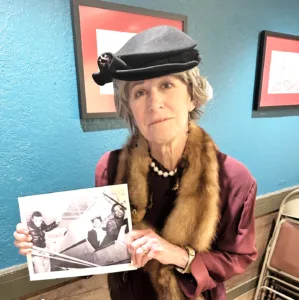
Member Denise Walters-Dobson introduced Eleanor Roosevelt, who wore a period dress accented with end-to-end fox stole and pillbox hat.
Her alter ego is Ruth Pangrace, who has portrayed Roosevelt 26 years for Women in History, a Cleveland organization that performs living histories of 90 women. Pangrace depicts about a dozen characters and does four different presentations as Roosevelt.
"Eleanor Roosevelt" described her upbringing. Her mother was beautiful, "so imagine how disappointed she was when she saw me." When Eleanor was orphaned at 8 years old, her caretaker grandmother said she would never attract a man with her looks so she better develop good manners.
It was when Eleanor attended school in England that educator Madame Marie Souvestre helped her overcome her shyness. She taught Eleanor that "nobody can make you feel inferior without your consent."
The other lesson Souvestre taught her was the need to find a purpose, as "happiness only comes from a life of service."
When the United States entered World War II, Eleanor used that lesson.
She encouraged the participation of all citizens. This included rationing materials needed for the war effort, growing "Victory Gardens" to save food for the troops, purchasing war bonds and encouraging women to work in the factories.
She also recognized the need to include people of all backgrounds. Civil rights and education pioneer Mary McLeod Bethune taught her about conditions African Americans had to endure. This "opened my eyes to racism." She would prod her husband to think about these issues, while President Franklin D. Roosevelt often moved slowly for political reasons.
Eleanor advocated for African American troops to have bigger roles than "peeling potatoes and cleaning latrines." She took a plane ride with flight instructor Charles Anderson of the Tuskegee Airmen so a photograph would be taken of the first lady being flown by a black pilot.
She visited troops in the South Pacific and stayed with the enlisted men and women. She ate bad food and slept on an uncomfortable cot in a barracks infested with bugs and rats. Although commander Adm. William Halsey did not want her to come, he admitted that "No one has had a greater effect on the morale of the soldiers."
After FDR's death in 1945, President Truman asked, "What can we do for you?" He was surprised that her answer was instead "What can I do for you?"
He responded by putting her on the Health, Education and Welfare Committee of the fledgling United Nations. The result was the publishing of the Universal Declaration of Human Rights, which Eleanor described as her greatest accomplishment.
Gail Halstead of Girard said she loved the presentation and was impressed that Pangrace had four versions of it along with so many other characters.
Tom Copeland of Youngstown agreed and enjoyed watching Pangrace become Eleanor Roosevelt, the way she dressed, talked, and even appeared to think like her.
Pangrace said of all the characters she portrays, Eleanor Roosevelt is the one she most admires.
There will be no meeting next month, but Memories of a Lifetime will return in January to start a new lineup of speakers.