
Prehistory of Ohio reviewed at Liberty talk
Trending
LIBERTY – Historical artifacts tell us a lot about the people who lived thousands of years ago in an area.
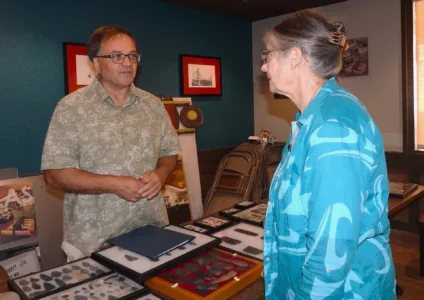
John Chuey, one of the founding members of the Mahoning County Archaeological Society, spoke of the arrowheads, tools and jewelry he has found in Ohio, other states and Canada during the William Holmes McGuffey Historical Society's Speaker series on Saturday at Denny's on Belmont Avenue. Richard Scarsella, chairman of the speaker series, said the monthly talks began 13 years ago.
Chuey discussed artifacts that Native Americans of the Ohio Valley used that were distinctive.
“These are adena spears. Adena had these characteristics of a round face but I also have a square faced adena from Coshocton,” Chuey said.
An adena arrowhead has a medium to thin triangular blade with a beaver tail stem. This tail is specific to this type of arrowhead, so it can be traced to Ohio.
Scarsella walked around the full meeting room to show the samples in cases that Chuey discussed. The items were very well preserved, even at hundreds to thousands of years old.
Chuey continued with an explanation of the numerous mounds where artifacts were found, including the Hopewell Mounds in Chillicothe. The Hopewell culture used the mounds for burial, religious services and other ceremonies.
“Some examples are the Hopewell Mica cutouts. Mica is not indigenous to Ohio. It is found in the Carolinas," Chuey said.
The Hopewell pottery found there is known for intricate geometric designs.
Chuey discussed numerous trips and vacations that he took to satisfy his hobby of archaeology.
“My son got married in Destin, Florida. Whenever I go somewhere, I am always searching out museums. They have a nice museum there. They had beautiful Adena quartz made out of Flintridge flint," Chuey said.
He proceeded to show a Flintridge piece that he found on a dig in New Mexico.
"The woman at the museum said the Flintridge in the museum was dug right there. So, Ohio to Florida is a ways,” he said.
Chuey recalled the first artifact he discovered.
“Some things you remember. I can remember precisely the day I found this point. It was the first one," Chuey said as he held up an arrowhead. “It was back in June, a nice warm day. I was rototilling our garden on Western Reserve Road. It was the bicentennial year, 1976. A few days later, I found a second one."
After also discussing his digs in New Mexico and Arizona in the United States and Manitoba, Labrador and New Foundland in Canada, Chuey took questions from the audience and answered queries about his individual collection spread on several tables at the front of the room.
Some people wondered about the legacy of his collection and where it will end up some day. Chuey admitted that his one son is not interested in his hobby and his other son is only partially interested. He hopes it is donated to a museum.
Another question was how to tell the difference between an every day rock and one that was carved hundreds of years ago to be used as a tool to make arrowheads or jewelry. Chuey had the person look at the tool and notice the indent for a person’s fingers to hold it in such a way that it could help shape an item of other material into a useful implement.
Through his digs and discoveries, Chuey learned that the indigenous people found ways "to use everything. They did not waste anything."
They were the original reduce, reuse and recycle proponents who strove to preserve the land where they lived.
The next speaker will be an Eleanor Roosevelt impersonator. Contact The William Holmes McGuffey Historical Society for more information about their speaker series or membership at 330-726-8277.