Snell, who scored the Jets’ only TD in the Super Bowl upset of Colts, died

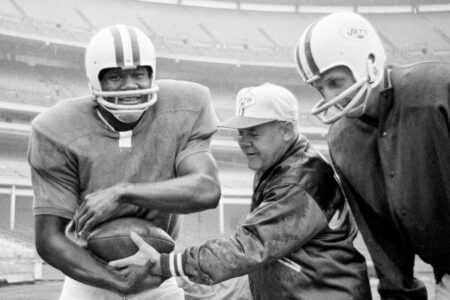
FILE - Weeb Ewbank, center, coach of the New York Jets, shows quarterback Dick Wood, right, the way to work the hand-off to Jets' leading running back Matt Snell during a workout on Nov. 5, 1964, in New York. (AP Photo/Harry Harris, File)
Matt Snell, the powerful running back who scored the New York Jets’ only touchdown in their Super Bowl win in 1969, has died. He was 84.
The Jets announced that Snell died Tuesday morning on Long Island, New York.
Snell teamed with Emerson Boozer to give Joe Namath and New York a formidable backfield, helping the AFL’s Jets pull off one of sports’ greatest upsets with a 16-7 victory over the NFL’s heavily favored Baltimore Colts in the 1969 Super Bowl.
“I’m really sad to hear that he passed,” Namath told the Jets’ website. “Matt was not only a hell of a player — he was a terrific teammate and without him, we wouldn’t have had a chance to win a championship.”
With the game scoreless in the second quarter, Snell went off left tackle for a 4-yard touchdown run that gave the Jets a 7-0 lead — the first time in three Super Bowls that an AFL team led.
New York used a run-blocking concept it called “19 Straight” — which is engraved on the championship rings of both Snell and Boozer — to perfection against the Colts. Snell finished with a then-Super Bowl-record 121 yards rushing on 30 carries, although Namath was selected the game’s MVP.
“Matt Snell will forever hold a special place in the history of the New York Jets,” Jets owner Woody Johnson said in a statement. “He was the embodiment of toughness, selflessness and belief — traits that defined our organization’s proudest moments. His performance in Super Bowl III was nothing short of legendary.
“Against the odds, Matt set the tone with his physical running, delivering the Jets’ lone touchdown and helping secure one of the most important victories in sports history.”
Snell, who grew up in the Long Island hamlet of Carle Place, stayed close to home his entire nine-year professional career with the Jets after four standout seasons at Ohio State. He was picked in the fourth round of the 1964 NFL draft by the Giants, the team for which he rooted as a youngster. But he chose to sign with the Jets after they selected him with the No. 3 overall pick in the AFL draft and presented him an opportunity to play right away.
He made an immediate impact for the Jets in his first season, a year before Namath arrived, winning the AFL Rookie of the Year award after rushing for 945 yards, including a then-franchise record 180-yard performance on 31 carries against the Houston Oilers. Both rushing marks remain Jets rookie records.
Snell made the AFL All-Star team three times and was a first-team All-AFL selection in 1969, building a reputation as a terrific ball carrier with soft hands as a receiver and for being a punishing pass blocker.
Snell’s physical approach took its toll, though, as he dealt with several injuries, particularly late in his career. He tore cartilage in a knee in 1967 and missed seven games. Three years later, Snell was limited to three games after tearing an Achilles tendon. He played in only nine games over the next two seasons because of a knee injury in 1971 and a ruptured spleen the following year.
Snell retired after the 1972 season, finishing with 4,285 yards rushing — still fourth on the franchise’s career list — 24 touchdowns, along with 193 receptions for 1,375 yards and seven scores.
After his years on the gridiron, Snell turned his attention to Wall Street, becoming a partner for Defco Securities Inc. He also became a familiar face on TV as the first pitchman for Miller Lite beer and its “Tastes Great, Less Filling” ad campaign. Snell later created his own construction company in New Jersey and worked there for several years.
He also put his football career far behind him, mostly turning down interviews or having contact with his former team. Snell and Boozer were inducted into the Jets’ Ring of Honor together in 2015, but Snell refused to attend the ceremony.
He revealed in Bob Lederer’s book, “Beyond Broadway Joe: The Super Bowl Team That Changed Football” in 2018 that he held a grudge against the team. Snell claimed the Jets reneged on a promise made by then-part owner Sonny Werblin that Snell would have a place with the team for life if it won the title. Werblin was bought out by his partners, including Leon Hess, before the Super Bowl-winning season.
“It may be that no one in Jets management knew about Sonny’s promises to me, but in 1974, there was a recession and I was in line for a construction job,” Snell said in Lederer’s book. “I asked the Jets for a reference. They told me they didn’t do that for players. They said they couldn’t do it! Can you believe that? I can’t prove it, but I don’t think any of that would have ever happened if Sonny were in charge. That’s why I don’t get along with the organization now.”
Snell was born on Aug. 18, 1941, in Garfield, Georgia, but moved to New York as a youngster. He became a star at Carle Place High School, where he’s in the school’s athletic hall of fame. He went on to even bigger fame in college at Ohio State, first as a lead blocker for the likes of Paul Warfield and Bob Ferguson and then as a defensive end. He moved into the starting fullback role as a senior and was chosen the Buckeyes’ MVP.
In 2000, Snell was selected to Ohio State’s all-century football team as a defensive end.
He is survived by his wife Sharon, son Beau and daughter Jada, grandson Donte, as well as great-nephew Benny Snell Jr., a former running back for the Pittsburgh Steelers.
Local Sports
‘Canes top Penguins in shootout

Garland sends Jackets past Tampa
Snell, who scored the Jets’ only TD in the Super Bowl upset of Colts, died
Lions down Skippers in regional semi
BARBERTON — When the game is on the line, the Heartland Christian boys basketball team has all the faith in ...

Grand Valley’s magical run ends with loss to Kirtland