
Vance: Talks with Iran set ‘good foundation’ for a deal
Trending
OBBUERGEN, Switzerland (AP) -- Vice President JD Vance on Monday said his lengthy talks with senior Iranian officials in Switzerland created a "good foundation for a successful final deal" as they seek a permanent end to the war that the U.S. and Israel began in late February.
Vance and U.S. officials claimed progress on multiple fronts, including the establishment of "mechanisms" to ensure the Strait of Hormuz, a vital waterway for global energy shipments, stays open and to address fighting between Israel and Iranian-backed Hezbollah militants in southern Lebanon, where a ceasefire appeared to be holding.
The interim deal to end the fighting in Iran, signed last week by the leaders of the U.S. and Iran, sets a 60-day period for negotiations on key issues, including the future of Tehran's nuclear program amid concerns that Iran wants to use it for military purposes, a claim the country denies.
The vice president departed Switzerland as technical teams were still negotiating, and U.S. President Donald Trump talked up the efforts to keep the strait open to create "an oil gusher" as he stressed that the key to resolving the war was "respect" from Iran.
"As long as they respect us, I don't want to use the word fear because that's an inappropriate word, but as long as they respect us, we're not going to have any trouble," Trump said from the Oval Office.
Iran effectively closed the strait after the U.S. and Israel attacked on Feb. 28, causing fuel prices to skyrocket far beyond the region. The interim agreement to end the war was supposed to reopen the channel. Dozens of ships passed through it over the weekend, even though the main route is still mined and closed.
The lead negotiator of the Iranian delegation, Iran's parliamentary speaker, Mohammad Bagher Qalibaf, insisted on Monday that the Strait of Hormuz will be managed by Iran, but following international laws.
"Hopefully we can activate the strait again, in terms of passage, and bring prosperity back to regional and global economy," Qalibaf told Iranian state media on the plane on his way back from Switzerland.
Qalibaf and the Foreign Minister, Abbas Araghchi, arrived on Monday night in Oman where they met with the country's Foreign Minister Badr al Busaidi to discuss the peace efforts and ensure safe navigation in the Strait of Hormuz.
The U.S. Treasury issued a 60-day license on Monday waiving sanctions on Iranian oil as part of the interim agreement. Notably, the license allows Iranian oil to be imported into the U.S., which has not imported significant amounts of Iranian oil since the 1990s.
Tanker traffic continued to pick up through the Strait of Hormuz. According to data and analytics firm Kpler, there were 71 confirmed transits over the weekend, with a peak of 35 crossings on Saturday. Before the war, 100 to 130 vessels passed through the strait each day.
Ships have been avoiding the central route to steer clear of mines, choosing instead to use the smaller northern route, which goes through Iranian waters, and the southern route, which goes through Omani waters. In the markets, Brent crude oil fell 3.2% to $77.52 per barrel, closer to its roughly $70 price from before the war. Benchmark U.S. crude oil fell 2.6% to $73.86 per barrel.
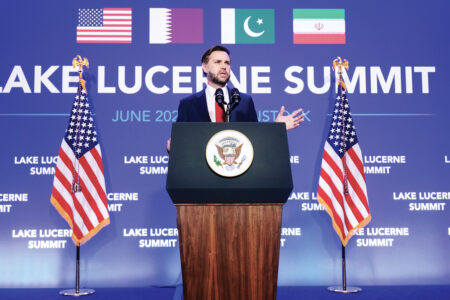
Trump did not attend what was dubbed the "Lake Lucerne Summit," but his presence certainly loomed large. The talks were jolted by statements from Trump, who, from thousands of miles away, fired off comments that offended the Iranians. But the mediation effort in Switzerland started Sunday and stretched into early Monday.