
Regional chamber president offers perspective on data centers
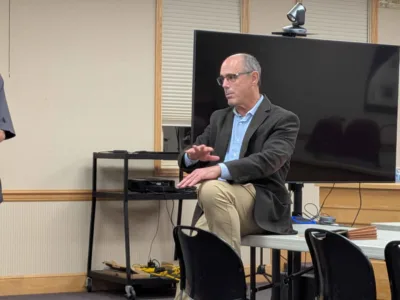 Staff photo/Brandon Cantwell
Trending
HOWLAND – The focus of Wednesday’s Trumbull County Council of Governments meeting was on data centers, as Youngstown/Warren Regional Chamber President and CEO Guy Coviello touted their importance and the value of responsible development.
Coviello acknowledged that not all data centers are smart or responsible, and not all areas are the right ones for the facilities. He said one area the chamber focuses on is “brain drain”- the emigration of skilled individuals from one area to another.
“If you look at where we lost our best and brightest people, it’s to information centers like Columbus, the Research Triangle in North Carolina, Silicon Valley,” Coviello said. “All of those places were built on the backs of data centers.”
He noted it wasn’t the data centers themselves, but jobs in technology, which data centers attract, adding that things are morphing from the Silicon Valley to the Silicon Parkway and they’re seeing an opportunity to build out data center capacity in the Mahoning Valley.
Coviello said there is a reason why Columbus and other neighboring cities are fighting for data centers. He said the officials at the COG meeting are in the same position he is, as they both have constituents with legitimate concerns.
“My constituents are existing business owners; it’s not good for me or my constituents if somebody comes in and creates a scarcity of utilities, comes in and creates an increase in cost,” Coviello said. “That to me, is not a smart, responsible data center, or any development, any industry, and you guys have the same concerns for your residents.”
Coviello said those concerns prompted the chamber to do research, which they’ve conducted for almost a year now, which was presented to officials in the form of four flyers.
The flyers had common questions and myths and facts about data centers, as well as a checklist for what officials should ask when approached by a company.
He said the documents are evolving because it’s still new, but their research has shown that historically, data centers have had proven bad effects on the water supply of the communities where they are located.
“A lot of that has changed because of technology and the closed-loop systems that are in those data centers today,” Coviello said. “More importantly, that problem does not exist here. We are different than the rest of the country.”
He said the chamber has met with a few data center representatives who said they’re going to put their closed-loop system in, but he doesn’t want them doing that because he wants them buying the area’s water.
“We are so far under capacity. If you’re getting your water from Mosquito (Lake) or Meander, we’re way more than 50% below capacity,” Coviello said. “MVSD just had a rate increase. I would venture to say that if we had a couple big data center water users a couple years ago, that rate increase would not have occurred this year.”
Coviello said they want good water users and there’s no extra cost to providing that water, but if there is, a “responsible data center development” is paying that cost.
He said the chamber also did research on the electrical issue with data centers, acknowledging places with older data centers where the negative impact in terms of cost could be seen.
“We worked very closely with our state legislators this year, and we’ve gotten some policies passed in Ohio that makes us a little bit different,” Coviello said. “Any cost associated with building out the delivery capacity or generation capacity for a data center cannot be spread out among the customers. It has to be absorbed by the data center.”
He acknowledged the conversations around the minimal jobs data centers create, but reiterated that the chamber is focused on the tech capacity they create.
Coviello also said he considered the comments about temporary construction jobs to be a “farce.”
“To say a construction job is temporary is like saying the third-grade teacher is a temporary job, because all the second-graders might flunk,” Coviello said.
Marty Loney, president of the Western Reserve Building Trades and chairman of the Western Reserve Port Authority’s board of directors, said they have a “golden opportunity.”
Loney noted that 1,700 construction jobs go into a medium-sized data center, with an average salary of $100,000.
“When I start hearing bans and moratoriums and things like that, it sounds like it’s a dirty word, it’s really not,” Loney said. “Who we should really be talking to is the folks up front and getting our community benefit agreement taken care of. Making sure the water is being take care of, or the electrical grid is being updated properly with no cost to the consumer.”
Loney said people have legitimate and valid concerns, but they need to alleviate them by educating themselves about data centers by talking to the companies up front.
“IF we put bans and moratoriums on things, that conversation stops, and we don’t know the bad actors from the good actors,” Loney said. “But if we have a conversation up front with business, labor, community – all the folks that should be in the room, talking.”
Loney said there are “bad actors” out there, but that comes with any industry. He said one of the WRPA’s jobs is to make sure the community is benefitting.
Coviello said data centers are “absolutely needed” to help build an economy, much like highways, railroads and utilities years ago.
“The entire world needs data centers, and I like the idea of the world needing us. I like the idea of data centers being here, and the whole world depending on us, because it’s not a want, it’s a need,” Coviello said. “And making sure we’re looking beyond the tax from jobs that the data centers create, but all of the companies that need to be near the high-speed technology that data centers present to a community.”
Many Trumbull County communities, as well as several in Mahoning County, have moratoriums or outright bans on data centers. A company is considering building a data center on vacant land on Logan Avenue on Youngstown’s North Side.