
Forum addresses voter protection, election security
Trending
YOUNGSTOWN – The November election is less than two weeks away, and voters want to be confident their vote is counted, whether they vote early, by absentee ballot or on Election Day before the polls close.
They also want to be confident that voter fraud is not occurring. A forum took place Tuesday evening at the Youngstown Jewish Community Center that addressed election security and misinformation, featuring a panel with elections experience at the national, state and local levels.
The Youngstown Press Club, the League of Women Voters of Greater Youngstown, and the Jewish Community Relations Council of the Youngstown Area Jewish Federation sponsored the forum that covered election safety and integrity, voter protection, vote security and the voting process.
Pat Nelms of Austintown attended the event.
"I am here to get the facts. There is so much misinformation out there, and I came here to get the truth," Nelms said.
Robert and Mary Jo Heller of Howland, who have been subscribers to The Vindicator since 1981, also attended the event.
"I just met the moderator at another event, and he is very good. All the articles he writes are very good. This is the first Press Club event we have been to," Robert Heller said.
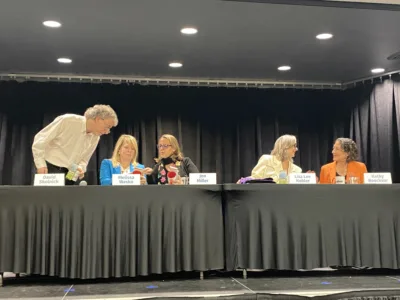
“Defending the Ballot Box” panelists shared insights into the voting process and how it ensures every legitimate vote is counted accurately. Moderator David Skolnick, politics reporter for The Vindicator and Tribune Chronicle, asked the panelists questions. Mahoning County Sheriff’s Deputy Adam Chase discussed the sheriff’s department’s role in collecting and securing ballots.
Panelists included Kathy Boockvar, a former chief election official in Pennsylvania and later Pennsylvania Secretary of State, and now president of an organization focused on strengthening election security; Lisa Lee Kohler, the regional coordinator for election protection and president of the League of Women Voters of Greater Youngstown; Jen Miller, executive director of the League of Women Voters of Ohio; and Melissa Wasko, deputy director of the Mahoning County Board of Elections.
Boockvar said people do not realize how decentralized elections are. States set the rules for how an election is run, for example, polling locations and hours, and those rules can differ from state to state and county to county in Ohio or jurisdiction to jurisdiction in some other states.
“It may be counterintuitive that we don’t all have the same rules, but decentralization matters for security because it increases complexity and makes it harder for a hacker to break into the system,” she said. “We all have the right to vote, but that looks different from state to state.”
Miller responded to Skolnick’s question about election security and the possibility of the system being hacked by saying the League of Women Voters helps secure the voting process. Ballots have tamper-proof seals, and a bipartisan system of checks and balances is in place. For example, curbside voting requires workers from both parties to help, so nothing can be changed.
She also said the machines cannot be hacked and that every election is audited with 99.99% accuracy. There are also rules about close elections.
“Every single ballot has a paper trail. Digital and paper ballots must match, and if not, we will count every single ballot if we need to do that,” Millers said.
Skolnick asked Wasko to take everyone through the steps from when a person votes to when the ballot is counted.
Wasko explained that all Boards of Election in Ohio are set up in a bipartisan manner: the director and deputy, all 900 poll workers and board members who oversee the board. The Boards of Election have 38 cameras. Logic and accuracy testing takes place. They shrink-wrap the equipment before it goes to the polling location. A voting machine was at the forum site Tuesday evening.
Board officials also reconcile each ballot, including ballots returned if a voter makes an error and requests a new ballot. Optical scanners record all votes on a memory stick.
“All these people work together to ensure the election is fair. The Sheriff’s Department also escorts our ballots and memory sticks. Bipartisan workers perform the final tabulation of ballots and memory sticks after they are delivered to the Board of Elections,” Wasko said.
Kohler explained the role of a poll monitor, which differs from that of a poll worker.
“Poll monitors monitor the election from outside the polling location. 866-OUR-VOTE has election experts, including attorneys, who can answer any question a voter might have,” Kohler said.
Kohler also explained that the Ohio Voting Rights Coalition and the League of Women Voters, nonpartisan third parties, help protect people’s right to vote and ensure voters feel comfortable and confident. They do not tell people who to vote for; instead, they explain how to cast their ballots.
One attendee asked why Issue 3 is on the November ballot.
Miller explained that voters have always had to provide some form of ID, and that requirement got much stricter with House Bill 458, which passed about four years ago.
"The ballot language requires the exact same list of IDs that is currently in Ohio law. So if one votes yes, they are saying that this set of IDs should be in the Constitution so the General Assembly cannot change it. If you are voting no, you are saying that that is good enough and we think the General Assembly may need to change it in the future if the IDs we trust change," Miller added.
An attendee asked the panel to explain provisional ballots.
Wasko explained that they serve as an additional layer so a voter can still cast a ballot even if they did not bring their driver’s license or their license was not up to date or if they came to the wrong polling location because of a recent move. Poll workers collect all of the provisional ballots in a sealed envelope and those provisional ballots go back to the Board of Elections on election night under the watch of a sheriff's deputy and bipartisan team.
She said that’s why there isn’t an official vote count on election night. Voters have four days to bring the necessary documentation so the provisional ballot can be counted.
"It can be due to an address change or name change, or maybe there is a question about citizenship. Or, after tracking your absentee ballot, it looks like it did not arrive at the Board of Elections, you can go vote at a polling location, using a provisional ballot. Only one of the ballots will be counted, whichever one comes to the office first," Miller said.